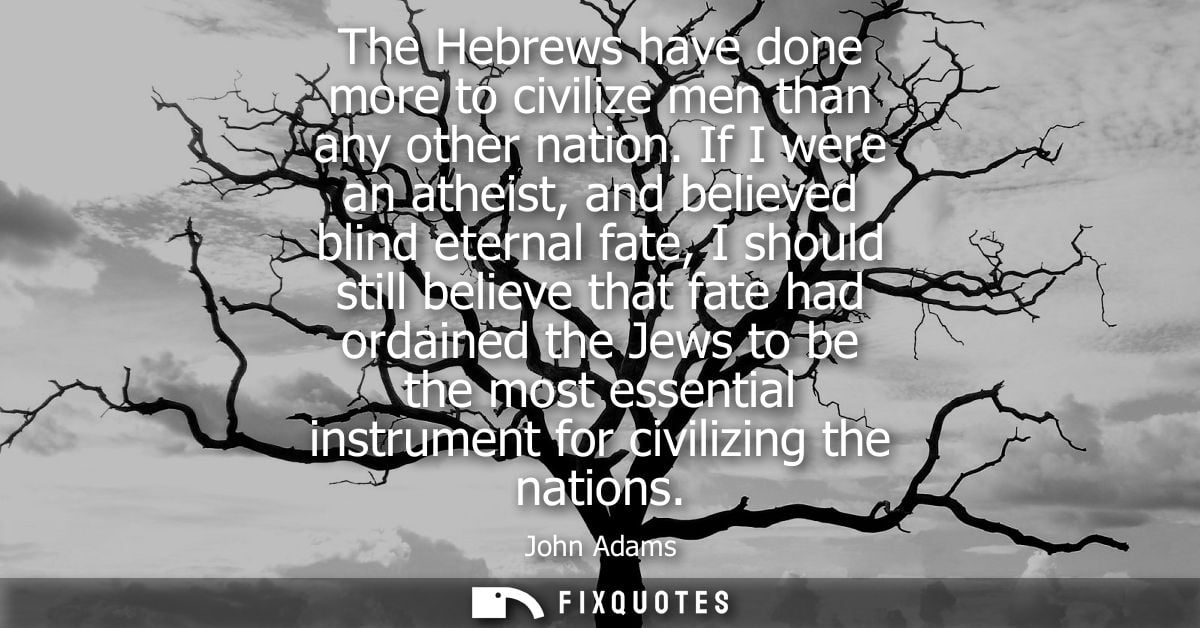
"The Hebrews have done more to civilize men than any other nation. If I were an atheist, and believed blind eternal fate, I should still believe that fate had ordained the Jews to be the most essential instrument for civilizing the nations"
About this Quote
The subtext is partly political. In the early republic, "civilization" was a loaded word: it implied moral order, literacy, law, commerce, and the habits that make republican self-government plausible. By crediting "the Hebrews" with civilizing force, Adams is implicitly arguing for Jewish inclusion within the American project - not on pity or exception, but on contribution and pedigree. It’s also a rebuke, delivered politely, to Christian triumphalism: Christianity, he hints, inherited its ethical infrastructure.
Still, the compliment carries a period-specific reduction. "The Jews" become an instrument - a providential tool - more symbol than living community. Adams’s admiration is real, but it’s also utilitarian: he values Jewish history as a civilizing technology, a way to ground modern freedom in ancient moral authority.
Quote Details
| Topic | Free Will & Fate |
|---|---|
| Source | Help us find the source |
| Cite |
Citation Formats
APA Style (7th ed.)
Adams, John. (2026, January 17). The Hebrews have done more to civilize men than any other nation. If I were an atheist, and believed blind eternal fate, I should still believe that fate had ordained the Jews to be the most essential instrument for civilizing the nations. FixQuotes. https://fixquotes.com/quotes/the-hebrews-have-done-more-to-civilize-men-than-33280/
Chicago Style
Adams, John. "The Hebrews have done more to civilize men than any other nation. If I were an atheist, and believed blind eternal fate, I should still believe that fate had ordained the Jews to be the most essential instrument for civilizing the nations." FixQuotes. January 17, 2026. https://fixquotes.com/quotes/the-hebrews-have-done-more-to-civilize-men-than-33280/.
MLA Style (9th ed.)
"The Hebrews have done more to civilize men than any other nation. If I were an atheist, and believed blind eternal fate, I should still believe that fate had ordained the Jews to be the most essential instrument for civilizing the nations." FixQuotes, 17 Jan. 2026, https://fixquotes.com/quotes/the-hebrews-have-done-more-to-civilize-men-than-33280/. Accessed 5 Apr. 2026.