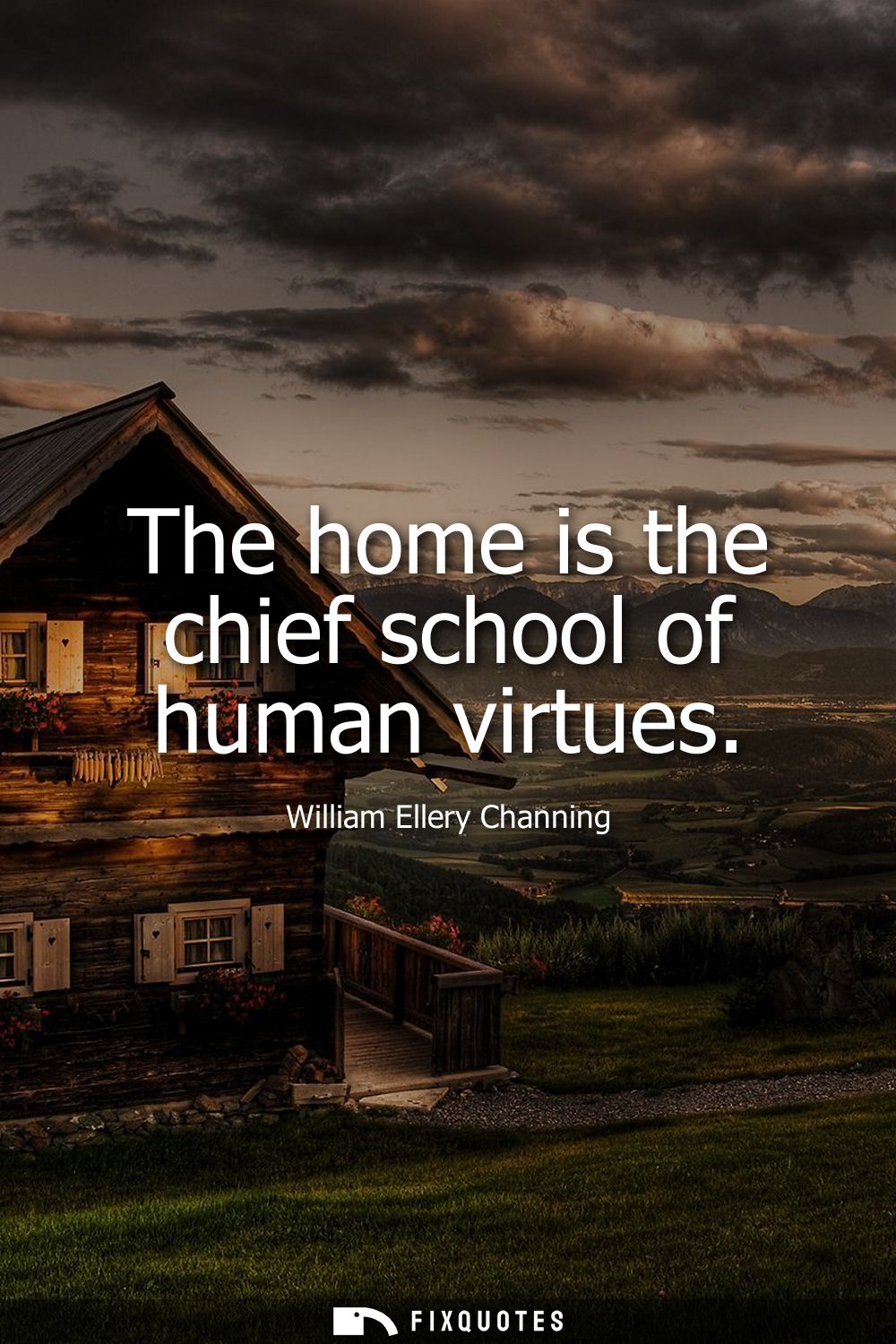
"The home is the chief school of human virtues"
About this Quote
Channing hands the biggest job of civic engineering to the smallest institution in sight. Calling the home the "chief school" doesn’t just praise family life; it quietly demotes churches, courts, and governments to remedial education. The line is structured like a moral syllabus: virtues aren’t innate, they’re taught; character isn’t discovered, it’s practiced under supervision. That’s a bracingly modern idea dressed in warm, domestic language.
The subtext is both idealistic and disciplinary. "School" implies routine, repetition, correction, authority. "Chief" implies hierarchy and, with it, blame: if public life is corrupt, start looking at private life. Channing, a Unitarian minister and public intellectual in early 19th-century New England, lived in a moment when the young American republic was trying to convince itself that freedom wouldn’t collapse into chaos. A democracy can’t rely on inherited aristocratic manners, so it needs a different supply chain for restraint, empathy, and responsibility. He’s arguing that the republic’s real infrastructure is emotional and ethical, not just roads and laws.
There’s also a subtle political hedge here. By locating virtue formation in the home, Channing advances reform without sounding like a radical: change the nation by changing households. Yet that same move carries a sharper edge. It elevates domestic labor (often women’s unpaid work) into nation-making work, while also trapping moral authority inside a private sphere that can hide cruelty as easily as it can cultivate kindness. The sentence works because it’s comforting and accusatory at once: the nation begins at the dinner table, and it can fail there, too.
The subtext is both idealistic and disciplinary. "School" implies routine, repetition, correction, authority. "Chief" implies hierarchy and, with it, blame: if public life is corrupt, start looking at private life. Channing, a Unitarian minister and public intellectual in early 19th-century New England, lived in a moment when the young American republic was trying to convince itself that freedom wouldn’t collapse into chaos. A democracy can’t rely on inherited aristocratic manners, so it needs a different supply chain for restraint, empathy, and responsibility. He’s arguing that the republic’s real infrastructure is emotional and ethical, not just roads and laws.
There’s also a subtle political hedge here. By locating virtue formation in the home, Channing advances reform without sounding like a radical: change the nation by changing households. Yet that same move carries a sharper edge. It elevates domestic labor (often women’s unpaid work) into nation-making work, while also trapping moral authority inside a private sphere that can hide cruelty as easily as it can cultivate kindness. The sentence works because it’s comforting and accusatory at once: the nation begins at the dinner table, and it can fail there, too.
Quote Details
| Topic | Family |
|---|---|
| Source | Help us find the source |
| Cite |
Citation Formats
APA Style (7th ed.)
Channing, William Ellery. (2026, January 15). The home is the chief school of human virtues. FixQuotes. https://fixquotes.com/quotes/the-home-is-the-chief-school-of-human-virtues-127345/
Chicago Style
Channing, William Ellery. "The home is the chief school of human virtues." FixQuotes. January 15, 2026. https://fixquotes.com/quotes/the-home-is-the-chief-school-of-human-virtues-127345/.
MLA Style (9th ed.)
"The home is the chief school of human virtues." FixQuotes, 15 Jan. 2026, https://fixquotes.com/quotes/the-home-is-the-chief-school-of-human-virtues-127345/. Accessed 6 Feb. 2026.
More Quotes by William
Add to List