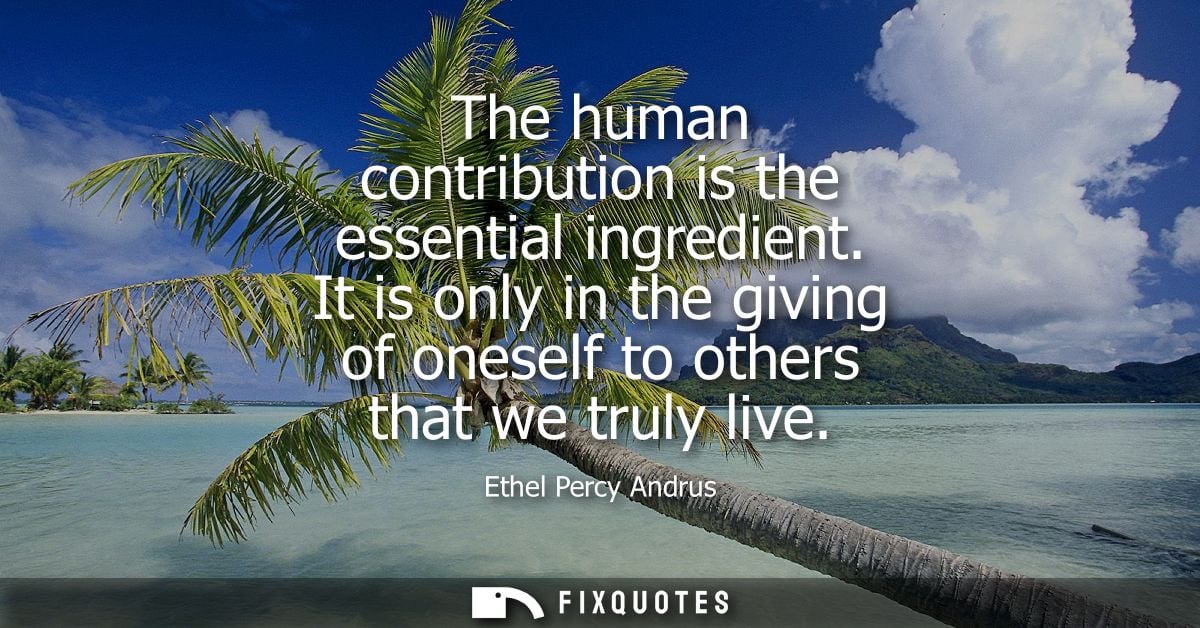
"The human contribution is the essential ingredient. It is only in the giving of oneself to others that we truly live"
About this Quote
The second sentence sharpens into moral pressure. “Only” is doing heavy work, narrowing the definition of a lived life until it becomes inseparable from generosity. Andrus isn’t selling self-sacrifice as sainthood; she’s arguing that identity itself is relational. You don’t “find yourself” in solitude or consumption, she implies, you assemble a self through obligation, presence, and the risk of being needed.
The subtext is a critique of American individualism, especially the mid-century version that equated success with private comfort. Andrus’s era saw war, economic upheaval, and the rise of mass institutions that could either atomize people or bind them together. Her answer is human-scale contribution: giving oneself not as martyrdom, but as the only reliable antidote to alienation.
It works because it flatters no one. It doesn’t promise happiness, balance, or personal branding. It dares you to measure your life by what you’ve made possible for other people.
Quote Details
| Topic | Kindness |
|---|---|
| Source | Help us find the source |
| Cite |
Citation Formats
APA Style (7th ed.)
Andrus, Ethel Percy. (2026, January 16). The human contribution is the essential ingredient. It is only in the giving of oneself to others that we truly live. FixQuotes. https://fixquotes.com/quotes/the-human-contribution-is-the-essential-126240/
Chicago Style
Andrus, Ethel Percy. "The human contribution is the essential ingredient. It is only in the giving of oneself to others that we truly live." FixQuotes. January 16, 2026. https://fixquotes.com/quotes/the-human-contribution-is-the-essential-126240/.
MLA Style (9th ed.)
"The human contribution is the essential ingredient. It is only in the giving of oneself to others that we truly live." FixQuotes, 16 Jan. 2026, https://fixquotes.com/quotes/the-human-contribution-is-the-essential-126240/. Accessed 25 Mar. 2026.