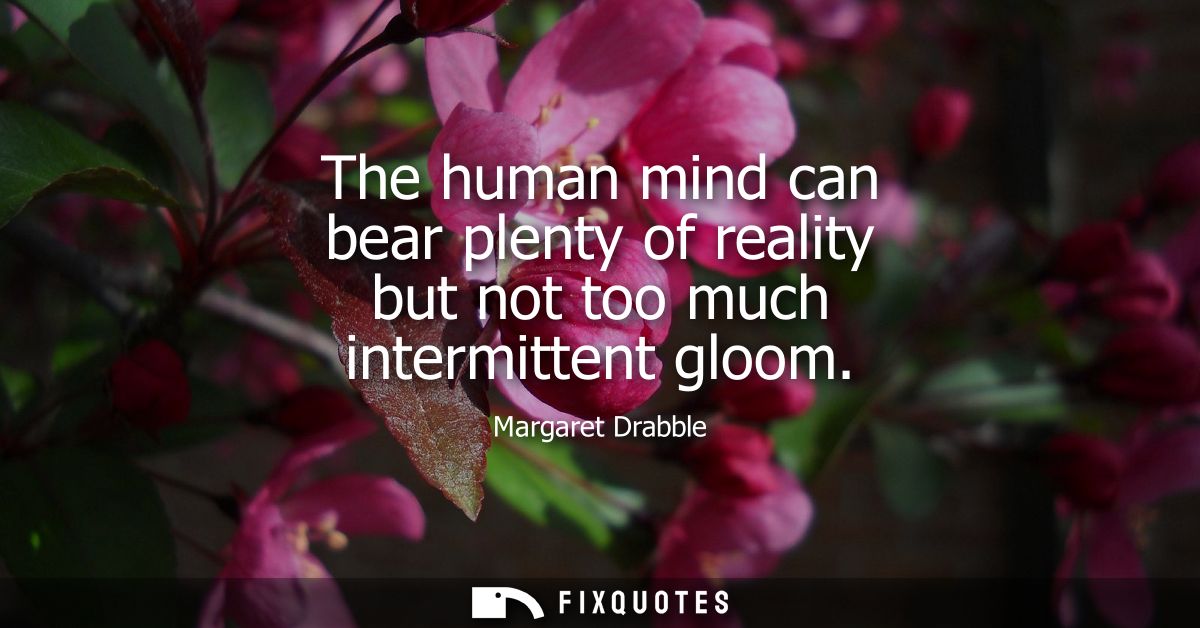
"The human mind can bear plenty of reality, but not too much intermittent gloom"
About this Quote
The intent isn’t to romanticize suffering; it’s to diagnose a particular psychological cruelty. Intermittency prevents habituation. When gloom is constant, you develop rituals, language, even a grim competence. When it arrives in unpredictable episodes, it colonizes the in-between time, turning relief into vigilance. Drabble is writing as a novelist attuned to interior life, and the sentence reads like fiction’s quiet rebuttal to heroic narratives of endurance. She isn’t praising stoicism; she’s exposing how fragile “normal” becomes when it’s repeatedly interrupted.
The subtext has a social edge. “Reality” can be borne because it’s shareable and nameable; “gloom” is more private, often shame-tinged, and harder to justify to others when it comes and goes. That intermittent quality also mirrors modern news cycles and precarious economies: long stretches of managed coping punctured by spikes of crisis. Drabble’s wit is in the understatement. She makes suffering sound almost logistical, which is exactly how it feels when you’re trying to schedule a life around the possibility of collapse.
Quote Details
| Topic | Sadness |
|---|---|
| Source | Help us find the source |
| Cite |
Citation Formats
APA Style (7th ed.)
Drabble, Margaret. (2026, February 18). The human mind can bear plenty of reality, but not too much intermittent gloom. FixQuotes. https://fixquotes.com/quotes/the-human-mind-can-bear-plenty-of-reality-but-not-69496/
Chicago Style
Drabble, Margaret. "The human mind can bear plenty of reality, but not too much intermittent gloom." FixQuotes. February 18, 2026. https://fixquotes.com/quotes/the-human-mind-can-bear-plenty-of-reality-but-not-69496/.
MLA Style (9th ed.)
"The human mind can bear plenty of reality, but not too much intermittent gloom." FixQuotes, 18 Feb. 2026, https://fixquotes.com/quotes/the-human-mind-can-bear-plenty-of-reality-but-not-69496/. Accessed 23 Mar. 2026.