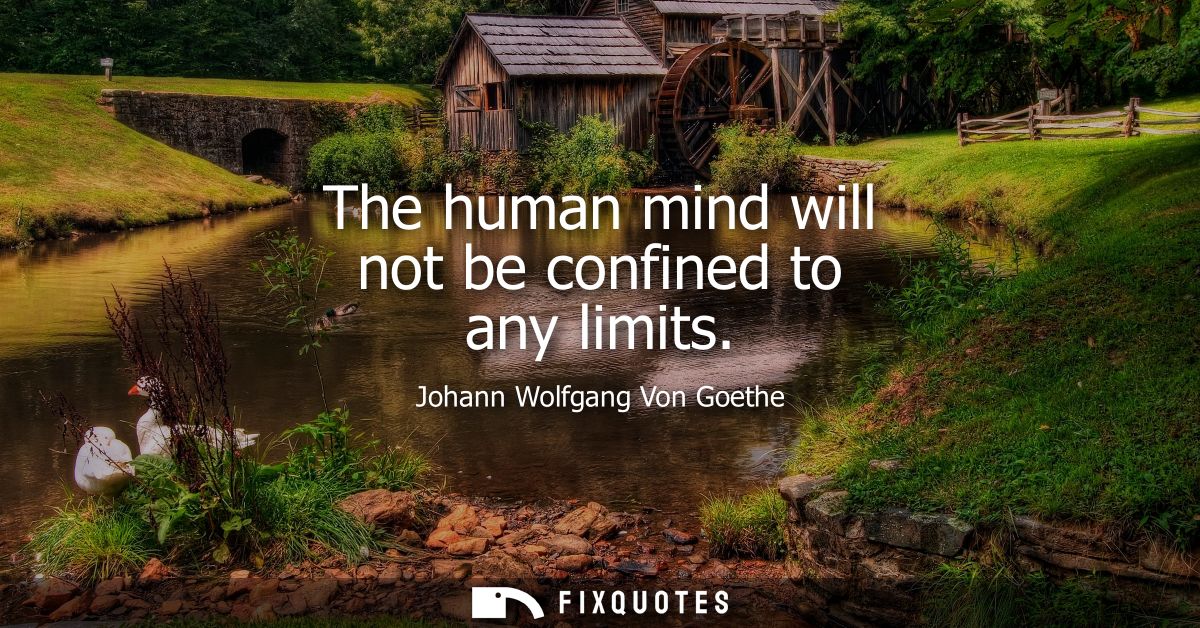
"The human mind will not be confined to any limits"
About this Quote
Goethe’s line lands like a jailbreak note slipped under the door of any era that tries to police thought. “Will not be confined” isn’t a gentle celebration of creativity; it’s a refusal, almost a threat. The mind, in this formulation, is not a well-behaved instrument waiting for instruction. It is restless, opportunistic, and allergic to fences - political, religious, aesthetic, even personal.
The intent is partly Enlightenment confidence, but Goethe’s subtext is more complicated than “reason wins.” He lived at the hinge between the Enlightenment and Romanticism, watching neat systems of knowledge collide with a hunger for the irrational: emotion, intuition, the sublime. So the “mind” here isn’t just logic; it’s imagination, desire, and the capacity to outgrow the categories that once felt definitive. Goethe’s own work embodies that refusal to specialize: poet, dramatist, scientist, statesman-adjacent cultural force. The sentence reads like a self-portrait of a writer who treated boundaries as temporary scaffolding.
Context sharpens the edge. Late-18th and early-19th-century Europe was a factory for limits: censorship, doctrinal religion, social rank, emerging nationalism, and the early bureaucratic state. Against that backdrop, Goethe offers a compact provocation: you can regulate bodies, publications, classrooms, and careers, but you can’t reliably regulate what a person will think once language, images, and questions get in. The line works because it’s both aspirational and diagnostic - less a promise that minds are always free than a reminder that containment is never complete, and never final.
The intent is partly Enlightenment confidence, but Goethe’s subtext is more complicated than “reason wins.” He lived at the hinge between the Enlightenment and Romanticism, watching neat systems of knowledge collide with a hunger for the irrational: emotion, intuition, the sublime. So the “mind” here isn’t just logic; it’s imagination, desire, and the capacity to outgrow the categories that once felt definitive. Goethe’s own work embodies that refusal to specialize: poet, dramatist, scientist, statesman-adjacent cultural force. The sentence reads like a self-portrait of a writer who treated boundaries as temporary scaffolding.
Context sharpens the edge. Late-18th and early-19th-century Europe was a factory for limits: censorship, doctrinal religion, social rank, emerging nationalism, and the early bureaucratic state. Against that backdrop, Goethe offers a compact provocation: you can regulate bodies, publications, classrooms, and careers, but you can’t reliably regulate what a person will think once language, images, and questions get in. The line works because it’s both aspirational and diagnostic - less a promise that minds are always free than a reminder that containment is never complete, and never final.
Quote Details
| Topic | Wisdom |
|---|---|
| Source | Help us find the source |
| Cite |
Citation Formats
APA Style (7th ed.)
Goethe, Johann Wolfgang Von. (2026, January 15). The human mind will not be confined to any limits. FixQuotes. https://fixquotes.com/quotes/the-human-mind-will-not-be-confined-to-any-limits-7949/
Chicago Style
Goethe, Johann Wolfgang Von. "The human mind will not be confined to any limits." FixQuotes. January 15, 2026. https://fixquotes.com/quotes/the-human-mind-will-not-be-confined-to-any-limits-7949/.
MLA Style (9th ed.)
"The human mind will not be confined to any limits." FixQuotes, 15 Jan. 2026, https://fixquotes.com/quotes/the-human-mind-will-not-be-confined-to-any-limits-7949/. Accessed 13 Mar. 2026.
More Quotes by Johann
Add to List