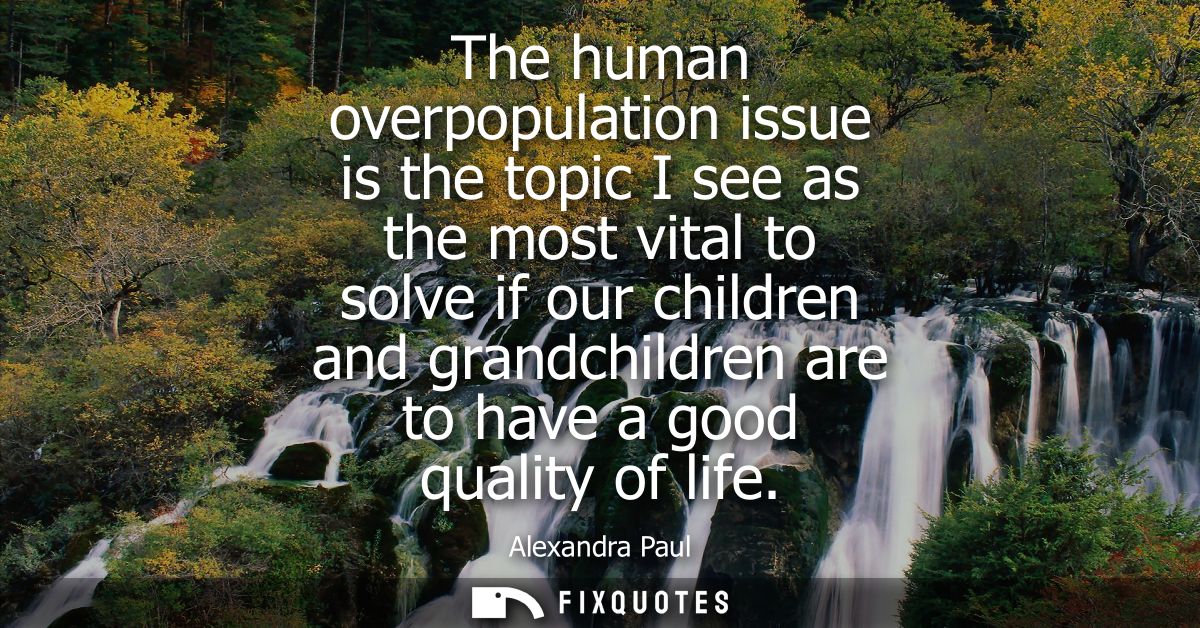
"The human overpopulation issue is the topic I see as the most vital to solve if our children and grandchildren are to have a good quality of life"
About this Quote
Alexandra Paul’s line lands less like a policy brief and more like a parental alarm bell, which makes sense coming from an actress-activist rather than a demographer. The phrasing is deliberately plain: “most vital,” “solve,” “good quality of life.” No numbers, no charts, just a moral hierarchy and a deadline. She’s trying to move the overpopulation debate out of the realm of abstract “someday” problems and into the immediate, intimate category of what we owe the next two generations.
The subtext is strategic: by centering “our children and grandchildren,” Paul borrows the cultural authority of caretaking. It’s a rhetorical shortcut that invites people who might otherwise tune out environmental talk to hear it as family talk. The cost is that it smuggles in a sweeping claim - that population is the keystone variable - without naming the other drivers that often compete for “most vital” status: consumption patterns, inequality, fossil-fuel dependence, corporate regulation. That omission isn’t accidental; it’s how a sentence stays portable enough to circulate in interviews and headlines.
Context matters because “overpopulation” is a loaded term with a messy history, sometimes used to moralize reproduction or shift blame onto poorer regions. Paul’s intent reads as climate-era triage: more people means more pressure on water, housing, biodiversity, and emissions, so we should treat population like infrastructure - something you plan for, not something you ignore. The line works because it’s both aspirational and accusatory: if we fail, we didn’t just mismanage resources; we betrayed our heirs.
The subtext is strategic: by centering “our children and grandchildren,” Paul borrows the cultural authority of caretaking. It’s a rhetorical shortcut that invites people who might otherwise tune out environmental talk to hear it as family talk. The cost is that it smuggles in a sweeping claim - that population is the keystone variable - without naming the other drivers that often compete for “most vital” status: consumption patterns, inequality, fossil-fuel dependence, corporate regulation. That omission isn’t accidental; it’s how a sentence stays portable enough to circulate in interviews and headlines.
Context matters because “overpopulation” is a loaded term with a messy history, sometimes used to moralize reproduction or shift blame onto poorer regions. Paul’s intent reads as climate-era triage: more people means more pressure on water, housing, biodiversity, and emissions, so we should treat population like infrastructure - something you plan for, not something you ignore. The line works because it’s both aspirational and accusatory: if we fail, we didn’t just mismanage resources; we betrayed our heirs.
Quote Details
| Topic | Ethics & Morality |
|---|
More Quotes by Alexandra
Add to List