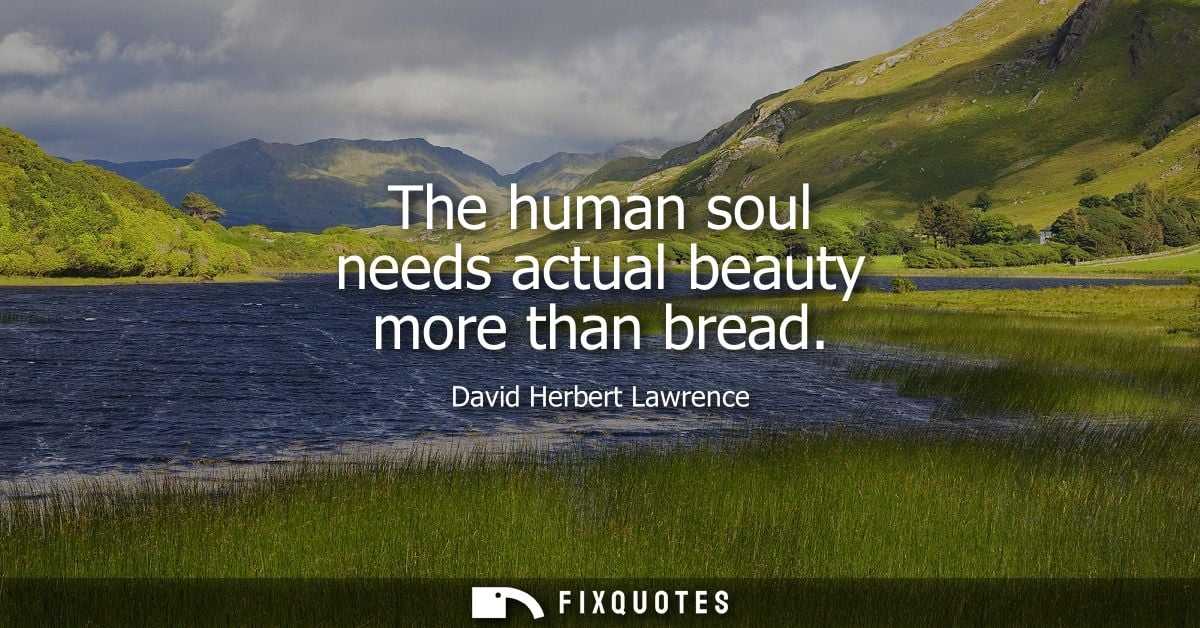
"The human soul needs actual beauty more than bread"
About this Quote
Lawrence throws down a provocation that’s meant to sound irresponsible on purpose: beauty over bread. Not because he’s unaware of hunger, but because he suspects modern life has gotten very good at feeding bodies while quietly starving everything else. Calling it "actual beauty" is the tell. He’s not talking about decorative taste, polite culture, or the museum-approved version of refinement. He means beauty as a lived, sensory charge: the kind that reorders your nerves, jolts you out of numbness, makes the world feel inhabited again.
The line carries Lawrence’s signature hostility to industrial modernity and its moral accounting. Bread is the language of necessity, wages, utility, respectability. Beauty is framed as equally necessary, but in a way capitalism can’t easily quantify or distribute. By naming the "soul" - a word that risks melodrama but earns its place here - Lawrence argues that deprivation isn’t only economic. You can be provisioned and still be wrecked: by ugliness, by routine, by the reduction of human experience to function.
There’s also a sly rebuke embedded in "needs". This isn’t a luxury item on the hierarchy of self-actualization; it’s an indictment of a society that treats aesthetic and erotic intensity as optional or even suspect. Written in an era of mechanization, mass war, and expanding consumer life, the claim reads like a moral counter-economy: if you don’t build a world with beauty in it, the bread won’t save you.
The line carries Lawrence’s signature hostility to industrial modernity and its moral accounting. Bread is the language of necessity, wages, utility, respectability. Beauty is framed as equally necessary, but in a way capitalism can’t easily quantify or distribute. By naming the "soul" - a word that risks melodrama but earns its place here - Lawrence argues that deprivation isn’t only economic. You can be provisioned and still be wrecked: by ugliness, by routine, by the reduction of human experience to function.
There’s also a sly rebuke embedded in "needs". This isn’t a luxury item on the hierarchy of self-actualization; it’s an indictment of a society that treats aesthetic and erotic intensity as optional or even suspect. Written in an era of mechanization, mass war, and expanding consumer life, the claim reads like a moral counter-economy: if you don’t build a world with beauty in it, the bread won’t save you.
Quote Details
| Topic | Wisdom |
|---|---|
| Source | Help us find the source |
| Cite |
Citation Formats
APA Style (7th ed.)
Lawrence, David Herbert. (2026, January 18). The human soul needs actual beauty more than bread. FixQuotes. https://fixquotes.com/quotes/the-human-soul-needs-actual-beauty-more-than-bread-12417/
Chicago Style
Lawrence, David Herbert. "The human soul needs actual beauty more than bread." FixQuotes. January 18, 2026. https://fixquotes.com/quotes/the-human-soul-needs-actual-beauty-more-than-bread-12417/.
MLA Style (9th ed.)
"The human soul needs actual beauty more than bread." FixQuotes, 18 Jan. 2026, https://fixquotes.com/quotes/the-human-soul-needs-actual-beauty-more-than-bread-12417/. Accessed 31 Mar. 2026.
More Quotes by David
Add to List