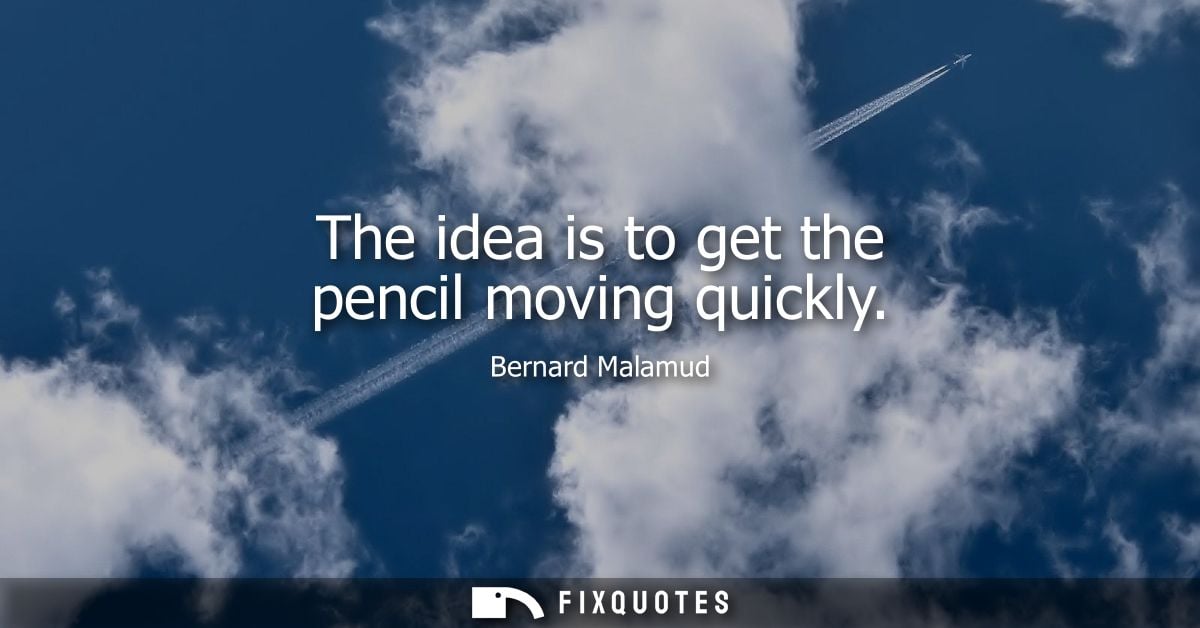
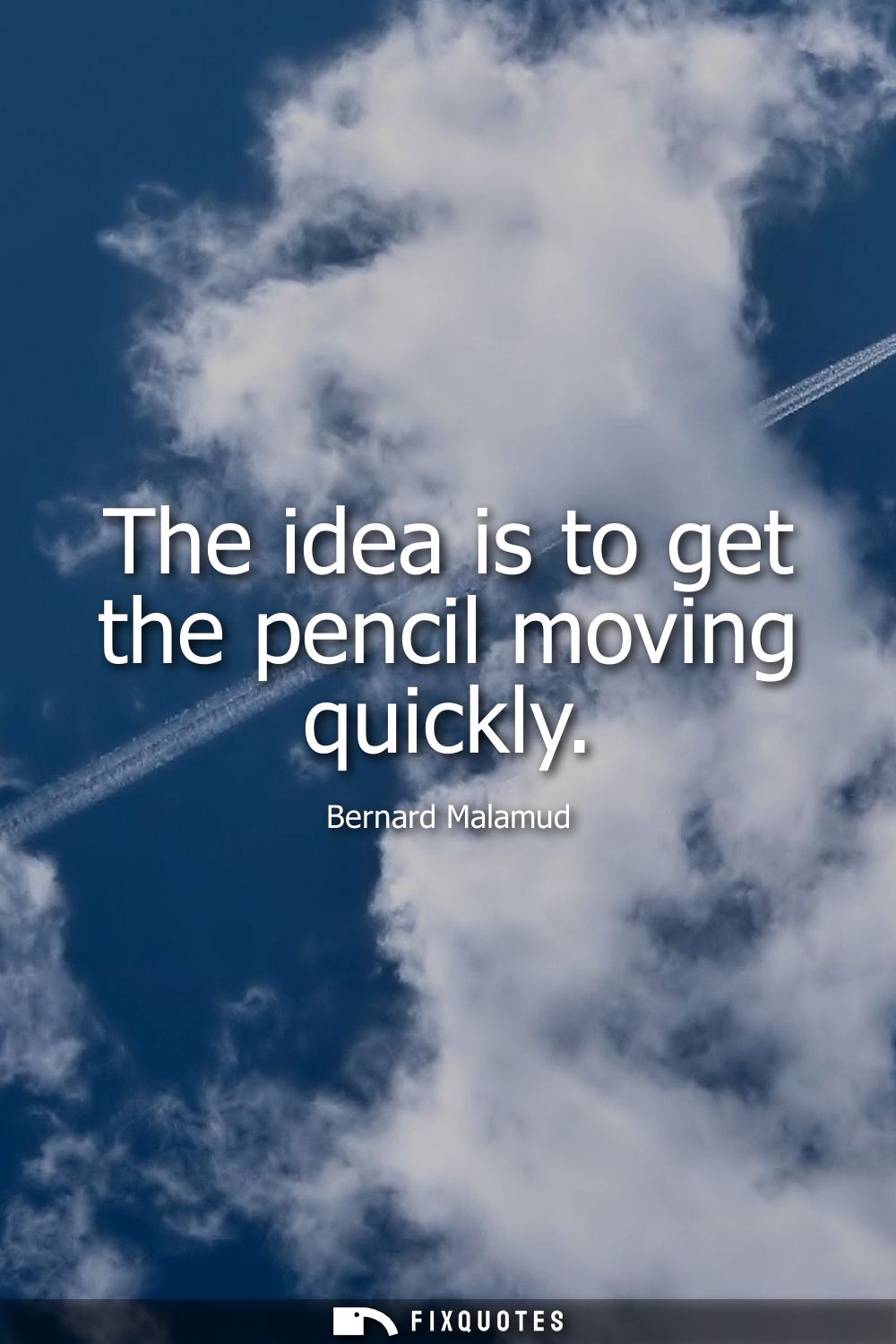
"The idea is to get the pencil moving quickly"
About this Quote
Speed is Malamud's backdoor into seriousness. "The idea is to get the pencil moving quickly" sounds like workshop pragmatism, almost throwaway advice, but it's really an ethic: outrun your inner censor before it recruits perfectionism, fear, and self-mythology. Malamud isn't romanticizing inspiration; he's demoting it. The sentence treats writing less as revelation than as labor that begins with momentum.
The subtext is a quiet argument with the fantasy of the immaculate first line. Malamud, whose fiction is packed with moral pressure and hard-earned tenderness, understood that depth rarely arrives on schedule. "Quickly" isn't about careless prose; it's about bypassing the part of the mind that confuses hesitation with quality control. Drafting fast lets the unconscious get a word in. Once the material exists, you can sculpt it; before that, you're just auditioning excuses.
Context matters: Malamud came up in mid-century American letters, when the cult of "voice" and the mystique of the solitary genius were in full swing. His work ethic, shaped by immigrant grit and a teacher's discipline, reads like a rebuke to that glamour. The pencil, not the typewriter or the myth, is the instrument. It's tactile, modest, almost stubbornly analog, which suits Malamud's sensibility: the human scale, the daily grind, the faith that craft is a form of moral attention.
The line works because it reframes anxiety as a mechanical problem. Start. Move. Keep going. Meaning comes later, but only if the hand does its job first.
The subtext is a quiet argument with the fantasy of the immaculate first line. Malamud, whose fiction is packed with moral pressure and hard-earned tenderness, understood that depth rarely arrives on schedule. "Quickly" isn't about careless prose; it's about bypassing the part of the mind that confuses hesitation with quality control. Drafting fast lets the unconscious get a word in. Once the material exists, you can sculpt it; before that, you're just auditioning excuses.
Context matters: Malamud came up in mid-century American letters, when the cult of "voice" and the mystique of the solitary genius were in full swing. His work ethic, shaped by immigrant grit and a teacher's discipline, reads like a rebuke to that glamour. The pencil, not the typewriter or the myth, is the instrument. It's tactile, modest, almost stubbornly analog, which suits Malamud's sensibility: the human scale, the daily grind, the faith that craft is a form of moral attention.
The line works because it reframes anxiety as a mechanical problem. Start. Move. Keep going. Meaning comes later, but only if the hand does its job first.
Quote Details
| Topic | Writing |
|---|---|
| Source | Help us find the source |
| Cite |
Citation Formats
APA Style (7th ed.)
Malamud, Bernard. (2026, January 15). The idea is to get the pencil moving quickly. FixQuotes. https://fixquotes.com/quotes/the-idea-is-to-get-the-pencil-moving-quickly-157797/
Chicago Style
Malamud, Bernard. "The idea is to get the pencil moving quickly." FixQuotes. January 15, 2026. https://fixquotes.com/quotes/the-idea-is-to-get-the-pencil-moving-quickly-157797/.
MLA Style (9th ed.)
"The idea is to get the pencil moving quickly." FixQuotes, 15 Jan. 2026, https://fixquotes.com/quotes/the-idea-is-to-get-the-pencil-moving-quickly-157797/. Accessed 8 Apr. 2026.
More Quotes by Bernard
Add to List