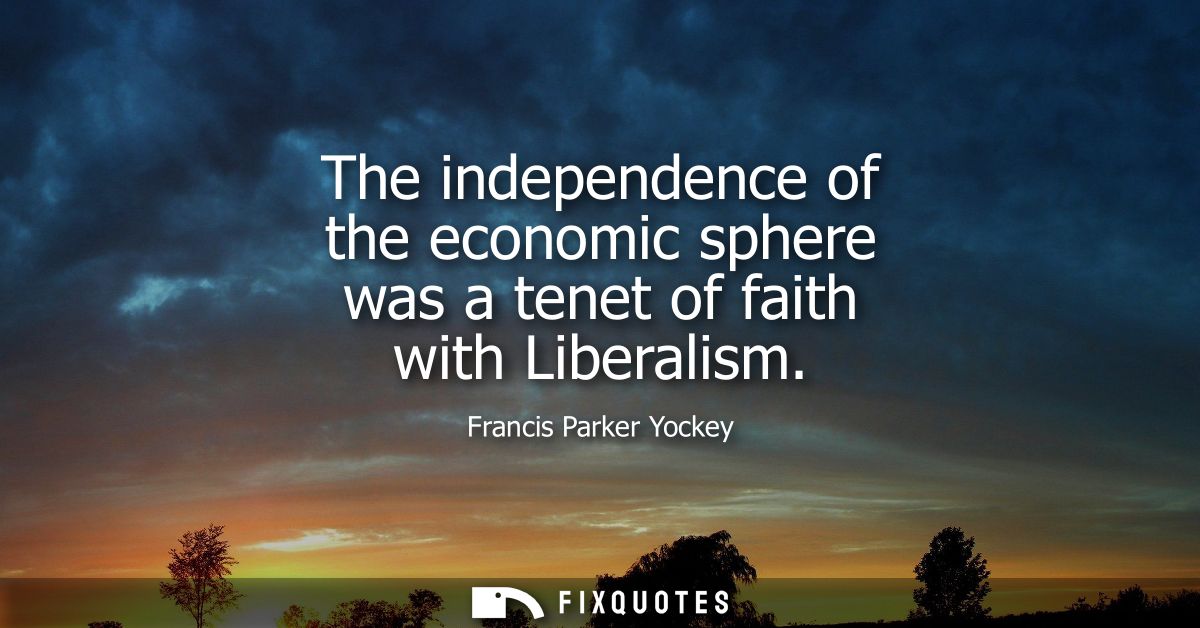
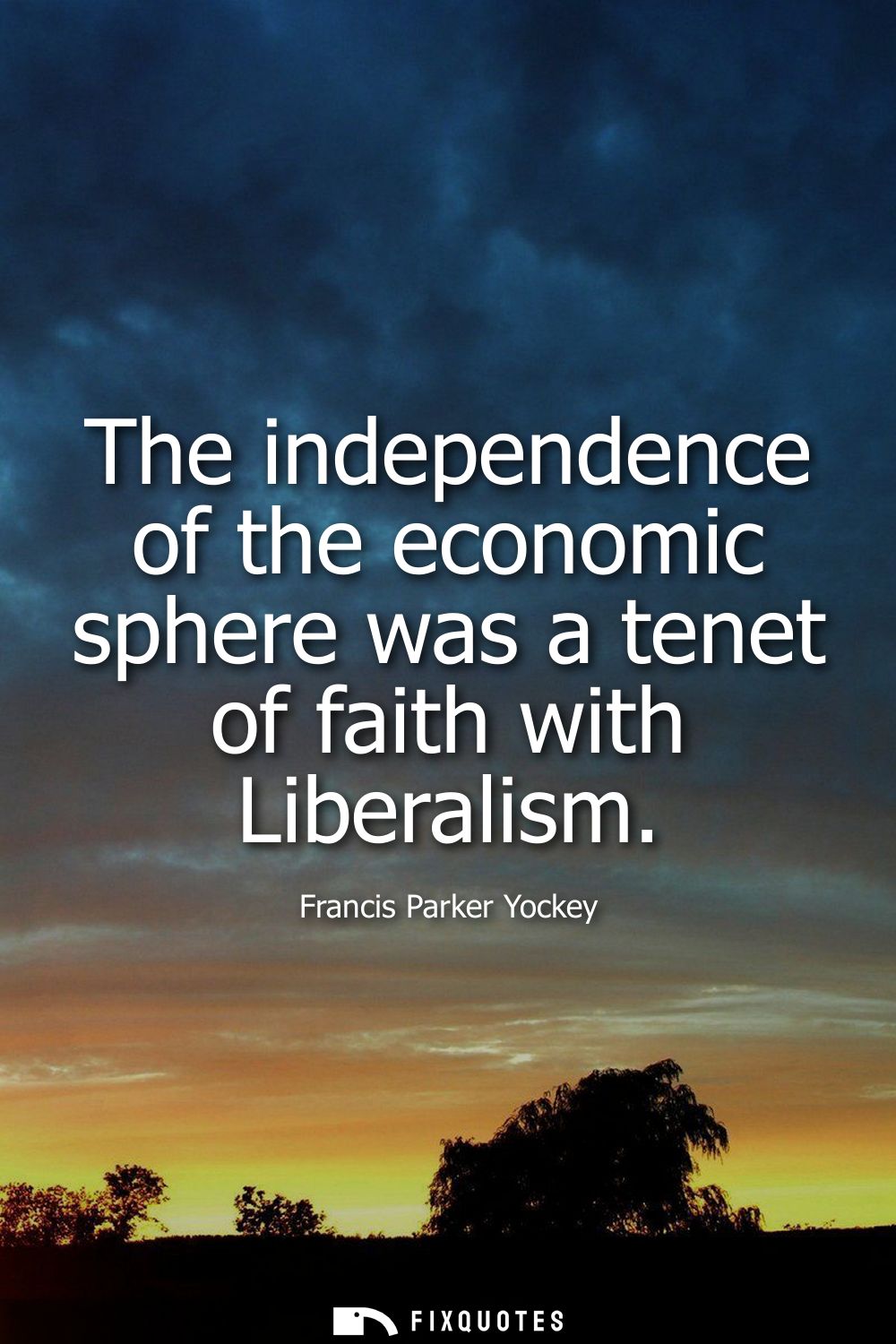
"The independence of the economic sphere was a tenet of faith with Liberalism"
About this Quote
That’s the subtextual move: delegitimize liberal economics by casting it as theology. Once Liberalism is framed as faith, its claims to objectivity look like pious self-justification, and its defenders become clerics for an order that pretends it isn’t an order at all. Yockey’s target is the liberal separation-of-powers instinct applied to society: politics over here, culture over there, economics somewhere “free,” insulated from collective ends. He’s attacking the idea that you can quarantine money from meaning.
Context sharpens the edge. Writing in the mid-20th century, Yockey is part of a reactionary, anti-liberal current that read the postwar Western settlement as decadent: individualist, commercial, fragmented, unable to mobilize as a civilization. In that worldview, “independent” markets are less a safeguard against tyranny than a solvent, dissolving hierarchy and binding commitments. His intent isn’t to improve Liberalism; it’s to unmask it, then clear space for a politics that re-subordinates the economic sphere to a larger cultural and national project.
Quote Details
| Topic | Freedom |
|---|---|
| Source | Help us find the source |
| Cite |
Citation Formats
APA Style (7th ed.)
Yockey, Francis Parker. (2026, January 17). The independence of the economic sphere was a tenet of faith with Liberalism. FixQuotes. https://fixquotes.com/quotes/the-independence-of-the-economic-sphere-was-a-58309/
Chicago Style
Yockey, Francis Parker. "The independence of the economic sphere was a tenet of faith with Liberalism." FixQuotes. January 17, 2026. https://fixquotes.com/quotes/the-independence-of-the-economic-sphere-was-a-58309/.
MLA Style (9th ed.)
"The independence of the economic sphere was a tenet of faith with Liberalism." FixQuotes, 17 Jan. 2026, https://fixquotes.com/quotes/the-independence-of-the-economic-sphere-was-a-58309/. Accessed 29 Mar. 2026.