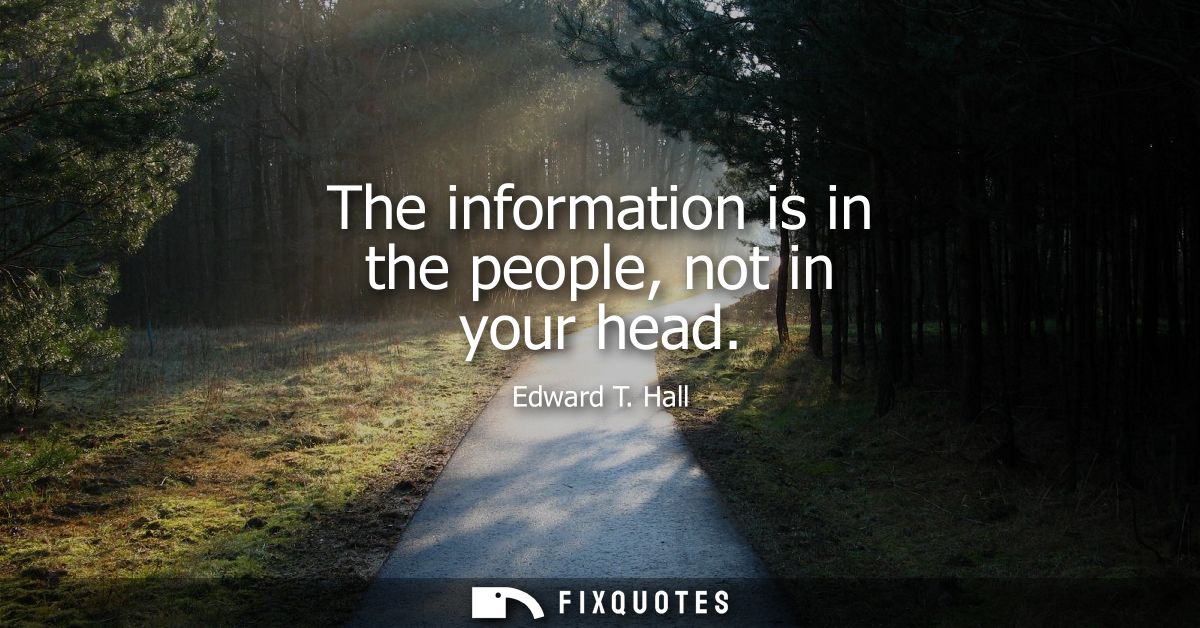
"The information is in the people, not in your head"
About this Quote
Hall’s line is a quiet rebuke to the Western fantasy of the self-sufficient mind: the idea that knowledge is something you stockpile privately, like files in a cabinet. “The information is in the people” flips the direction of authority. It suggests that what matters most in human systems isn’t what you’ve memorized or theorized, but what lives in relationships: in patterns of behavior, unspoken norms, proxemics, timing, status cues, and the thousand micro-decisions a community makes without ever writing them down.
The phrasing matters. “In the people” isn’t sentimental; it’s empirical. As an anthropologist and cross-cultural researcher, Hall spent his career showing how communication is largely nonverbal and contextual. In high-context cultures especially, meaning travels through shared assumptions, roles, and environments more than through explicit statements. So the line functions as method advice: if you want to understand a workplace, a negotiation, or a culture, stop over-trusting your internal narrative and start observing the social field.
The subtext is also a warning about expertise. If information is distributed across people, then solitary “genius” becomes less heroic and more error-prone. Misunderstandings aren’t just personal failures; they’re predictable outcomes of treating knowledge as private property rather than a collective process. Hall is nudging us toward humility: your head is noisy with interpretation, but the data is out there, moving between bodies, rooms, rituals, and power.
The phrasing matters. “In the people” isn’t sentimental; it’s empirical. As an anthropologist and cross-cultural researcher, Hall spent his career showing how communication is largely nonverbal and contextual. In high-context cultures especially, meaning travels through shared assumptions, roles, and environments more than through explicit statements. So the line functions as method advice: if you want to understand a workplace, a negotiation, or a culture, stop over-trusting your internal narrative and start observing the social field.
The subtext is also a warning about expertise. If information is distributed across people, then solitary “genius” becomes less heroic and more error-prone. Misunderstandings aren’t just personal failures; they’re predictable outcomes of treating knowledge as private property rather than a collective process. Hall is nudging us toward humility: your head is noisy with interpretation, but the data is out there, moving between bodies, rooms, rituals, and power.
Quote Details
| Topic | Knowledge |
|---|---|
| Source | Later attribution: Mental Health Assessment with Children and Adolescents (Sara L. Buckingham, Gerald D. Oster, 2026) modern compilationISBN: 9783032040688 · ID: IZilEQAAQBAJ
Evidence:
... Edward T. Hall, “The information is in the people, not in your head.” In our diverse society, you are far more ... et al., 2001). Ways of functioning deemed optimal depend on the social and physical envi- ronmental cues that ... |
| Cite |
Citation Formats
APA Style (7th ed.)
Hall, Edward T. (2026, March 15). The information is in the people, not in your head. FixQuotes. https://fixquotes.com/quotes/the-information-is-in-the-people-not-in-your-head-123887/
Chicago Style
Hall, Edward T. "The information is in the people, not in your head." FixQuotes. March 15, 2026. https://fixquotes.com/quotes/the-information-is-in-the-people-not-in-your-head-123887/.
MLA Style (9th ed.)
"The information is in the people, not in your head." FixQuotes, 15 Mar. 2026, https://fixquotes.com/quotes/the-information-is-in-the-people-not-in-your-head-123887/. Accessed 6 Apr. 2026.
More Quotes by Edward
Add to List