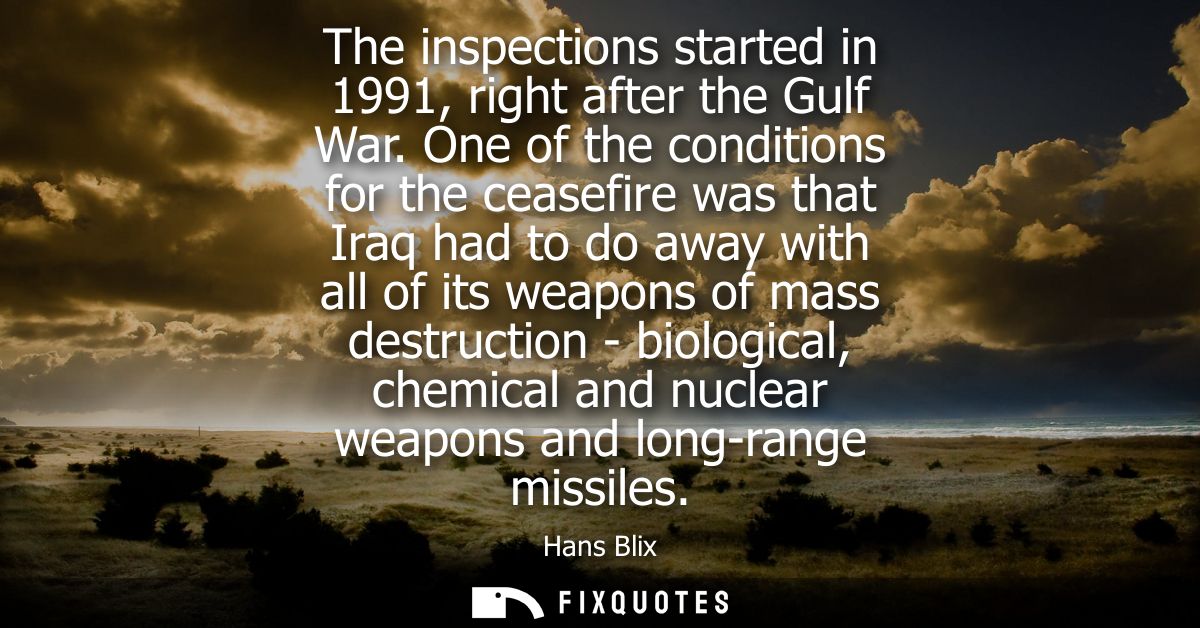
"The inspections started in 1991, right after the Gulf War. One of the conditions for the ceasefire was that Iraq had to do away with all of its weapons of mass destruction - biological, chemical and nuclear weapons and long-range missiles"
About this Quote
The subtext is a quiet rebuke to the way the Iraq story was later sold to the public. The quote insists that the WMD question is not an abstract fear but an obligation Iraq agreed to under duress, monitored by an international apparatus that was supposed to convert battlefield victory into verifiable compliance. Listing the categories - biological, chemical, nuclear, and long-range missiles - does two things at once: it signals comprehensiveness (nothing left conveniently vague), and it exposes the rhetorical elasticity of "WMD", a phrase that can be invoked to cover everything from labs to hypotheticals.
Context matters: Blix speaks as someone who lived in the seams between law and force, when the UN’s legitimacy hinged on inspection reports while major powers treated those reports as either validation or inconvenience. The intent is to pull the discussion back to first principles: inspections were born from a ceasefire bargain. The implication is harder: if you ignore that bargain’s verification process, you’re not enforcing international order - you’re shopping for a pretext.
Quote Details
| Topic | War |
|---|---|
| Source | Help us find the source |
| Cite |
Citation Formats
APA Style (7th ed.)
Blix, Hans. (2026, January 17). The inspections started in 1991, right after the Gulf War. One of the conditions for the ceasefire was that Iraq had to do away with all of its weapons of mass destruction - biological, chemical and nuclear weapons and long-range missiles. FixQuotes. https://fixquotes.com/quotes/the-inspections-started-in-1991-right-after-the-61193/
Chicago Style
Blix, Hans. "The inspections started in 1991, right after the Gulf War. One of the conditions for the ceasefire was that Iraq had to do away with all of its weapons of mass destruction - biological, chemical and nuclear weapons and long-range missiles." FixQuotes. January 17, 2026. https://fixquotes.com/quotes/the-inspections-started-in-1991-right-after-the-61193/.
MLA Style (9th ed.)
"The inspections started in 1991, right after the Gulf War. One of the conditions for the ceasefire was that Iraq had to do away with all of its weapons of mass destruction - biological, chemical and nuclear weapons and long-range missiles." FixQuotes, 17 Jan. 2026, https://fixquotes.com/quotes/the-inspections-started-in-1991-right-after-the-61193/. Accessed 7 Apr. 2026.