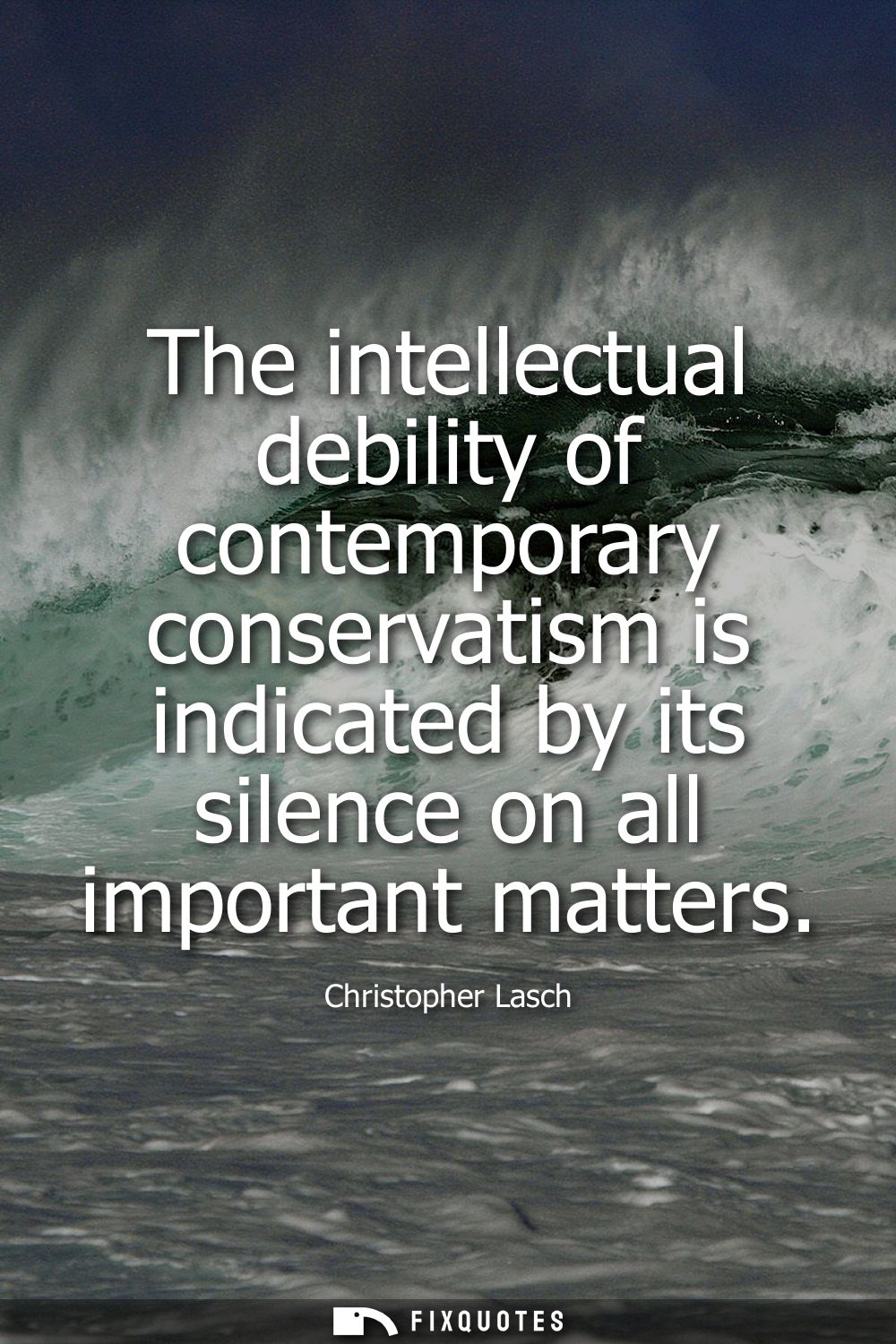
"The intellectual debility of contemporary conservatism is indicated by its silence on all important matters"
About this Quote
The subtext is that a tradition that once justified itself by defending institutions, limits, and moral order has, in Lasch’s view, stopped grappling with the actual pressures dissolving those things. “All important matters” implicitly points beyond the headline issues of the moment to deeper questions Lasch returned to across his work: the hollowing-out of civic life, the market’s colonization of everyday experience, the loss of shared standards that can’t be reduced to consumer preference. Silence here can mean complicity (benefiting from the status quo), fear (big questions fracture coalitions), or mere exhaustion (outsourcing thought to slogans).
Context matters because Lasch was no campus radical scolding from the sidelines. He was a heterodox critic of liberal technocracy and therapeutic culture who distrusted elites across the spectrum. That makes the line sharper: it’s not partisan trash talk so much as a warning that “conservatism” as an intellectual project is being replaced by a posture - reactive, managerial, and risk-averse. For Lasch, a politics that can’t name what’s truly at stake isn’t just losing debates; it’s forfeiting responsibility.
Quote Details
| Topic | Reason & Logic |
|---|---|
| Source | Help us find the source |
| Cite |
Citation Formats
APA Style (7th ed.)
Lasch, Christopher. (2026, January 17). The intellectual debility of contemporary conservatism is indicated by its silence on all important matters. FixQuotes. https://fixquotes.com/quotes/the-intellectual-debility-of-contemporary-48830/
Chicago Style
Lasch, Christopher. "The intellectual debility of contemporary conservatism is indicated by its silence on all important matters." FixQuotes. January 17, 2026. https://fixquotes.com/quotes/the-intellectual-debility-of-contemporary-48830/.
MLA Style (9th ed.)
"The intellectual debility of contemporary conservatism is indicated by its silence on all important matters." FixQuotes, 17 Jan. 2026, https://fixquotes.com/quotes/the-intellectual-debility-of-contemporary-48830/. Accessed 30 Mar. 2026.