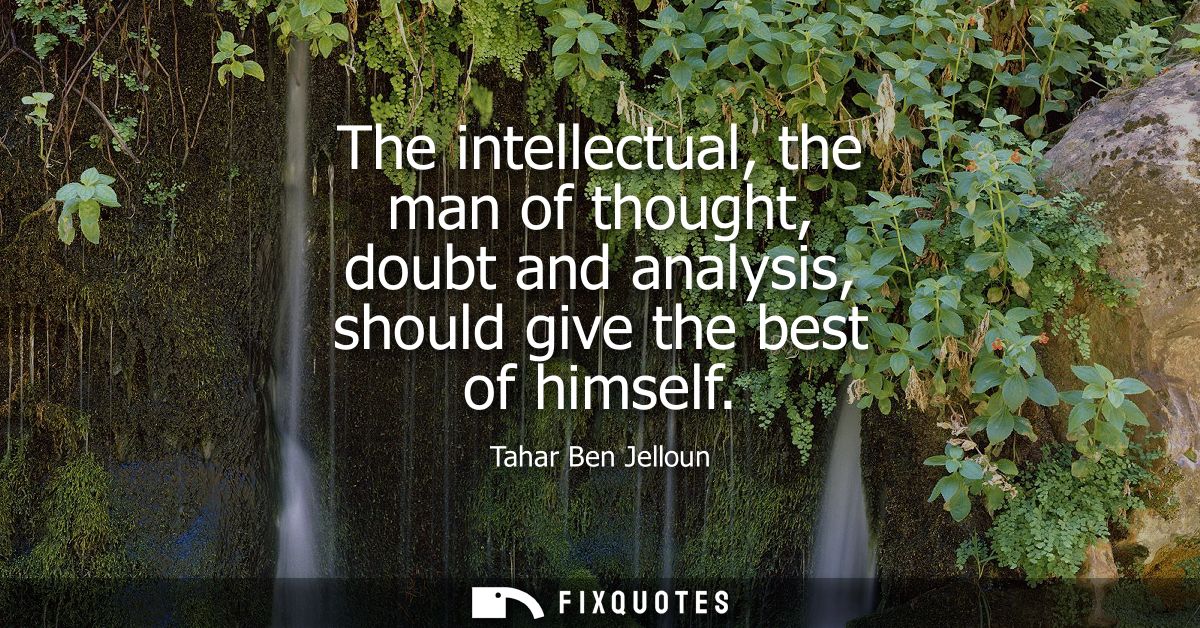
"The intellectual, the man of thought, doubt and analysis, should give the best of himself"
About this Quote
What makes it work is the tension inside its first clause. “Thought, doubt and analysis” are usually associated with hesitation, refinement, even withdrawal. Ben Jelloun flips that expectation. Doubt isn’t paralysis here; it’s the discipline that keeps power honest and language clean. “Should give the best of himself” shifts the intellectual from commentator to contributor, implying sacrifice: time, reputation, safety. In societies where speech can be policed - by the state, by the crowd, by identity gatekeepers - “the best” is not just intelligence but courage, empathy, and clarity.
There’s subtext, too, about the temptations of intellectual life: cynicism, performative critique, the comfort of being right in theory while remaining absent in practice. Coming from a poet, the phrase also doubles as a quiet defense of art’s usefulness. The poet’s labor is not escapism; it’s moral attention, offered at full strength when public life grows coarse and fear tries to pass for common sense.
Quote Details
| Topic | Reason & Logic |
|---|---|
| Source | Help us find the source |
| Cite |
Citation Formats
APA Style (7th ed.)
Jelloun, Tahar Ben. (2026, January 16). The intellectual, the man of thought, doubt and analysis, should give the best of himself. FixQuotes. https://fixquotes.com/quotes/the-intellectual-the-man-of-thought-doubt-and-102902/
Chicago Style
Jelloun, Tahar Ben. "The intellectual, the man of thought, doubt and analysis, should give the best of himself." FixQuotes. January 16, 2026. https://fixquotes.com/quotes/the-intellectual-the-man-of-thought-doubt-and-102902/.
MLA Style (9th ed.)
"The intellectual, the man of thought, doubt and analysis, should give the best of himself." FixQuotes, 16 Jan. 2026, https://fixquotes.com/quotes/the-intellectual-the-man-of-thought-doubt-and-102902/. Accessed 22 Mar. 2026.