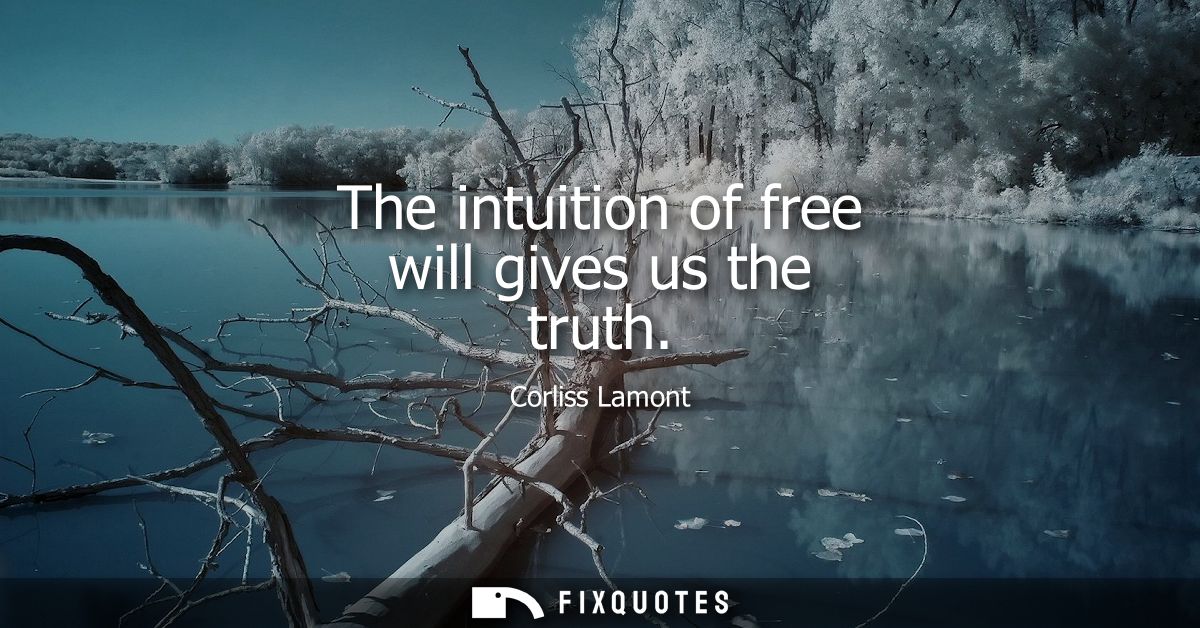
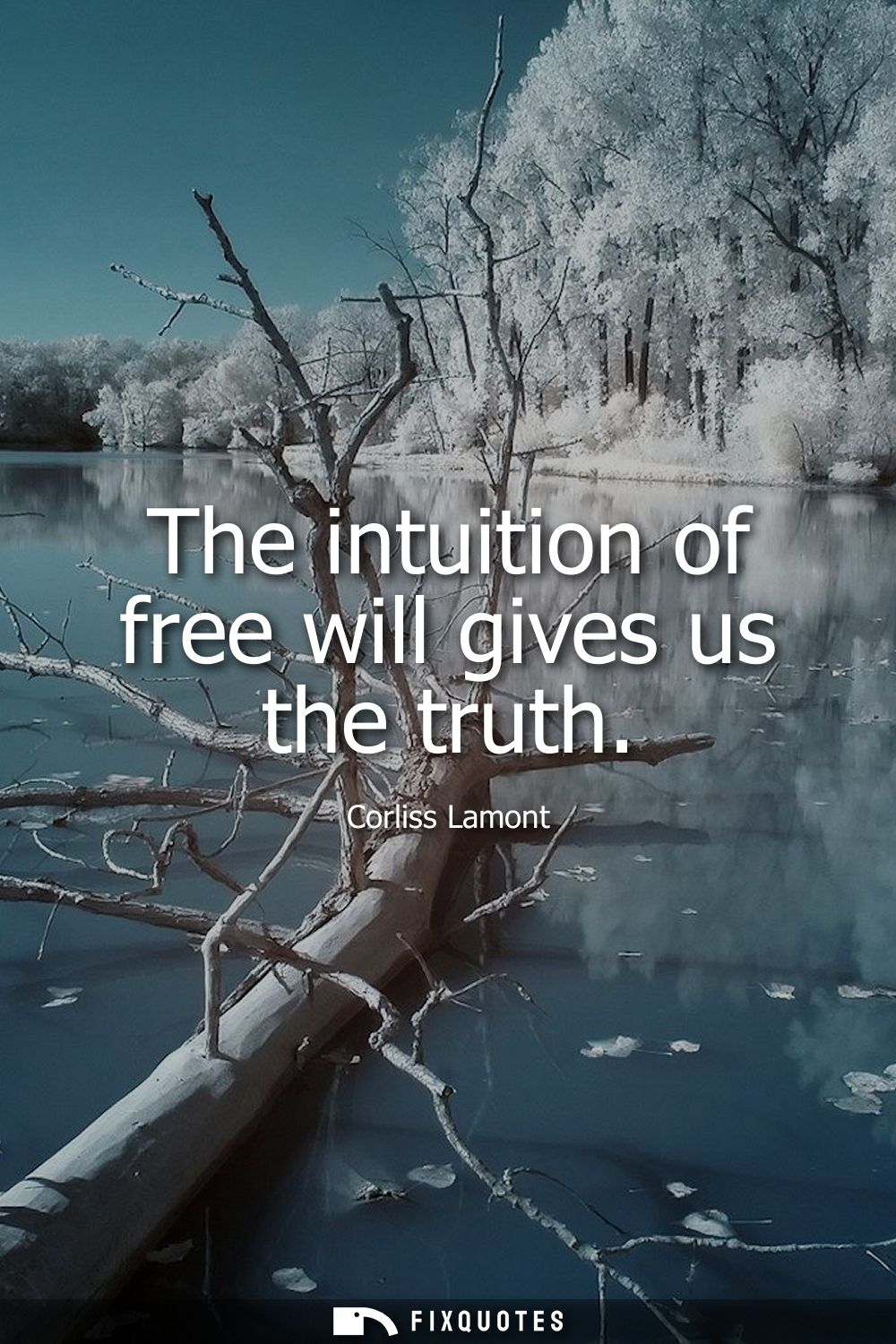
"The intuition of free will gives us the truth"
About this Quote
Lamont is betting on a stubborn piece of inner evidence: the felt experience of choosing. In a century fascinated by behaviorism, Freudian determinism, and later the prestige of scientific reductionism, “The intuition of free will gives us the truth” reads like a strategic counterpunch. He’s not arguing free will from metaphysical first principles; he’s appealing to a psychological datum we carry around like a compass. The intent is polemical and pragmatic: stop letting abstract systems talk you out of the one thing that makes moral life intelligible.
The subtext is almost political. Lamont, a committed humanist, wants an ethics that doesn’t collapse into excuse-making. If free will is “true” because it is intuited, then responsibility isn’t a theological import or a legal fiction; it’s grounded in everyday consciousness. That matters in modern mass society, where institutions can treat people as data points, patients, or products. “Intuition” here functions as a small act of resistance: your lived agency outranks the lab report when it comes to how you must live.
What makes the line work is its deliberate provocation. Philosophers typically treat intuition as suspect, a first draft of belief, not a truth-guarantee. Lamont flips that hierarchy, implying that any worldview that denies free will must explain away the very equipment by which we navigate decisions. The claim is less “I can prove free will” than “you already know it, and denying it is an intellectual performance with moral costs.”
The subtext is almost political. Lamont, a committed humanist, wants an ethics that doesn’t collapse into excuse-making. If free will is “true” because it is intuited, then responsibility isn’t a theological import or a legal fiction; it’s grounded in everyday consciousness. That matters in modern mass society, where institutions can treat people as data points, patients, or products. “Intuition” here functions as a small act of resistance: your lived agency outranks the lab report when it comes to how you must live.
What makes the line work is its deliberate provocation. Philosophers typically treat intuition as suspect, a first draft of belief, not a truth-guarantee. Lamont flips that hierarchy, implying that any worldview that denies free will must explain away the very equipment by which we navigate decisions. The claim is less “I can prove free will” than “you already know it, and denying it is an intellectual performance with moral costs.”
Quote Details
| Topic | Free Will & Fate |
|---|---|
| Source | Help us find the source |
| Cite |
Citation Formats
APA Style (7th ed.)
Lamont, Corliss. (2026, January 15). The intuition of free will gives us the truth. FixQuotes. https://fixquotes.com/quotes/the-intuition-of-free-will-gives-us-the-truth-161873/
Chicago Style
Lamont, Corliss. "The intuition of free will gives us the truth." FixQuotes. January 15, 2026. https://fixquotes.com/quotes/the-intuition-of-free-will-gives-us-the-truth-161873/.
MLA Style (9th ed.)
"The intuition of free will gives us the truth." FixQuotes, 15 Jan. 2026, https://fixquotes.com/quotes/the-intuition-of-free-will-gives-us-the-truth-161873/. Accessed 6 Apr. 2026.
More Quotes by Corliss
Add to List