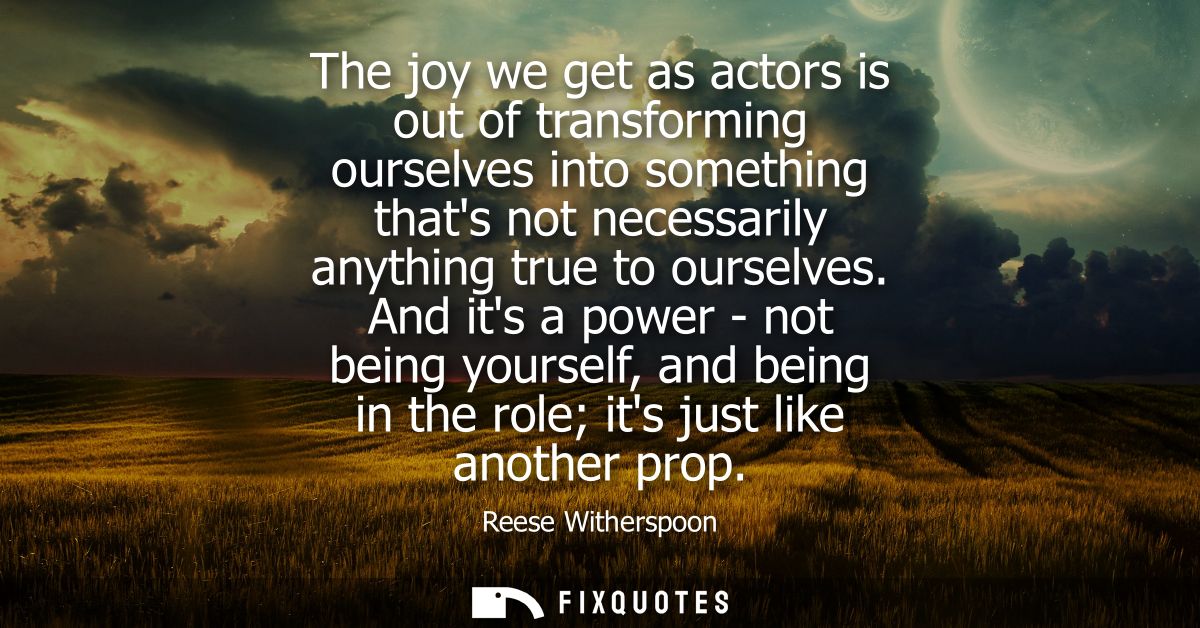
"The joy we get as actors is out of transforming ourselves into something that's not necessarily anything true to ourselves. And it's a power - not being yourself, and being in the role; it's just like another prop"
About this Quote
The intent isn’t to sound nihilistic; it’s to defend technique. By framing transformation as joy, she points to a pleasure that’s tactile and practical, not mystical. The subtext: great acting isn’t confession. It’s construction. "Not necessarily anything true to ourselves" reads like a pushback against the prestige-TV expectation that every role must be rooted in personal trauma or lived experience. She’s arguing for imagination and artifice as legitimate sources of truth.
The line also carries the perspective of someone who has played both the underestimated and the hyper-visible. Witherspoon’s career has been shaped by roles that weaponize performance (Legally Blonde’s strategic femininity, Big Little Lies’ curated perfection). Calling the self a prop acknowledges how women in public life are forced to treat identity as equipment: adjustable, deployable, sometimes protective armor. The quote lands because it refuses the sentimental version of acting and replaces it with a bracingly modern idea: freedom isn’t self-expression; it’s self-suspension.
Quote Details
| Topic | Movie |
|---|---|
| Source | Verified source: Reese Witherspoon (Talent Development Resources interview... (Reese Witherspoon)
Evidence:
The joy we get as actors is out of transforming ourselves into something that's not necessarily anything true to ourselves. If somebody has a naturally violent tendency, I think more than anything, it's not about who we are, it's about the characters we like to play in the sense of being not yourself. "And it's a power - not being yourself, and being in the role; it's just like another prop.". I was able to verify the quote verbatim on TalentDevelop.com’s Reese Witherspoon interview transcript/page, in a section discussing her films FEAR and FREEWAY and the idea of acting as transformation. However, this page does NOT provide an original publication name (magazine/newspaper), interviewer, or a date/year, and it appears to be a repost/compiled transcript. Because the user needs the FIRST publication/spoken primary source, this is not yet sufficient to conclusively identify where it FIRST appeared. I did not find (in the available search results) an earlier primary source (e.g., the original magazine issue, a dated interview, TV/radio transcript, or book) that can be cited as the first occurrence. The most likely situation is: the quote originates from a mid-1990s interview done around FEAR (1996) / FREEWAY (1996), later rehosted by Talent Development Resources; but the exact original outlet and year cannot be verified from this page alone. |
| Cite |
Citation Formats
APA Style (7th ed.)
Witherspoon, Reese. (2026, February 27). The joy we get as actors is out of transforming ourselves into something that's not necessarily anything true to ourselves. And it's a power - not being yourself, and being in the role; it's just like another prop. FixQuotes. https://fixquotes.com/quotes/the-joy-we-get-as-actors-is-out-of-transforming-28700/
Chicago Style
Witherspoon, Reese. "The joy we get as actors is out of transforming ourselves into something that's not necessarily anything true to ourselves. And it's a power - not being yourself, and being in the role; it's just like another prop." FixQuotes. February 27, 2026. https://fixquotes.com/quotes/the-joy-we-get-as-actors-is-out-of-transforming-28700/.
MLA Style (9th ed.)
"The joy we get as actors is out of transforming ourselves into something that's not necessarily anything true to ourselves. And it's a power - not being yourself, and being in the role; it's just like another prop." FixQuotes, 27 Feb. 2026, https://fixquotes.com/quotes/the-joy-we-get-as-actors-is-out-of-transforming-28700/. Accessed 14 Mar. 2026.