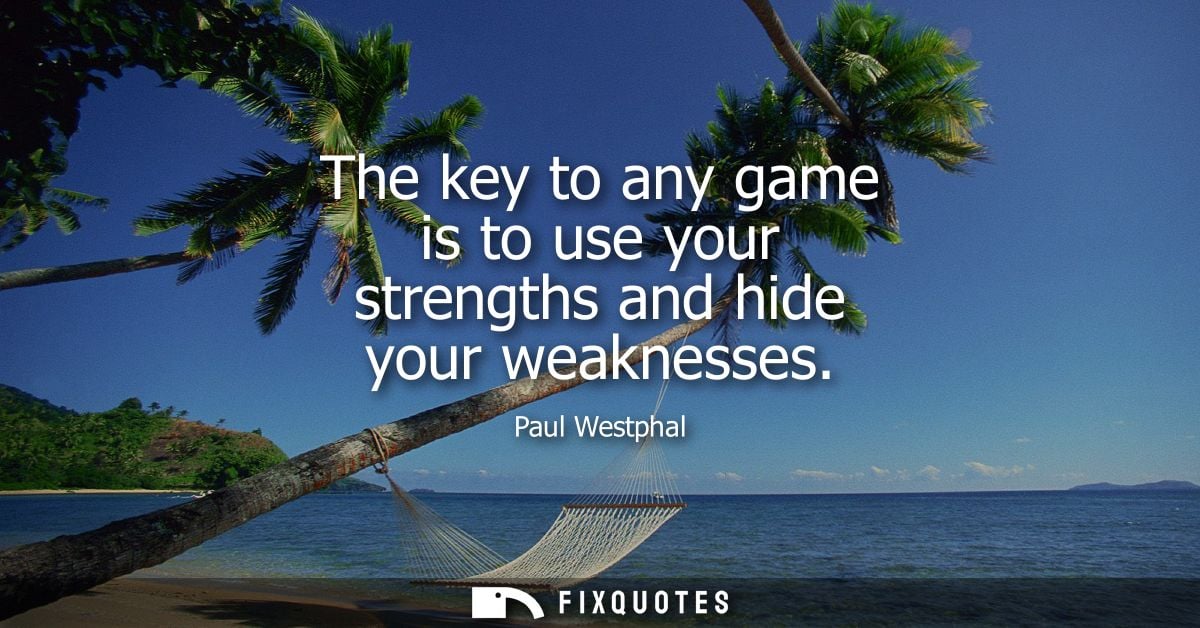
"The key to any game is to use your strengths and hide your weaknesses"
About this Quote
The phrasing matters: “any game” stretches beyond a single matchup into a worldview. Westphal played and coached in eras when the NBA became increasingly schematic, when matchups and adjustments started to feel like chess played at sprint speed. In that environment, “hiding” isn’t cowardice; it’s design. You shade help to protect a slow-footed big. You run sets that keep a shaky ball-handler off the decision tree. You switch your defensive coverages to force opponents away from the one action they’ve practiced all week. The strategy is less about perfection than about minimizing the places where you can be forced into it.
There’s also a quiet psychological lesson here: you don’t win by pretending you’re flawless, you win by being honest about your limits without advertising them. Westphal’s intent is pragmatic confidence - build an identity around what you do well, then manage the damage everywhere else. It’s a blueprint for role acceptance and team construction, the anti-heroic version of “just work harder,” and that’s why it lands.
Quote Details
| Topic | Sports |
|---|---|
| Source | Help us find the source |
| Cite |
Citation Formats
APA Style (7th ed.)
Westphal, Paul. (2026, January 16). The key to any game is to use your strengths and hide your weaknesses. FixQuotes. https://fixquotes.com/quotes/the-key-to-any-game-is-to-use-your-strengths-and-120349/
Chicago Style
Westphal, Paul. "The key to any game is to use your strengths and hide your weaknesses." FixQuotes. January 16, 2026. https://fixquotes.com/quotes/the-key-to-any-game-is-to-use-your-strengths-and-120349/.
MLA Style (9th ed.)
"The key to any game is to use your strengths and hide your weaknesses." FixQuotes, 16 Jan. 2026, https://fixquotes.com/quotes/the-key-to-any-game-is-to-use-your-strengths-and-120349/. Accessed 12 Feb. 2026.