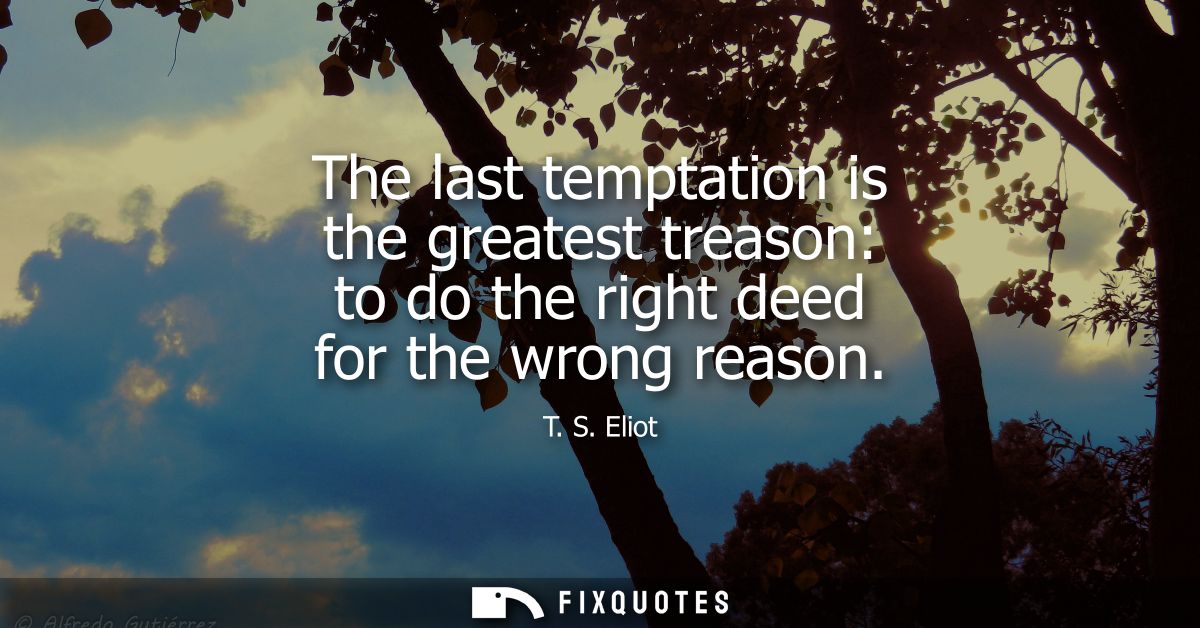
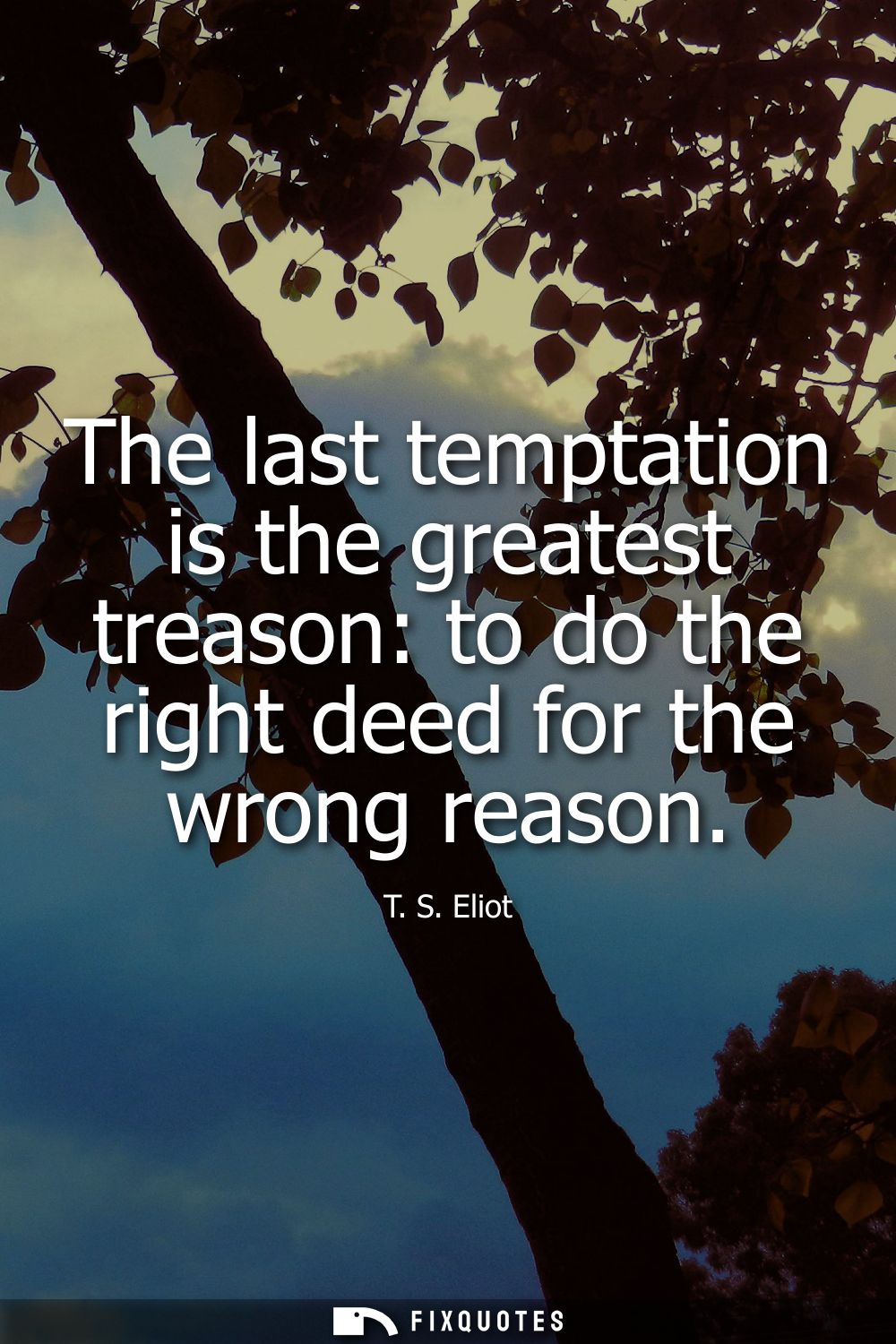
"The last temptation is the greatest treason: to do the right deed for the wrong reason"
About this Quote
What makes the sentence work is its grim paradox: the “right deed” can still be corruption. Eliot is attacking the modern fantasy that outcomes absolve motives, that being on the correct side of history (or of a cause) sanitizes ego. The “wrong reason” is left deliberately vague, which is the point - it could be vanity, careerism, spiritual pride, the hunger to be seen as good. The poem’s cadence turns ethical diagnosis into liturgy: “temptation,” “treason,” “deed” all carry a religious charge, as if morality is less a checklist than a discipline of the soul.
Context matters. Eliot wrote in an era of public ideologies and private disillusionment, after the Great War shredded easy moral narratives. In “Murder in the Cathedral,” the line functions as a warning to Thomas Becket: martyrdom itself can become self-serving if it’s pursued for glory rather than God. Eliot’s subtext is brutal: even our best gestures can be another way of keeping ourselves at the center.
Quote Details
| Topic | Ethics & Morality |
|---|---|
| Source | Verified source: Murder in the Cathedral (T. S. Eliot, 1935)
Evidence: The last temptation is the greatest treason: To do the right deed for the wrong reason. (Part I, near the end of the Fourth Tempter sequence (exact page varies by edition)). This line is spoken by Thomas Becket in T. S. Eliot’s verse drama. The earliest publication I can directly verify via a primary-library catalog record is the first edition book: London: Faber and Faber Limited, 1935, with the note “First published in June MCMXXXV” on the title-page verso. The play was written for performance at the Canterbury Festival (June 1935) and was performed at Canterbury Cathedral in 1935, but establishing whether the line was ‘spoken’ publicly before the June 1935 first publication would require access to contemporaneous performance scripts/programs or press reports; the first-edition publication is the cleanest verifiable primary-source ‘first appearance’ in print. The quote is often punctuated exactly as above (with a colon and a line break); versions that run it together on one line are secondary reformatting. Other candidates (1) Prescriptive Legal Positivism (Tom Campbell, 2024) compilation95.0% ... TS Eliot , Murder in the Cathedral , London : Faber , 1935 , pt 1 : ' The last temptation is the greatest treason... |
| Cite |
Citation Formats
APA Style (7th ed.)
Eliot, T. S. (2026, February 27). The last temptation is the greatest treason: to do the right deed for the wrong reason. FixQuotes. https://fixquotes.com/quotes/the-last-temptation-is-the-greatest-treason-to-do-29048/
Chicago Style
Eliot, T. S. "The last temptation is the greatest treason: to do the right deed for the wrong reason." FixQuotes. February 27, 2026. https://fixquotes.com/quotes/the-last-temptation-is-the-greatest-treason-to-do-29048/.
MLA Style (9th ed.)
"The last temptation is the greatest treason: to do the right deed for the wrong reason." FixQuotes, 27 Feb. 2026, https://fixquotes.com/quotes/the-last-temptation-is-the-greatest-treason-to-do-29048/. Accessed 31 Mar. 2026.