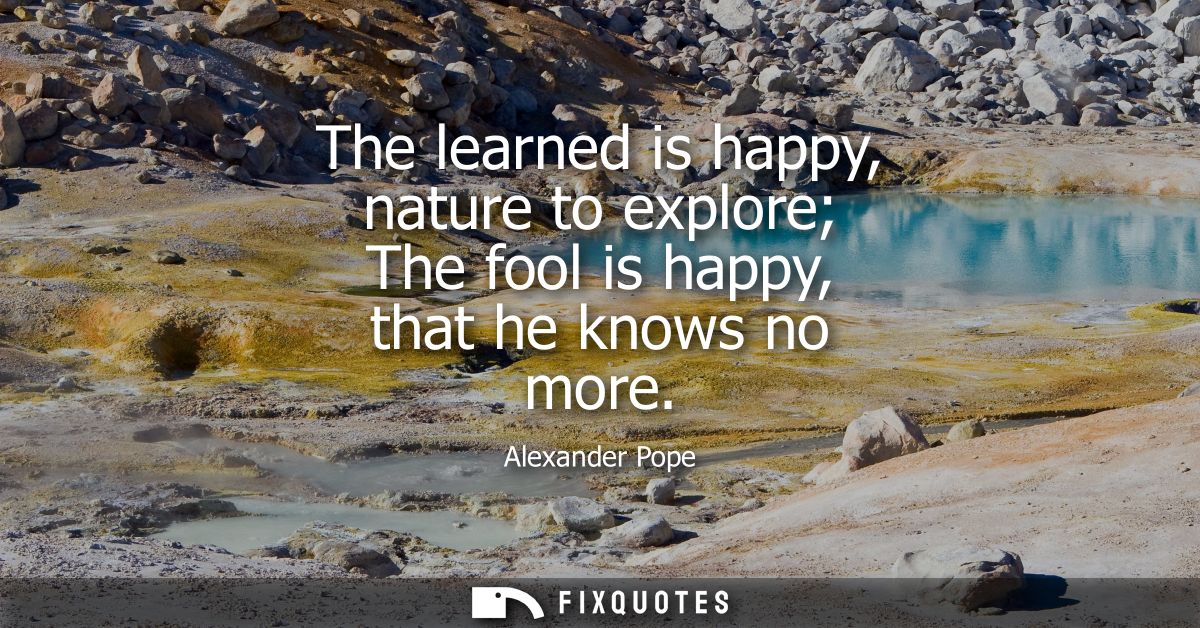
"The learned is happy, Nature to explore; The fool is happy, that he knows no more"
About this Quote
Then he twists the knife with the second line. The fool isn't merely content; he's "happy, that he knows no more". The subtext is less "ignorance is bad" than "ignorance is stable". There's no new information to disturb self-satisfaction, no moral complication, no cognitive overhead. Pope's wit lives in the symmetry: both are happy, but for opposite reasons, and the balance makes the judgment feel clinical even as it smuggles in a critique of complacency.
Context sharpens the edge. Writing in an Enlightenment moment that prized reason, Pope also distrusted human pride and overreach. He can praise the learned without turning learning into salvation. The line reads as a miniature of his larger preoccupation: the limits of human understanding, and the comic tragedy of thinking we're above those limits. It's a couplet that admires inquiry while warning that peace and truth rarely share a room.
Quote Details
| Topic | Knowledge |
|---|---|
| Source | Verified source: An Essay on Man: In Epistles to a Friend (Epistle IV) (Alexander Pope, 1734)
Evidence: The learn'd is happy nature to explore, The fool is happy that he knows no more; (Epistle IV (lines 263–264 in many modern line-numbered editions)). This couplet appears in Alexander Pope’s An Essay on Man, Epistle IV (the epistle on happiness). The quote is often modernized/punctuated as “The learned is happy, Nature to explore; The fool is happy, that he knows no more,” but the original spelling/punctuation in many early/standard texts is “learn'd” and typically lacks the comma after “happy.” The earliest *publication* for this specific couplet is Epistle IV, issued as a separately published pamphlet in London in 1734 (printed for J. Wilford). A library catalog record for that 1734 Epistle IV pamphlet is provided by the Folger Shakespeare Library. The line-numbered text location can be seen in modern scholarly/archival transcriptions of Epistle IV (e.g., Wikisource’s Epistle IV text includes the couplet immediately before “The rich is happy…”). Other candidates (1) The Rape of the Lock (Alexander Pope, 1898) compilation95.0% And An Essay on Man Alexander Pope Augustus Mortimer Van Dyke. The learned is happy nature to explore , The fool is h... |
| Cite |
Citation Formats
APA Style (7th ed.)
Pope, Alexander. (2026, March 2). The learned is happy, Nature to explore; The fool is happy, that he knows no more. FixQuotes. https://fixquotes.com/quotes/the-learned-is-happy-nature-to-explore-the-fool-3350/
Chicago Style
Pope, Alexander. "The learned is happy, Nature to explore; The fool is happy, that he knows no more." FixQuotes. March 2, 2026. https://fixquotes.com/quotes/the-learned-is-happy-nature-to-explore-the-fool-3350/.
MLA Style (9th ed.)
"The learned is happy, Nature to explore; The fool is happy, that he knows no more." FixQuotes, 2 Mar. 2026, https://fixquotes.com/quotes/the-learned-is-happy-nature-to-explore-the-fool-3350/. Accessed 6 Apr. 2026.