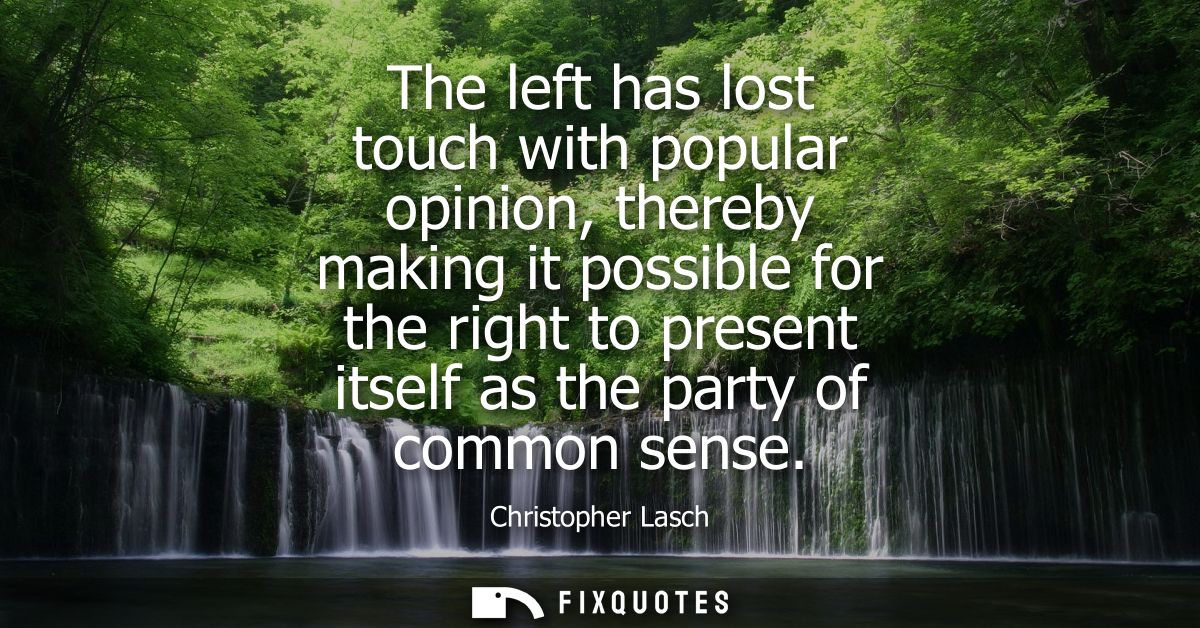
"The left has lost touch with popular opinion, thereby making it possible for the right to present itself as the party of common sense"
About this Quote
The phrase “party of common sense” is doing the real work. Lasch is naming politics as branding, not philosophy: the right doesn’t have to win on policy merit if it can win on tone. “Common sense” implies a world where problems are obvious and solutions are straightforward; it flatters the audience as competent and sane, while casting opponents as detached, doctrinaire, even contemptuous. If the left is perceived as policing language, re-litigating symbols, or outsourcing judgment to institutions people no longer trust, the right gets to pose as the adult in the room - even when its answers are simplistic or punitive.
Context matters: Lasch wrote in the long shadow of post-1960s liberalism, deindustrialization, and the rise of a professional-managerial class. He saw a left that talked emancipation while drifting away from the solidarities and limits that make mass politics possible. The subtext is brutal: you don’t lose elections only by being wrong; you lose by sounding like you don’t like the people you claim to represent.
Quote Details
| Topic | Deep |
|---|---|
| Source | Help us find the source |
| Cite |
Citation Formats
APA Style (7th ed.)
Lasch, Christopher. (2026, January 17). The left has lost touch with popular opinion, thereby making it possible for the right to present itself as the party of common sense. FixQuotes. https://fixquotes.com/quotes/the-left-has-lost-touch-with-popular-opinion-39720/
Chicago Style
Lasch, Christopher. "The left has lost touch with popular opinion, thereby making it possible for the right to present itself as the party of common sense." FixQuotes. January 17, 2026. https://fixquotes.com/quotes/the-left-has-lost-touch-with-popular-opinion-39720/.
MLA Style (9th ed.)
"The left has lost touch with popular opinion, thereby making it possible for the right to present itself as the party of common sense." FixQuotes, 17 Jan. 2026, https://fixquotes.com/quotes/the-left-has-lost-touch-with-popular-opinion-39720/. Accessed 12 Feb. 2026.