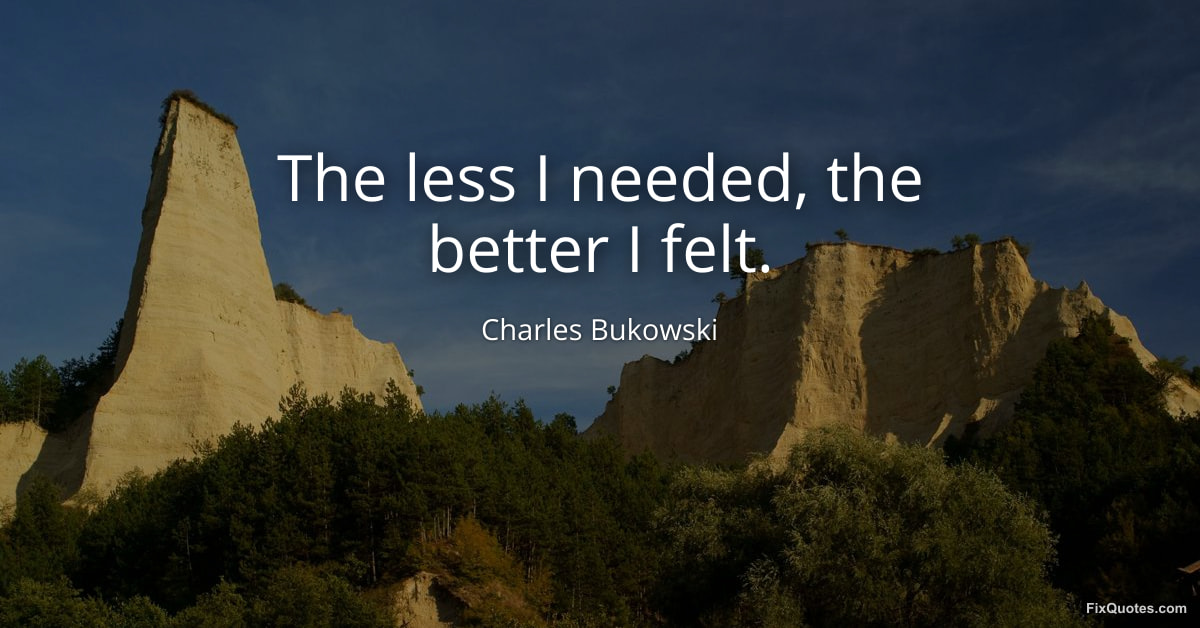
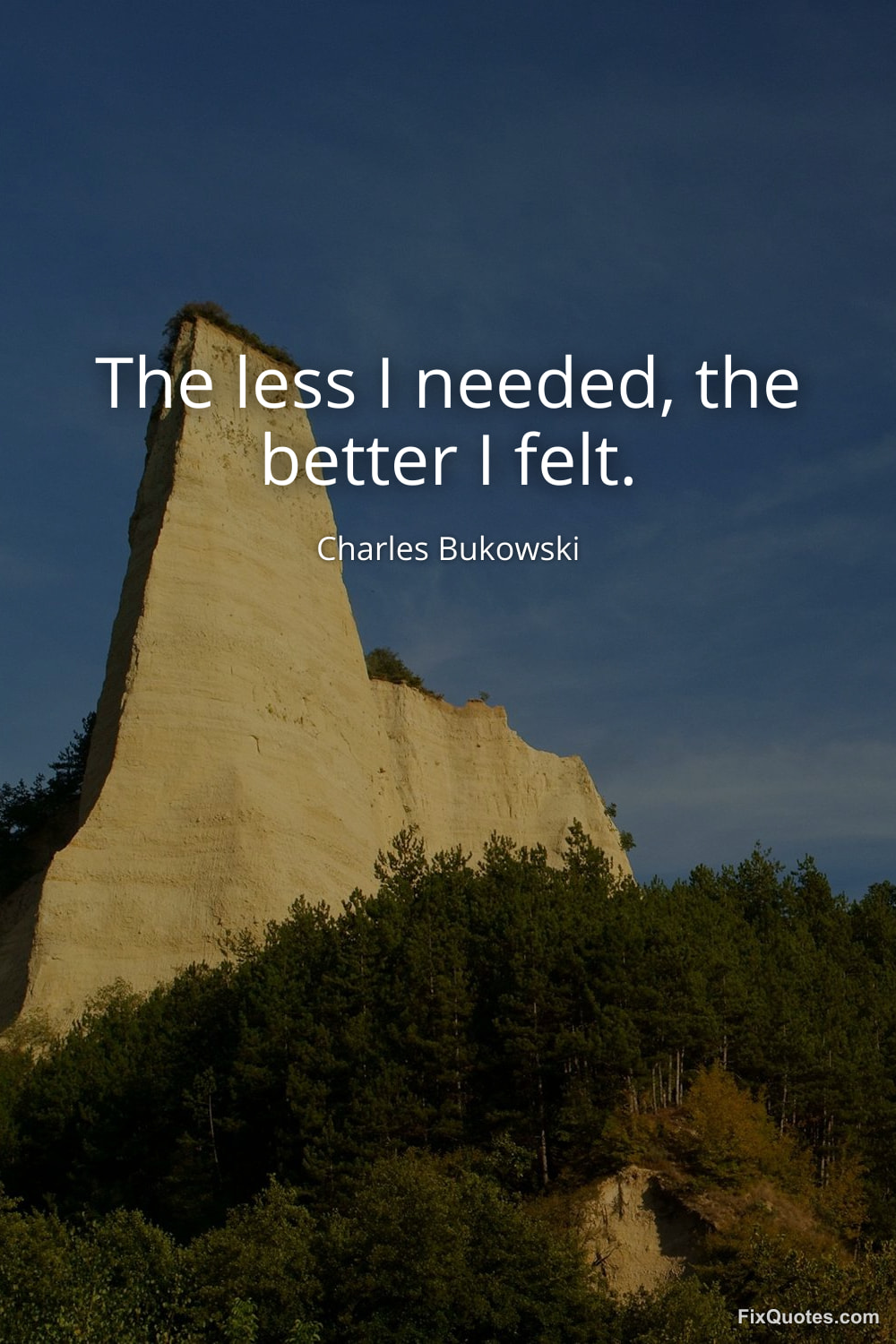
"The less I needed, the better I felt"
About this Quote
A Bukowski line that sounds like self-help until you taste the ash in it. "The less I needed, the better I felt" isn’t a polished minimalist manifesto; it’s a street-level survival tactic. Need, in Bukowski’s world, is leverage handed to landlords, bosses, lovers, bartenders, and luck itself. Strip it down and you can’t be squeezed as easily. The sentence is blunt, almost anti-poetic, which is precisely the point: he’s allergic to grand moralizing. He offers a rule of thumb you learn by getting burned.
The intent is partly ascetic, partly defensive. Bukowski isn’t praising purity; he’s praising insulation. To need less is to feel less exposed to disappointment and humiliation, the two constant taxes of his working-class, booze-soaked landscape. The subtext is bleakly transactional: desire is a bill that always comes due, and the interest rate is shame. In that sense, "better" doesn’t mean joyful. It means quieter, less reactive, less at the mercy of other people’s decisions.
Context matters: Bukowski wrote from the underside of American prosperity, where the dream is visible but not purchasable. His speakers are chronically underpaid, hungover, and suspicious of any promise that requires optimism. Minimal need becomes a kind of grim freedom, a way to reclaim agency when conventional routes to stability are closed or contemptible.
There’s also a trap door in the phrasing. If needing less makes you feel better, what happens to the parts of life that require need - tenderness, ambition, community? Bukowski’s hard-won calm doubles as a warning: numbness can masquerade as liberation.
The intent is partly ascetic, partly defensive. Bukowski isn’t praising purity; he’s praising insulation. To need less is to feel less exposed to disappointment and humiliation, the two constant taxes of his working-class, booze-soaked landscape. The subtext is bleakly transactional: desire is a bill that always comes due, and the interest rate is shame. In that sense, "better" doesn’t mean joyful. It means quieter, less reactive, less at the mercy of other people’s decisions.
Context matters: Bukowski wrote from the underside of American prosperity, where the dream is visible but not purchasable. His speakers are chronically underpaid, hungover, and suspicious of any promise that requires optimism. Minimal need becomes a kind of grim freedom, a way to reclaim agency when conventional routes to stability are closed or contemptible.
There’s also a trap door in the phrasing. If needing less makes you feel better, what happens to the parts of life that require need - tenderness, ambition, community? Bukowski’s hard-won calm doubles as a warning: numbness can masquerade as liberation.
Quote Details
| Topic | Self-Improvement |
|---|---|
| Source | Charles Bukowski, “Let It Enfold You” |
| Cite |
Citation Formats
APA Style (7th ed.)
Bukowski, Charles. (2026, February 10). The less I needed, the better I felt. FixQuotes. https://fixquotes.com/quotes/the-less-i-needed-the-better-i-felt-185139/
Chicago Style
Bukowski, Charles. "The less I needed, the better I felt." FixQuotes. February 10, 2026. https://fixquotes.com/quotes/the-less-i-needed-the-better-i-felt-185139/.
MLA Style (9th ed.)
"The less I needed, the better I felt." FixQuotes, 10 Feb. 2026, https://fixquotes.com/quotes/the-less-i-needed-the-better-i-felt-185139/. Accessed 29 Mar. 2026.
More Quotes by Charles
Add to List