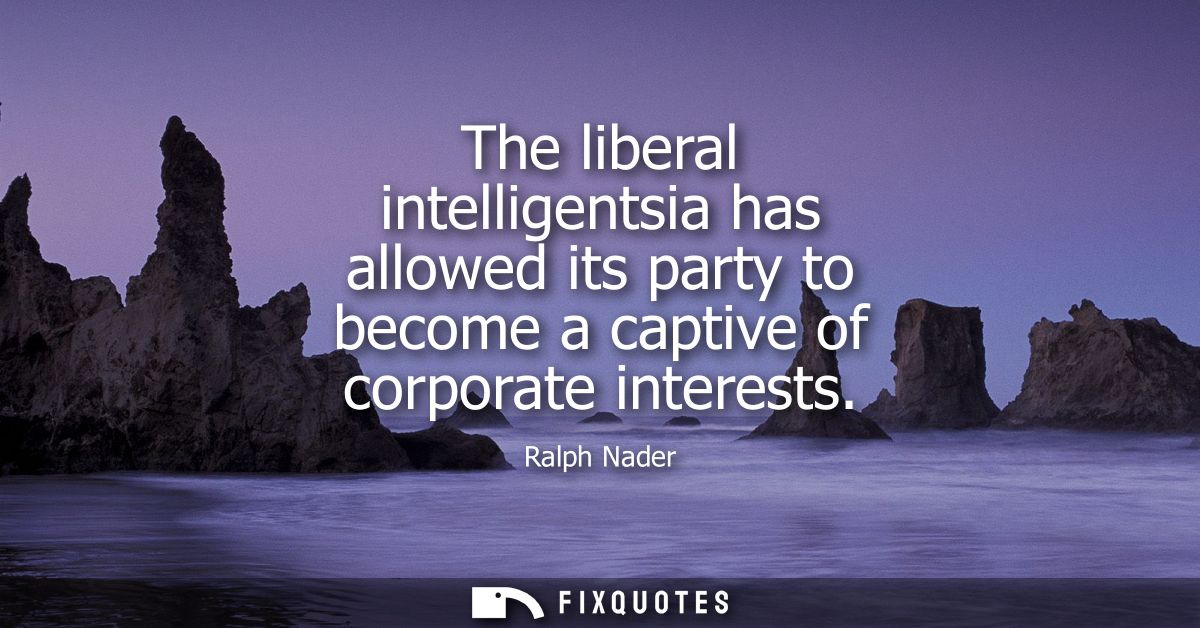
"The liberal intelligentsia has allowed its party to become a captive of corporate interests"
About this Quote
The phrase “allowed its party” does two jobs. It suggests ownership (this is your party) while denying agency (you let it be taken). That tension is the subtext: liberals can dominate culture, campuses, and editorial pages yet still lose the actual machinery of governance to donors, lobbyists, and “pragmatic” dealmaking. “Captive” sharpens the charge by making corporate influence feel coercive and totalizing, not just transactional. It’s not that politicians take money; it’s that the party’s imagination gets narrowed until corporate-friendly policy becomes the only “serious” option.
Context matters: Nader spent decades arguing that the Democratic Party absorbed reform energy and then neutered it, a critique sharpened by late-20th-century deregulation, Wall Street centrism, and the party’s growing dependence on big fundraising. As a lawyer and consumer advocate, he’s talking like someone who has watched the rulebook get quietly rewritten. The intent is disciplinary: to shame elite liberals into choosing conflict with capital over proximity to power.
Quote Details
| Topic | Justice |
|---|---|
| Source | Help us find the source |
| Cite |
Citation Formats
APA Style (7th ed.)
Nader, Ralph. (2026, January 17). The liberal intelligentsia has allowed its party to become a captive of corporate interests. FixQuotes. https://fixquotes.com/quotes/the-liberal-intelligentsia-has-allowed-its-party-64248/
Chicago Style
Nader, Ralph. "The liberal intelligentsia has allowed its party to become a captive of corporate interests." FixQuotes. January 17, 2026. https://fixquotes.com/quotes/the-liberal-intelligentsia-has-allowed-its-party-64248/.
MLA Style (9th ed.)
"The liberal intelligentsia has allowed its party to become a captive of corporate interests." FixQuotes, 17 Jan. 2026, https://fixquotes.com/quotes/the-liberal-intelligentsia-has-allowed-its-party-64248/. Accessed 20 Mar. 2026.