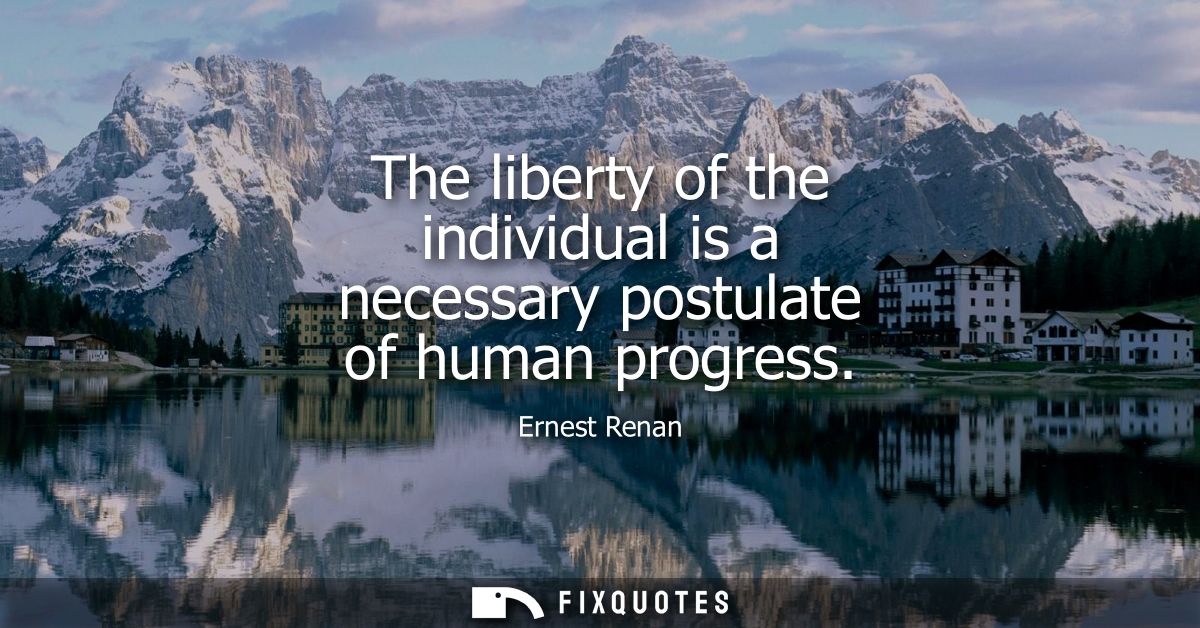
"The liberty of the individual is a necessary postulate of human progress"
About this Quote
Renan’s line reads like a calm axiom, but it’s really a provocation aimed at the 19th century’s favorite temptation: trading freedom for a supposedly higher historical destiny. By calling individual liberty a “necessary postulate,” he smuggles a political demand into the language of logic. A postulate isn’t argued for; it’s the starting condition without which the whole proof collapses. Renan isn’t politely praising freedom. He’s warning that any program promising “progress” while treating the person as disposable is a category error.
The word “progress” does heavy lifting. In Renan’s era, progress was the secular religion of Europe, invoked to justify empire, technocracy, and the tightening grip of modern states. Renan rides that consensus while quietly narrowing it: progress isn’t railways and administration; it’s the moral and intellectual expansion that only happens when individuals can dissent, experiment, and fail without being crushed. Liberty becomes less a romantic ideal than an operating system for civilization.
The subtext is defensive and strategic. After the revolutions of 1848, after the rise of mass politics and authoritarian “order,” liberalism needed a sturdier rationale than sentiment. Renan offers one that flatters moderns: if you believe in history moving forward, you must tolerate the unruly individual. The line also anticipates his later reflections on nations and consent; the “individual” is the unit whose freedom keeps collective identities from hardening into coercion.
It works because it hijacks the era’s faith in inevitability and turns it into a limit on power. If you want the future, you have to make room for the person.
The word “progress” does heavy lifting. In Renan’s era, progress was the secular religion of Europe, invoked to justify empire, technocracy, and the tightening grip of modern states. Renan rides that consensus while quietly narrowing it: progress isn’t railways and administration; it’s the moral and intellectual expansion that only happens when individuals can dissent, experiment, and fail without being crushed. Liberty becomes less a romantic ideal than an operating system for civilization.
The subtext is defensive and strategic. After the revolutions of 1848, after the rise of mass politics and authoritarian “order,” liberalism needed a sturdier rationale than sentiment. Renan offers one that flatters moderns: if you believe in history moving forward, you must tolerate the unruly individual. The line also anticipates his later reflections on nations and consent; the “individual” is the unit whose freedom keeps collective identities from hardening into coercion.
It works because it hijacks the era’s faith in inevitability and turns it into a limit on power. If you want the future, you have to make room for the person.
Quote Details
| Topic | Freedom |
|---|---|
| Source | Help us find the source |
| Cite |
Citation Formats
APA Style (7th ed.)
Renan, Ernest. (2026, January 18). The liberty of the individual is a necessary postulate of human progress. FixQuotes. https://fixquotes.com/quotes/the-liberty-of-the-individual-is-a-necessary-2843/
Chicago Style
Renan, Ernest. "The liberty of the individual is a necessary postulate of human progress." FixQuotes. January 18, 2026. https://fixquotes.com/quotes/the-liberty-of-the-individual-is-a-necessary-2843/.
MLA Style (9th ed.)
"The liberty of the individual is a necessary postulate of human progress." FixQuotes, 18 Jan. 2026, https://fixquotes.com/quotes/the-liberty-of-the-individual-is-a-necessary-2843/. Accessed 4 Apr. 2026.
More Quotes by Ernest
Add to List