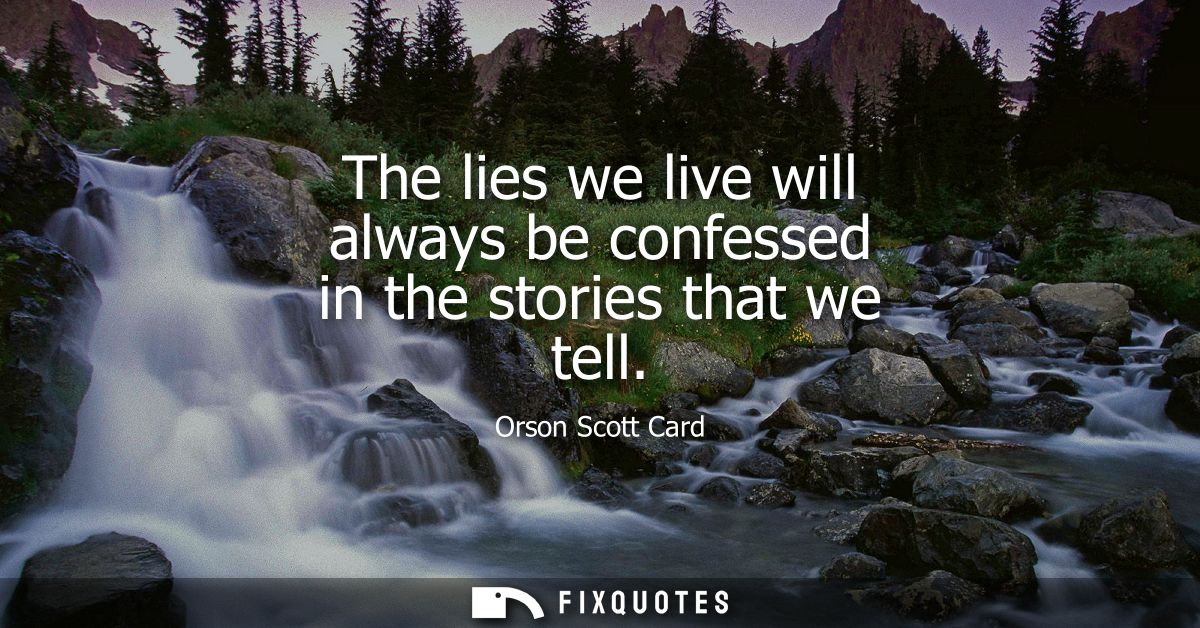
"The lies we live will always be confessed in the stories that we tell"
About this Quote
Card’s line cuts with the cool certainty of a moral diagnosis: you can stage-manage your public life, but your fiction will narc on you anyway. “The lies we live” isn’t about casual fibs; it’s about the daily compromises we normalize until they become identity. The phrasing makes deceit structural, almost architectural. These aren’t lies we tell. They’re lies we inhabit.
The sting is in “confessed.” Card frames storytelling as an involuntary deposition, not a self-expressive hobby. Even when we think we’re inventing worlds, we’re leaking our private rationalizations: what we fear, what we excuse, what we secretly want to be forgiven for. That’s why the line works rhetorically: it flips the common defense of art as escapism. Stories don’t let you out of your life; they route you back into it, with the receipts.
Subtextually, it’s also a warning about authorial innocence. Readers often treat narratives as entertainment sealed off from ethics. Card implies the opposite: narrative is where the unconscious (and the conscience) shows its work. The villains you draw, the heroes you reward, the endings you find “satisfying” all testify.
Context matters because Card is a writer whose work and public stances have sparked fierce debate. That tension makes the quote feel less like abstract craft advice and more like a provocation: if stories inevitably confess, then culture gets to cross-examine. The line doesn’t promise purity; it promises exposure.
The sting is in “confessed.” Card frames storytelling as an involuntary deposition, not a self-expressive hobby. Even when we think we’re inventing worlds, we’re leaking our private rationalizations: what we fear, what we excuse, what we secretly want to be forgiven for. That’s why the line works rhetorically: it flips the common defense of art as escapism. Stories don’t let you out of your life; they route you back into it, with the receipts.
Subtextually, it’s also a warning about authorial innocence. Readers often treat narratives as entertainment sealed off from ethics. Card implies the opposite: narrative is where the unconscious (and the conscience) shows its work. The villains you draw, the heroes you reward, the endings you find “satisfying” all testify.
Context matters because Card is a writer whose work and public stances have sparked fierce debate. That tension makes the quote feel less like abstract craft advice and more like a provocation: if stories inevitably confess, then culture gets to cross-examine. The line doesn’t promise purity; it promises exposure.
Quote Details
| Topic | Truth |
|---|
More Quotes by Orson
Add to List