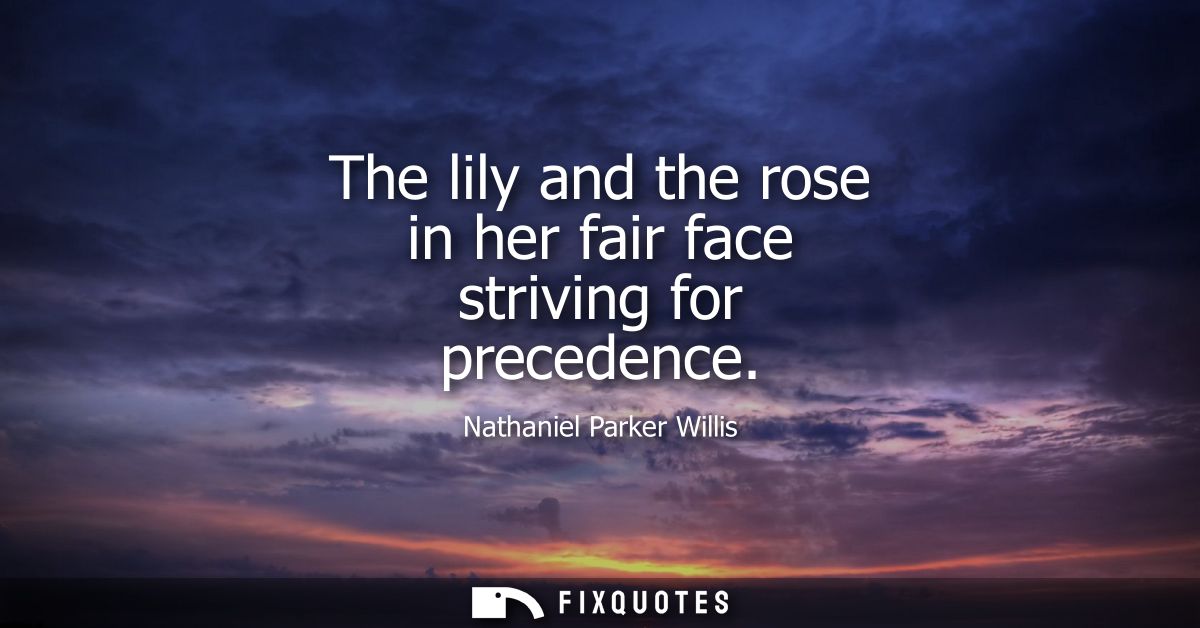
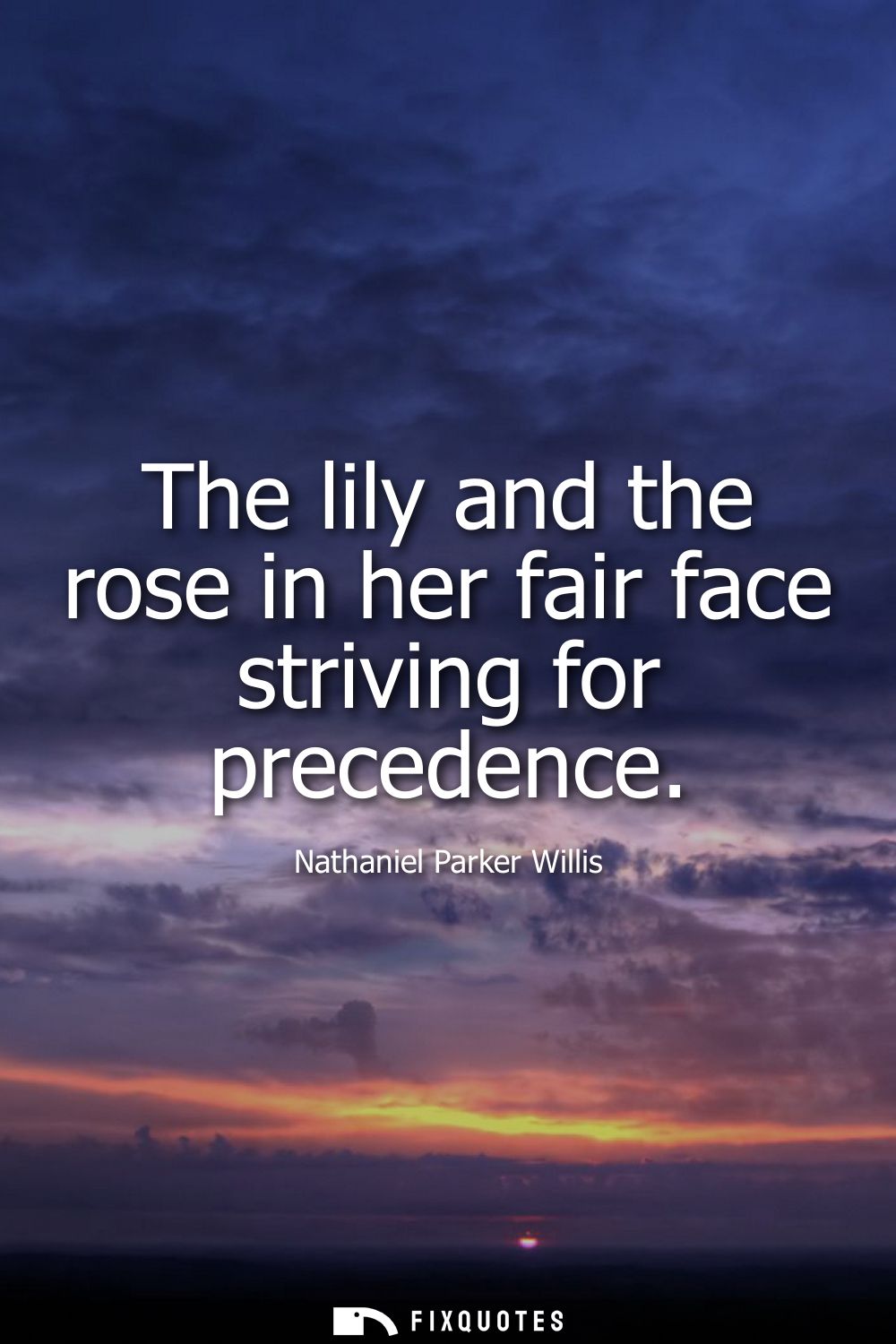
"The lily and the rose in her fair face striving for precedence"
About this Quote
Willis gives you a portrait, then immediately turns it into a contest. The “lily” and the “rose” aren’t just flowers; they’re coded pigments, the era’s shorthand for idealized feminine beauty: lily as pallor and purity, rose as blush and vitality. By making them “striving for precedence,” he animates her face as a polite battlefield where innocence and desire jostle for dominance. That little verb choice does the real work: it flatters the woman while also framing her as an aesthetic problem to be solved, a surface whose meanings can be read like symbols in a poem.
The line sits squarely in the 19th-century Anglo-American romantic register, where women are often rendered as botanical arrangements and moral emblems, not fully social actors. The “fair face” signals more than attractiveness; it nods to whiteness as a beauty standard and, by extension, a cultural hierarchy that could pass as “natural” the way flowers do. The subtext is control: by translating a person into lily/rose, Willis makes her legible within a tidy vocabulary of purity and blush, virtue and flirtation, passivity and heat.
It also reflects Willis’s brand as a polished sentimentalist in the antebellum literary marketplace: ornate, instantly picturable, meant to be recited, clipped, remembered. The charm is its compression - a single face becomes a whole drama of competing ideals - but the cost is obvious, too. Her complexity is reduced to a color war the observer gets to judge.
The line sits squarely in the 19th-century Anglo-American romantic register, where women are often rendered as botanical arrangements and moral emblems, not fully social actors. The “fair face” signals more than attractiveness; it nods to whiteness as a beauty standard and, by extension, a cultural hierarchy that could pass as “natural” the way flowers do. The subtext is control: by translating a person into lily/rose, Willis makes her legible within a tidy vocabulary of purity and blush, virtue and flirtation, passivity and heat.
It also reflects Willis’s brand as a polished sentimentalist in the antebellum literary marketplace: ornate, instantly picturable, meant to be recited, clipped, remembered. The charm is its compression - a single face becomes a whole drama of competing ideals - but the cost is obvious, too. Her complexity is reduced to a color war the observer gets to judge.
Quote Details
| Topic | Romantic |
|---|---|
| Source | Help us find the source |
| Cite |
Citation Formats
APA Style (7th ed.)
Willis, Nathaniel Parker. (2026, January 16). The lily and the rose in her fair face striving for precedence. FixQuotes. https://fixquotes.com/quotes/the-lily-and-the-rose-in-her-fair-face-striving-126880/
Chicago Style
Willis, Nathaniel Parker. "The lily and the rose in her fair face striving for precedence." FixQuotes. January 16, 2026. https://fixquotes.com/quotes/the-lily-and-the-rose-in-her-fair-face-striving-126880/.
MLA Style (9th ed.)
"The lily and the rose in her fair face striving for precedence." FixQuotes, 16 Jan. 2026, https://fixquotes.com/quotes/the-lily-and-the-rose-in-her-fair-face-striving-126880/. Accessed 5 Mar. 2026.
More Quotes by Nathaniel
Add to List