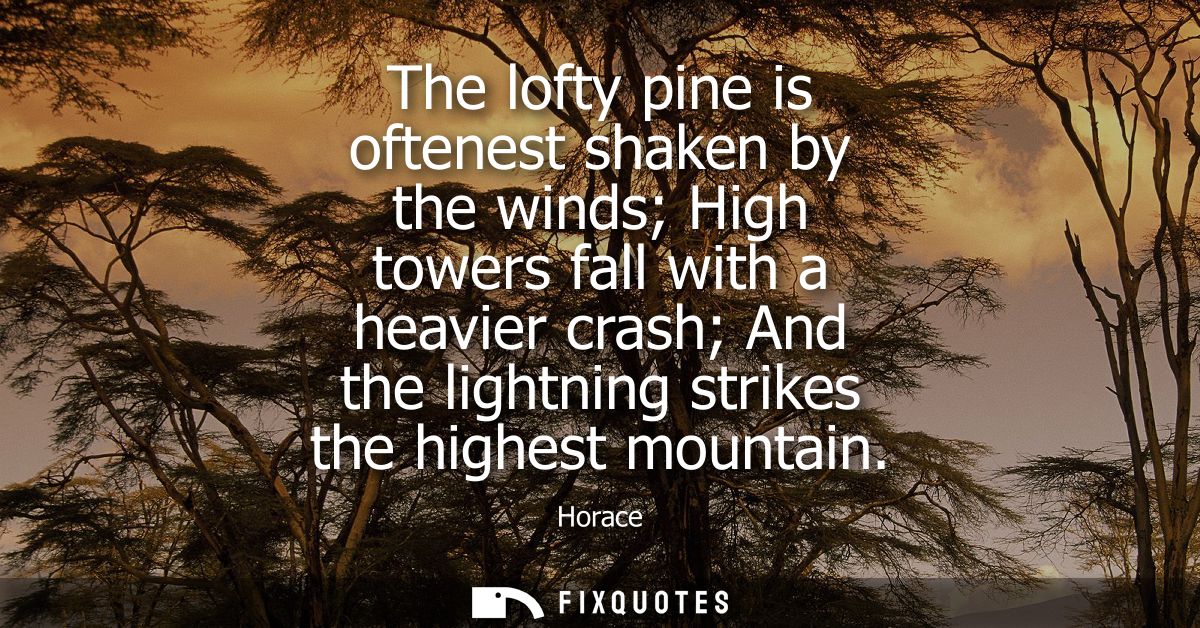
"The lofty pine is oftenest shaken by the winds; High towers fall with a heavier crash; And the lightning strikes the highest mountain"
About this Quote
The intent is recognizably Horatian: a case for measure, not martyrdom. Horace’s poetry repeatedly argues for the aurea mediocritas, the “golden mean,” and this triad of disasters is a memorable way to make moderation sound less like timidity and more like self-possession. The subtext is political as much as personal. Writing in the shadow of Rome’s civil wars and the new Augustan order, Horace understood how quickly public height becomes a target: for rivals, for rumor, for imperial suspicion, for the literal hazards of status. In a society where patronage could lift you overnight and unmake you just as fast, “high towers” aren’t only buildings; they’re careers.
What makes the lines work is their cold empathy. Horace doesn’t condemn the pine for growing tall; he simply notes what tallness costs. It’s counsel without sermonizing, a poetic way of saying: you can seek eminence, but don’t be surprised when the weather starts paying attention.
Quote Details
| Topic | Latin Phrases |
|---|---|
| Source | Help us find the source |
| Cite |
Citation Formats
APA Style (7th ed.)
Horace. (2026, January 17). The lofty pine is oftenest shaken by the winds; High towers fall with a heavier crash; And the lightning strikes the highest mountain. FixQuotes. https://fixquotes.com/quotes/the-lofty-pine-is-oftenest-shaken-by-the-winds-24565/
Chicago Style
Horace. "The lofty pine is oftenest shaken by the winds; High towers fall with a heavier crash; And the lightning strikes the highest mountain." FixQuotes. January 17, 2026. https://fixquotes.com/quotes/the-lofty-pine-is-oftenest-shaken-by-the-winds-24565/.
MLA Style (9th ed.)
"The lofty pine is oftenest shaken by the winds; High towers fall with a heavier crash; And the lightning strikes the highest mountain." FixQuotes, 17 Jan. 2026, https://fixquotes.com/quotes/the-lofty-pine-is-oftenest-shaken-by-the-winds-24565/. Accessed 28 Mar. 2026.