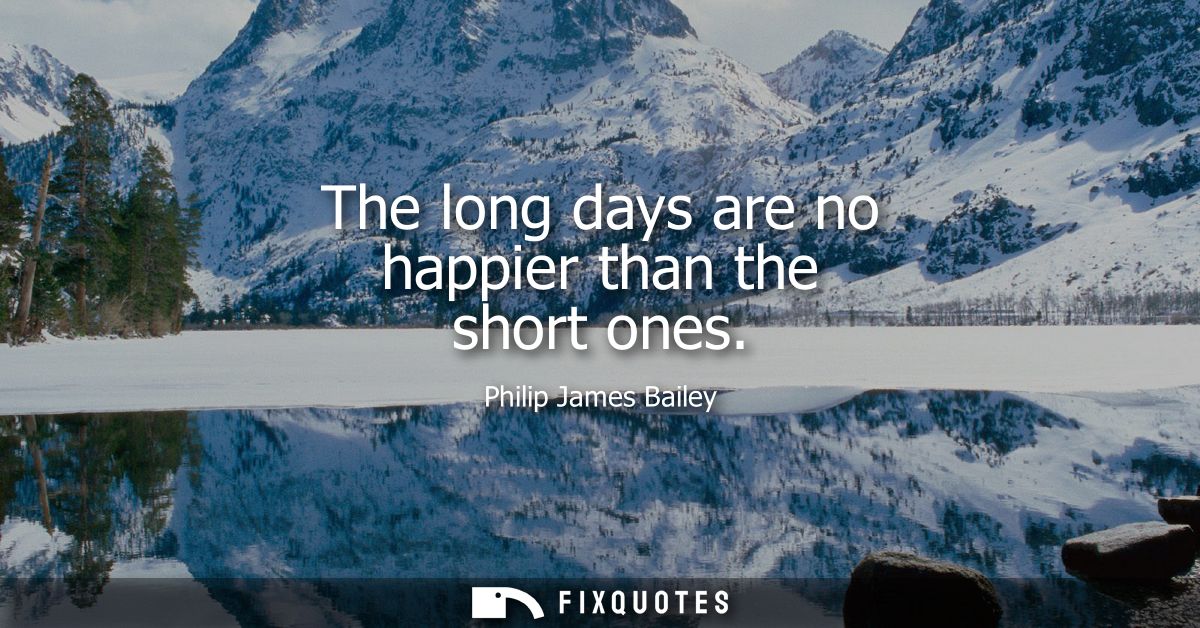
"The long days are no happier than the short ones"
About this Quote
Time, Bailey suggests, is a lousy stand-in for meaning. "The long days are no happier than the short ones" sounds at first like a mild, almost pastoral observation, but it carries the quiet sting of a poet who distrusts the modern habit of treating duration as a cure. More hours, more light, more room on the calendar: we reach for these as if happiness were a matter of acreage. Bailey snaps that illusion in half with a simple comparative structure. "Long" and "short" are measurable; "happier" is not. The line works because it makes the mismatch feel inevitable.
Bailey wrote in the 19th century, when industrial timekeeping was tightening its grip and "progress" increasingly meant speed, productivity, and the moral glow of busyness. Against that backdrop, the quote reads like a refusal to let the clock set the terms of inner life. It also carries a seasonal subtext: summer's endless daylight is popularly romanticized, yet anyone who has been lonely in July knows that brightness can sharpen emptiness rather than soften it. The long day can even be crueller, stretching dissatisfaction across more hours, giving restlessness extra oxygen.
The intent isn't pure pessimism; it's a calibration. Bailey is warning that happiness isn't additive. You don't get it by extending the day, prolonging youth, padding the weekend, or dragging out a relationship past its honest ending. You get it, if at all, by changing what fills the hours, not by bargaining for more of them.
Bailey wrote in the 19th century, when industrial timekeeping was tightening its grip and "progress" increasingly meant speed, productivity, and the moral glow of busyness. Against that backdrop, the quote reads like a refusal to let the clock set the terms of inner life. It also carries a seasonal subtext: summer's endless daylight is popularly romanticized, yet anyone who has been lonely in July knows that brightness can sharpen emptiness rather than soften it. The long day can even be crueller, stretching dissatisfaction across more hours, giving restlessness extra oxygen.
The intent isn't pure pessimism; it's a calibration. Bailey is warning that happiness isn't additive. You don't get it by extending the day, prolonging youth, padding the weekend, or dragging out a relationship past its honest ending. You get it, if at all, by changing what fills the hours, not by bargaining for more of them.
Quote Details
| Topic | Happiness |
|---|---|
| Source | Help us find the source |
| Cite | Cite this Quote |
Citation Formats
APA Style (7th ed.)
Bailey, Philip James. (2026, January 17). The long days are no happier than the short ones. FixQuotes. https://fixquotes.com/quotes/the-long-days-are-no-happier-than-the-short-ones-64196/
Chicago Style
Bailey, Philip James. "The long days are no happier than the short ones." FixQuotes. January 17, 2026. https://fixquotes.com/quotes/the-long-days-are-no-happier-than-the-short-ones-64196/.
MLA Style (9th ed.)
"The long days are no happier than the short ones." FixQuotes, 17 Jan. 2026, https://fixquotes.com/quotes/the-long-days-are-no-happier-than-the-short-ones-64196/. Accessed 4 Feb. 2026.
More Quotes by Philip
Add to List