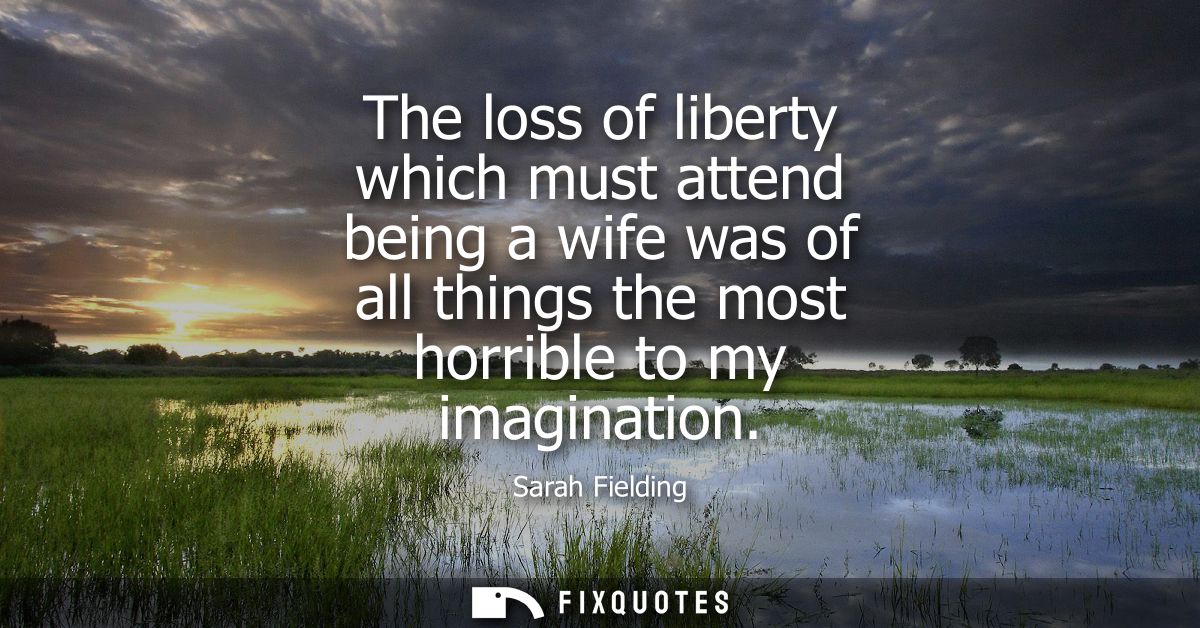
"The loss of liberty which must attend being a wife was of all things, the most horrible to my imagination"
About this Quote
The subtext is an indictment of how 18th-century English society laundered coercion into respectability. Under coverture, a married woman's property and legal identity were effectively absorbed by her husband. Fielding doesn't need to cite statutes; she translates a structural reality into visceral dread. "Attend" is a sly word too, implying a faithful companion: liberty's loss arrives with marriage the way a shadow follows a body. No villain required; the institution itself does the work.
"Horrible to my imagination" reads less like melodrama than an assertion of interior authority. If the law denies full personhood, the imagination becomes the last ungoverned territory. Fielding, a novelist attuned to psychology and moral education, uses that private faculty as a political sensor: her mind recoils because it can already picture the everyday humiliations - curtailed movement, narrowed choices, obligatory deference - that polite society prefers to keep offstage.
It also signals an early feminist realism: not "men are bad", but "the contract is rigged". In one sentence, Fielding turns the domestic ideal into a warning label.
Quote Details
| Topic | Marriage |
|---|---|
| Source | Help us find the source |
| Cite |
Citation Formats
APA Style (7th ed.)
Fielding, Sarah. (2026, February 16). The loss of liberty which must attend being a wife was of all things, the most horrible to my imagination. FixQuotes. https://fixquotes.com/quotes/the-loss-of-liberty-which-must-attend-being-a-119374/
Chicago Style
Fielding, Sarah. "The loss of liberty which must attend being a wife was of all things, the most horrible to my imagination." FixQuotes. February 16, 2026. https://fixquotes.com/quotes/the-loss-of-liberty-which-must-attend-being-a-119374/.
MLA Style (9th ed.)
"The loss of liberty which must attend being a wife was of all things, the most horrible to my imagination." FixQuotes, 16 Feb. 2026, https://fixquotes.com/quotes/the-loss-of-liberty-which-must-attend-being-a-119374/. Accessed 2 Apr. 2026.