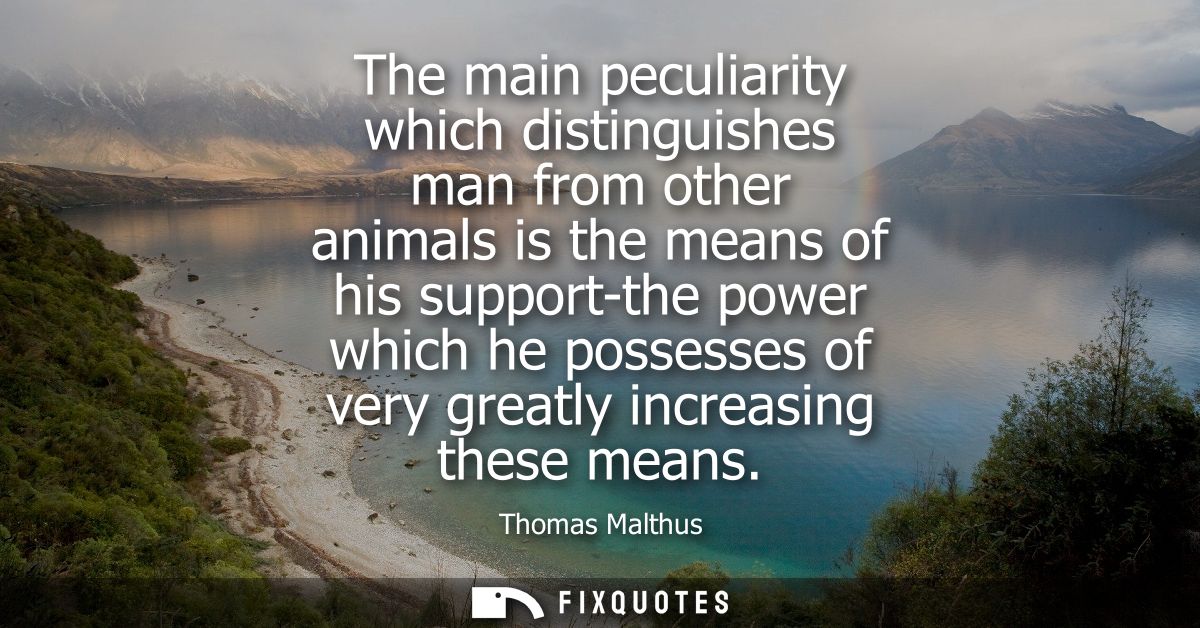
"The main peculiarity, which distinguishes man from other animals, is the means of his support-the power which he possesses of very greatly increasing these means"
About this Quote
The subtext is a warning about feedback loops. Our capacity to expand resources isn’t an escape hatch; it’s an accelerant. Increased support enables population growth, which then consumes the gains and pushes a society back toward scarcity. That’s the Malthusian sting: human ingenuity is real, but it operates inside a system where demand multiplies faster than supply can comfortably keep up. The quote’s clinical tone is part of the rhetoric. By placing “man” alongside “other animals,” he strips away moral exceptionalism and invites the reader to see economic life as ecology.
Context matters: writing at the turn of the 19th century, amid rapid population increases and early industrial change, Malthus was intervening against rosy utopian forecasts (like Godwin and Condorcet) that reason and reform would deliver indefinite improvement. His sentence is engineered to puncture that optimism while sounding like common sense, a polite understatement masking a fairly radical claim: the engine of human progress also manufactures the conditions for human stress.
Quote Details
| Topic | Wisdom |
|---|---|
| Source | Help us find the source |
| Cite |
Citation Formats
APA Style (7th ed.)
Malthus, Thomas. (2026, February 20). The main peculiarity, which distinguishes man from other animals, is the means of his support-the power which he possesses of very greatly increasing these means. FixQuotes. https://fixquotes.com/quotes/the-main-peculiarity-which-distinguishes-man-from-3029/
Chicago Style
Malthus, Thomas. "The main peculiarity, which distinguishes man from other animals, is the means of his support-the power which he possesses of very greatly increasing these means." FixQuotes. February 20, 2026. https://fixquotes.com/quotes/the-main-peculiarity-which-distinguishes-man-from-3029/.
MLA Style (9th ed.)
"The main peculiarity, which distinguishes man from other animals, is the means of his support-the power which he possesses of very greatly increasing these means." FixQuotes, 20 Feb. 2026, https://fixquotes.com/quotes/the-main-peculiarity-which-distinguishes-man-from-3029/. Accessed 30 Mar. 2026.