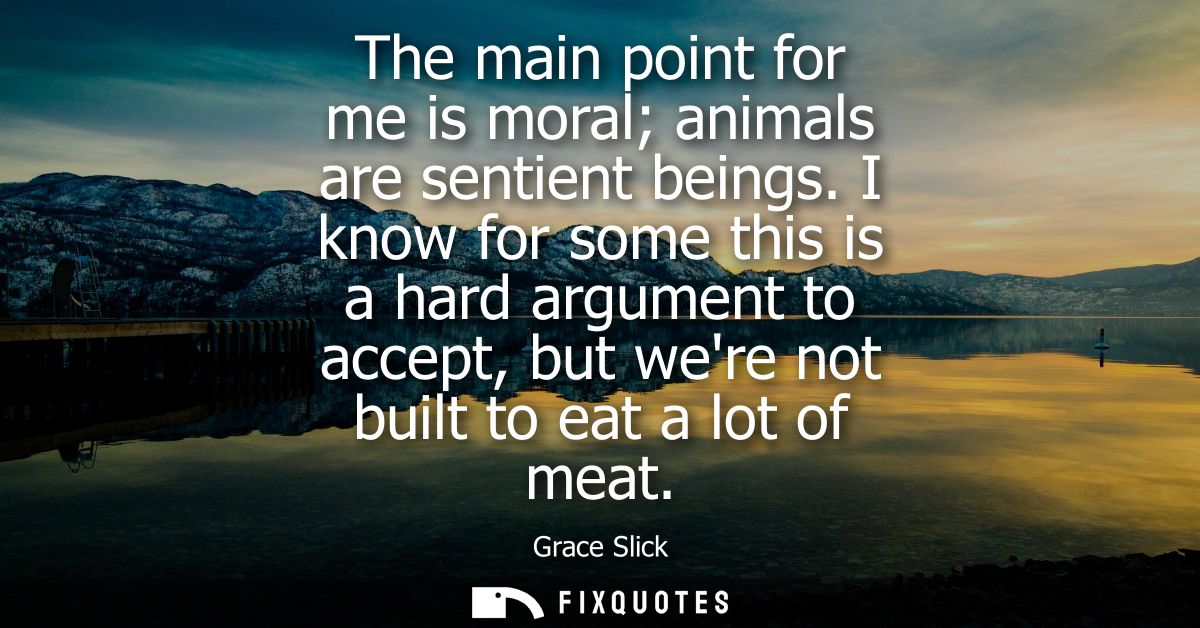
"The main point for me is moral; animals are sentient beings. I know for some this is a hard argument to accept, but we're not built to eat a lot of meat"
About this Quote
Grace Slick’s line lands like a backstage confession that turns into a cultural dare. She starts with “The main point for me is moral,” staking out a blunt, unfashionable certainty in a world that loves to treat food choices as vibes, branding, or personal “journeys.” Then she tightens the screw: “animals are sentient beings.” No mystical language, no crunchy euphemisms. Just a clean ethical premise that forces the listener into a binary: either sentience matters, or it doesn’t.
The next move is craftier than it looks. “I know for some this is a hard argument to accept” acknowledges denial as social fact, not intellectual puzzle. She’s naming the psychological cost of empathy: if you admit the animal has an inner life, dinner stops being background noise. That little concession also keeps her from sounding like a scold. It’s an invitation with teeth.
Then she pivots from ethics to biology: “we’re not built to eat a lot of meat.” That’s the strategic subtext. She’s not just arguing that meat is wrong; she’s saying it’s unnatural - a word that, in American culture, carries the authority of common sense even when the science is contested. Coming from a counterculture icon, it reads as a 1960s-style critique of industrial modernity: factory farming as both moral failure and bodily sabotage.
Slick’s intent isn’t to win a debate; it’s to collapse the comfortable separation between what we feel and what we consume. The power is in the double bind: compassion is framed as rational, and appetite as something we’ve been trained into.
The next move is craftier than it looks. “I know for some this is a hard argument to accept” acknowledges denial as social fact, not intellectual puzzle. She’s naming the psychological cost of empathy: if you admit the animal has an inner life, dinner stops being background noise. That little concession also keeps her from sounding like a scold. It’s an invitation with teeth.
Then she pivots from ethics to biology: “we’re not built to eat a lot of meat.” That’s the strategic subtext. She’s not just arguing that meat is wrong; she’s saying it’s unnatural - a word that, in American culture, carries the authority of common sense even when the science is contested. Coming from a counterculture icon, it reads as a 1960s-style critique of industrial modernity: factory farming as both moral failure and bodily sabotage.
Slick’s intent isn’t to win a debate; it’s to collapse the comfortable separation between what we feel and what we consume. The power is in the double bind: compassion is framed as rational, and appetite as something we’ve been trained into.
Quote Details
| Topic | Ethics & Morality |
|---|
More Quotes by Grace
Add to List