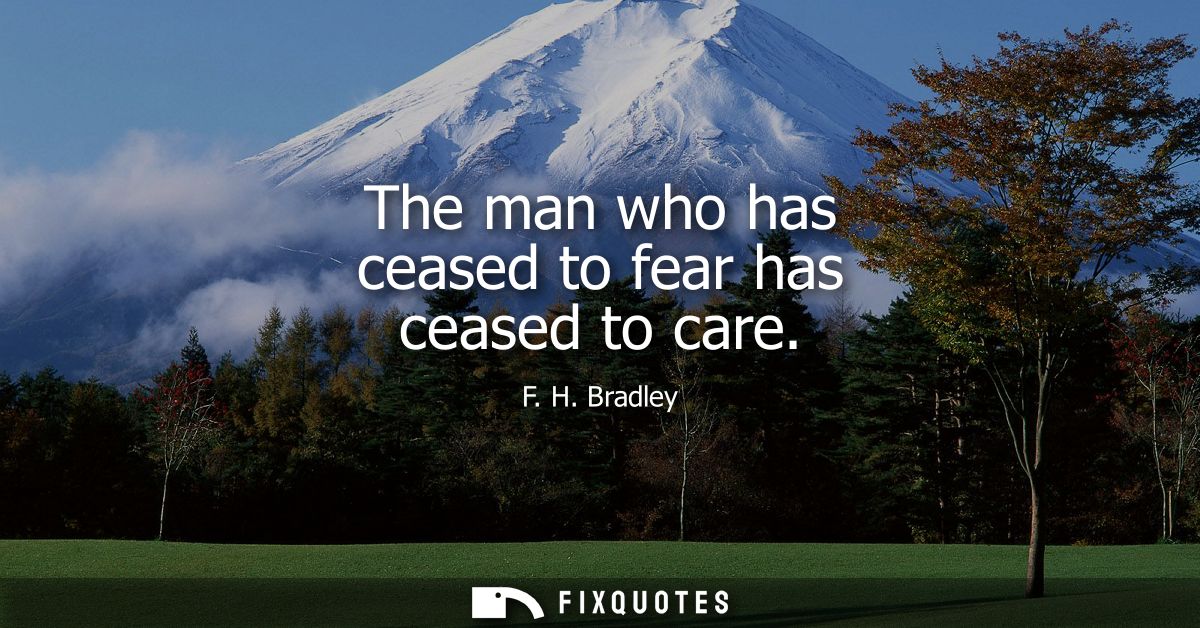
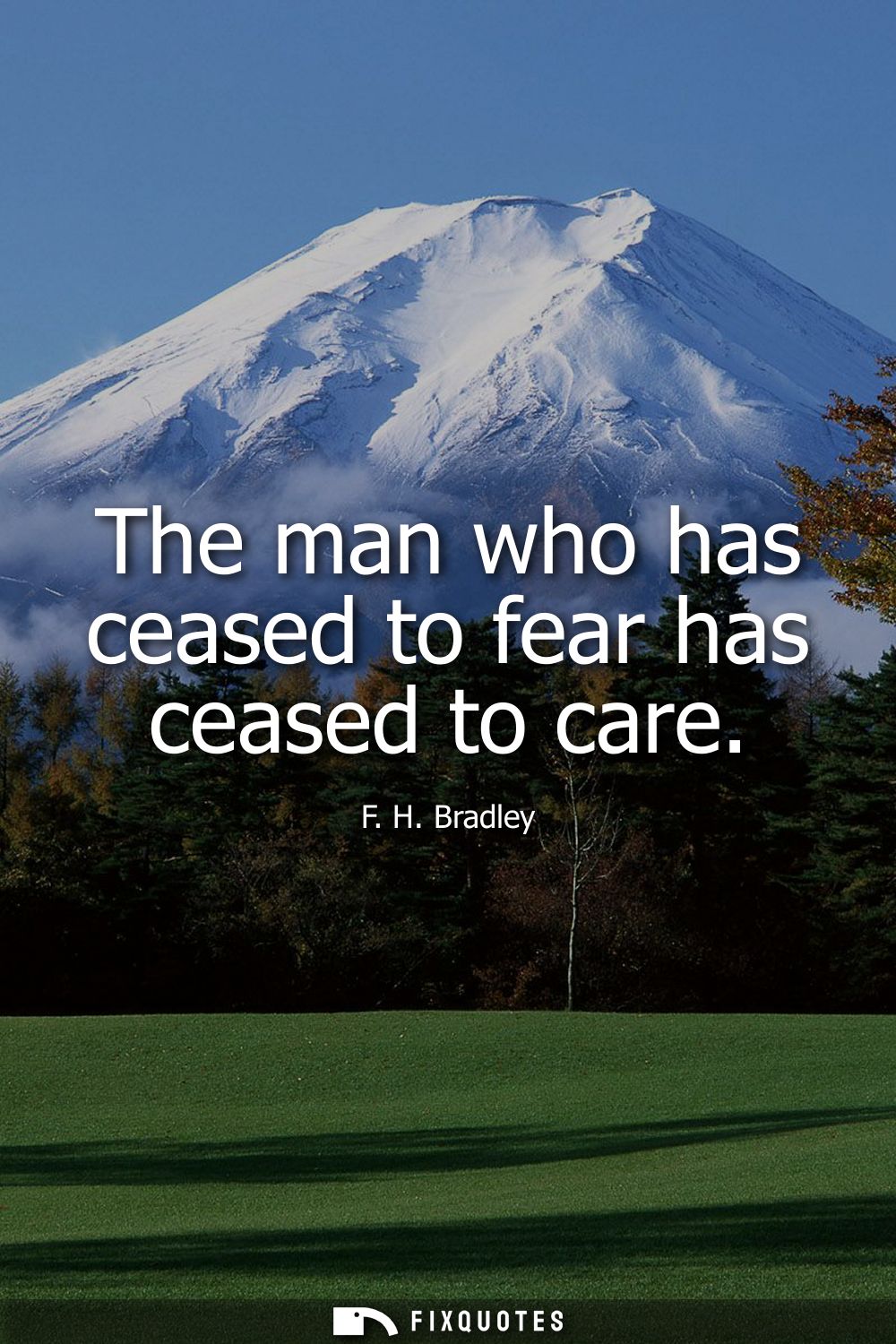
"The man who has ceased to fear has ceased to care"
About this Quote
Bradley’s line is a cold diagnosis masquerading as a moral warning: fear isn’t just a private weakness, it’s the last evidence that you still have stakes in the world. The sentence pivots on “ceased” twice, like a door locking. Fear doesn’t fade into wisdom; it curdles into indifference. In that sense, Bradley isn’t praising bravery. He’s suspicious of the person who claims to be beyond fear, because “nothing can touch me” often means “nothing matters to me.”
The subtext lands hardest in the Victorian and late-19th-century context Bradley inhabited, where philosophy was busy auditing the self: what counts as real, what counts as moral, what counts as a person at all. As a British Idealist, Bradley treated the individual ego as shaky and partial; emotions become clues about our entanglement with others. Fear, here, isn’t merely panic. It’s the pressure of consequence: the awareness that actions ripple outward, that you can lose something, damage someone, be judged, fail.
The intent is almost prosecutorial. Bradley turns a celebrated modern pose - cool detachment, the “unbothered” personality - into a kind of ethical vacancy. Caring requires vulnerability; vulnerability creates fear. Remove fear entirely and you don’t get enlightenment, you get anesthesia. Read that way, the quote is less about courage than about the emotional cost of pretending to be invincible: if you insist you’re beyond fear, you may have already resigned from belonging.
The subtext lands hardest in the Victorian and late-19th-century context Bradley inhabited, where philosophy was busy auditing the self: what counts as real, what counts as moral, what counts as a person at all. As a British Idealist, Bradley treated the individual ego as shaky and partial; emotions become clues about our entanglement with others. Fear, here, isn’t merely panic. It’s the pressure of consequence: the awareness that actions ripple outward, that you can lose something, damage someone, be judged, fail.
The intent is almost prosecutorial. Bradley turns a celebrated modern pose - cool detachment, the “unbothered” personality - into a kind of ethical vacancy. Caring requires vulnerability; vulnerability creates fear. Remove fear entirely and you don’t get enlightenment, you get anesthesia. Read that way, the quote is less about courage than about the emotional cost of pretending to be invincible: if you insist you’re beyond fear, you may have already resigned from belonging.
Quote Details
| Topic | Wisdom |
|---|---|
| Source | Help us find the source |
| Cite |
Citation Formats
APA Style (7th ed.)
Bradley, F. H. (2026, January 18). The man who has ceased to fear has ceased to care. FixQuotes. https://fixquotes.com/quotes/the-man-who-has-ceased-to-fear-has-ceased-to-care-15339/
Chicago Style
Bradley, F. H. "The man who has ceased to fear has ceased to care." FixQuotes. January 18, 2026. https://fixquotes.com/quotes/the-man-who-has-ceased-to-fear-has-ceased-to-care-15339/.
MLA Style (9th ed.)
"The man who has ceased to fear has ceased to care." FixQuotes, 18 Jan. 2026, https://fixquotes.com/quotes/the-man-who-has-ceased-to-fear-has-ceased-to-care-15339/. Accessed 7 Mar. 2026.
More Quotes by H. Bradley
Add to List