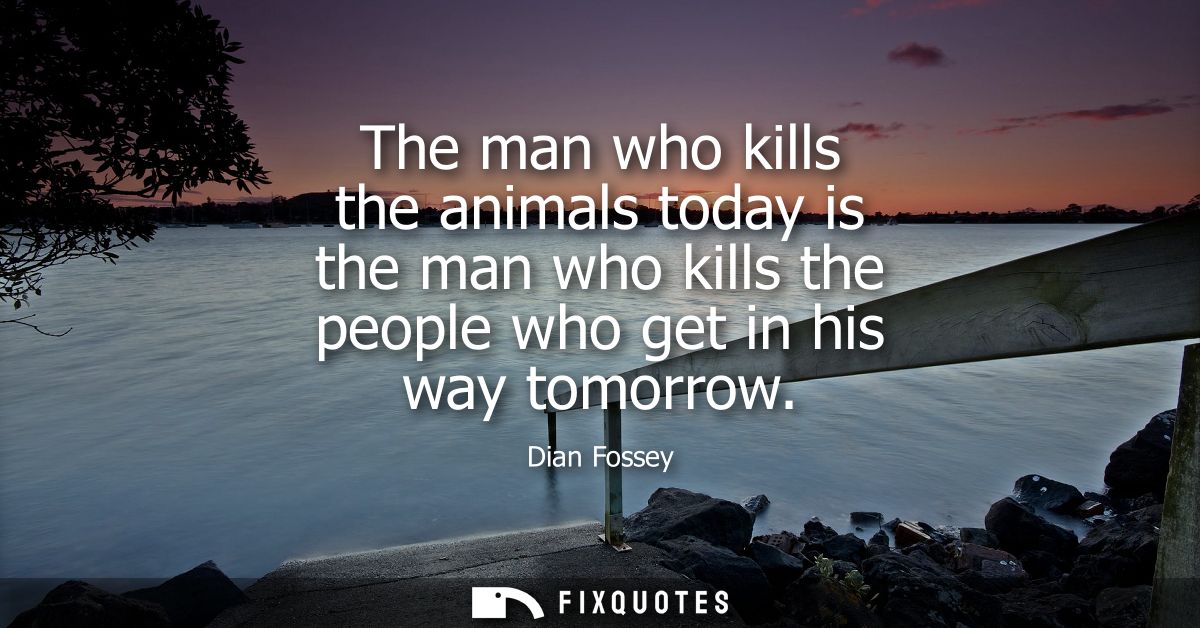
"The man who kills the animals today is the man who kills the people who get in his way tomorrow"
About this Quote
The subtext is strategic. Fossey is arguing for moral continuity at a time when conservation was often dismissed as an elite luxury project, something to care about only after “real” political problems are solved. She flips that hierarchy: violence against animals is not separate from social order; it’s one of its early warning signs. The phrase “get in his way” is doing heavy lifting, shifting the focus from hunger or tradition to power. This isn’t subsistence hunting; it’s the logic of domination, where inconvenience justifies cruelty.
Context matters because Fossey wasn’t theorizing from a distance. Working with mountain gorillas in Rwanda, she confronted organized poaching networks tied to local economies, corruption, and intimidation. Her activism made enemies, and she was killed in 1985. Read alongside her life, the quote doubles as a self-indicting prophecy: protectors become targets when profit depends on fear. Fossey’s intent is to make conservation sound like public safety, because in her world, it was.
Quote Details
| Topic | Ethics & Morality |
|---|---|
| Source | Help us find the source |
| Cite |
Citation Formats
APA Style (7th ed.)
Fossey, Dian. (2026, January 16). The man who kills the animals today is the man who kills the people who get in his way tomorrow. FixQuotes. https://fixquotes.com/quotes/the-man-who-kills-the-animals-today-is-the-man-111292/
Chicago Style
Fossey, Dian. "The man who kills the animals today is the man who kills the people who get in his way tomorrow." FixQuotes. January 16, 2026. https://fixquotes.com/quotes/the-man-who-kills-the-animals-today-is-the-man-111292/.
MLA Style (9th ed.)
"The man who kills the animals today is the man who kills the people who get in his way tomorrow." FixQuotes, 16 Jan. 2026, https://fixquotes.com/quotes/the-man-who-kills-the-animals-today-is-the-man-111292/. Accessed 18 Mar. 2026.