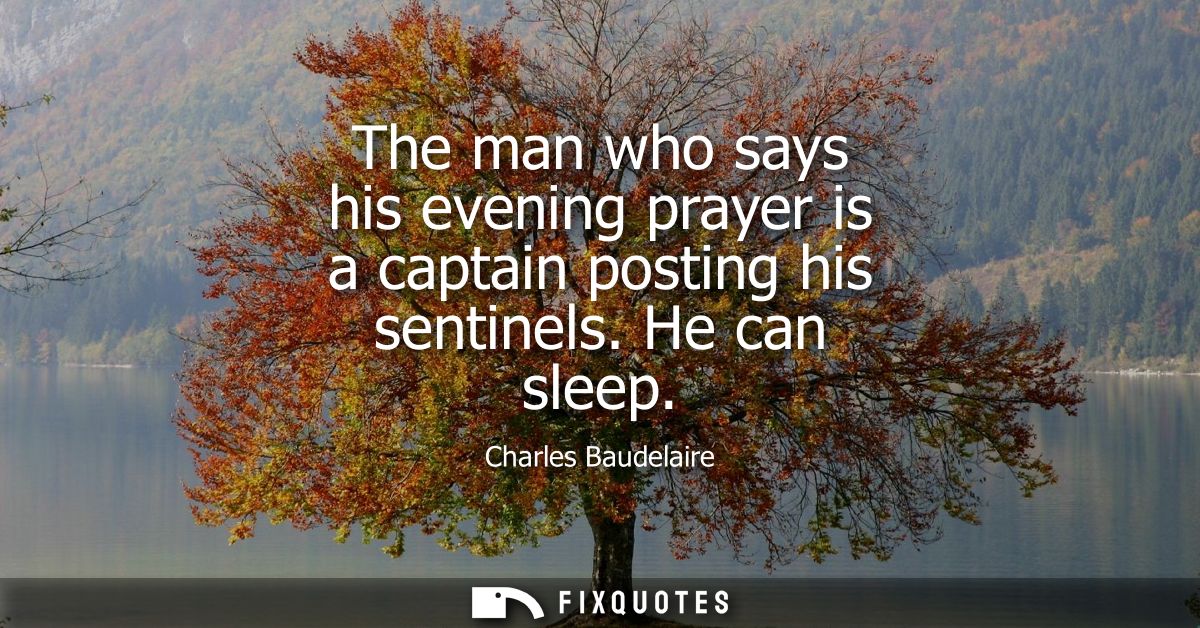
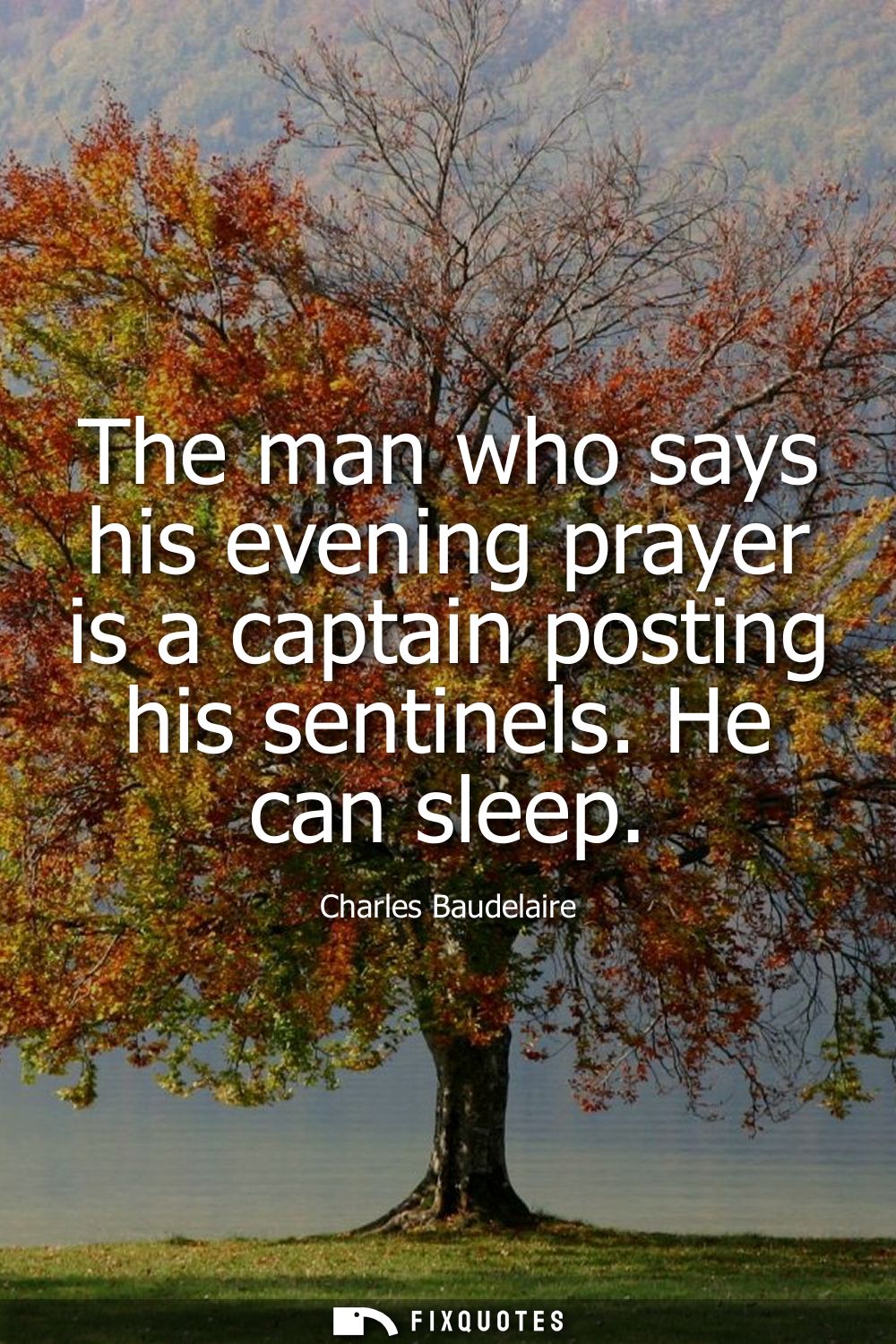
"The man who says his evening prayer is a captain posting his sentinels. He can sleep"
About this Quote
The subtext is anxiety: the night is when cravings, guilt, and intrusive thoughts stage their coup. Baudelaire, the poet of modern restlessness and self-division, knows that consciousness doesn’t power off; it prowls. Prayer functions less as communion with God than as a technology of reassurance, a ritual that externalizes vigilance. You post guards so you don’t have to be the guard. The “He can sleep” lands with dry finality, like a report filed.
Context matters: Baudelaire writes in a 19th-century Paris where Catholic practice is both cultural furniture and contested authority, where modernity is accelerating and inner life is getting louder. He’s also a poet fascinated by the machinery of sin and self-surveillance. This metaphor smuggles in a bleak tenderness: whatever you believe, you need something that can stand watch over you. Not transcendence, exactly - a night shift for the soul.
Quote Details
| Topic | Prayer |
|---|---|
| Source | Help us find the source |
| Cite |
Citation Formats
APA Style (7th ed.)
Baudelaire, Charles. (2026, January 17). The man who says his evening prayer is a captain posting his sentinels. He can sleep. FixQuotes. https://fixquotes.com/quotes/the-man-who-says-his-evening-prayer-is-a-captain-40580/
Chicago Style
Baudelaire, Charles. "The man who says his evening prayer is a captain posting his sentinels. He can sleep." FixQuotes. January 17, 2026. https://fixquotes.com/quotes/the-man-who-says-his-evening-prayer-is-a-captain-40580/.
MLA Style (9th ed.)
"The man who says his evening prayer is a captain posting his sentinels. He can sleep." FixQuotes, 17 Jan. 2026, https://fixquotes.com/quotes/the-man-who-says-his-evening-prayer-is-a-captain-40580/. Accessed 11 Mar. 2026.