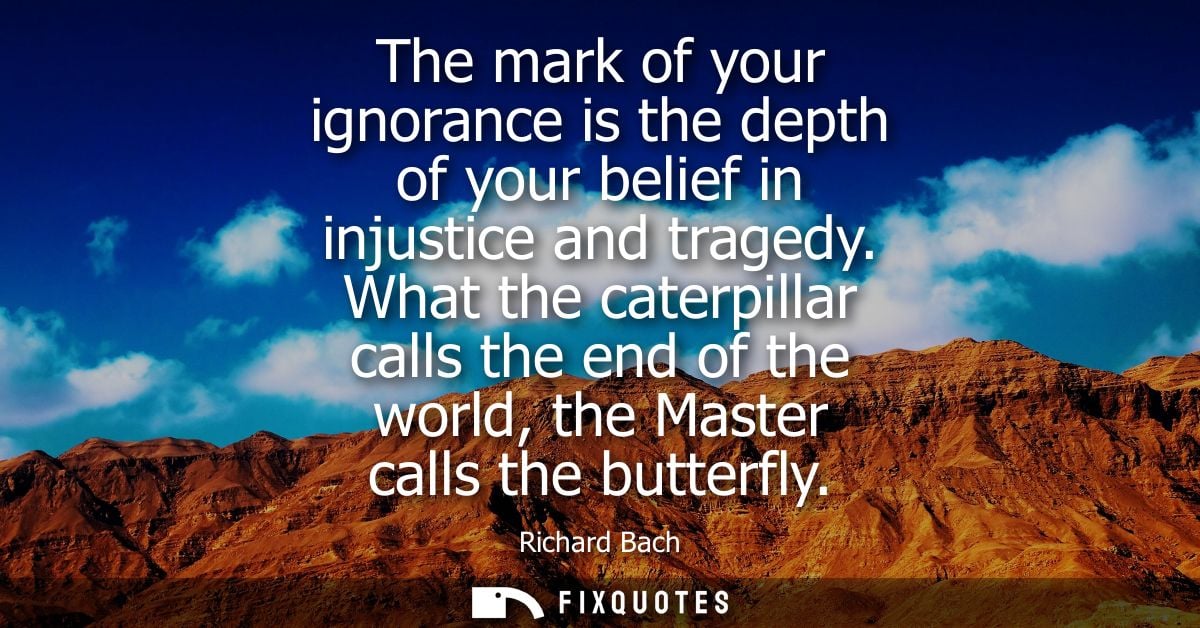
"The mark of your ignorance is the depth of your belief in injustice and tragedy. What the caterpillar calls the end of the world, the Master calls the butterfly"
About this Quote
The caterpillar/butterfly turn is doing heavy lifting because it reframes perspective as scale and maturity, not mere optimism. "End of the world" isn't mocked; it's honored as an honest perception from a creature whose body has not yet learned what transformation costs. The "Master" is the rhetorical lever: an authority figure who sees continuity where the caterpillar sees collapse. Bach's subtext flirts with spiritual hierarchy (teacher vs. novice, enlightened vs. asleep), implying that what we call disaster can be a phase change in disguise. That can feel liberating or, in harsher readings, a little impatient with structural harm - as if injustice is best met with mindset upgrades.
Context matters: Bach's work (especially the 1970s-era Jonathan Livingston Seagull) is steeped in self-actualization, parable, and airy metaphysics, arriving in a culture hungry for personal transcendence amid political disillusionment. The quote's intent is less to deny tragedy than to deprive it of total authority. It works because it makes belief itself the battleground: not whether pain exists, but whether we let it define the horizon.
Quote Details
| Topic | Embrace Change |
|---|---|
| Source | Verified source: Illusions: The Adventures of a Reluctant Messiah (Richard Bach, 1977)
Evidence: The mark of your ignorance is the depth of your belief in injustice And tragedy. What the caterpillar calls the end of the world, the master calls a butterfly. (Page 19 (page numbering varies by edition)). This quote appears in Richard Bach’s novel 'Illusions: The Adventures of a Reluctant Messiah' (first published 1977) as one of the aphorisms from the (fictional) 'Messiah’s Handbook' that is printed within the novel. A web-reproduced scan/transcription shows it on a page labeled '19', immediately followed by narrative text (“The words in the Handbook the day before were the only warning I had...”). Note: different editions/reprints can have different pagination; Wikipedia also notes that 'Messiah’s Handbook' inside the novel is presented without page numbers in-universe, which contributes to inconsistent page attributions across editions. The earliest attributable primary-source appearance located is within the 1977 book, and the common alternate attribution to Lao Tzu appears to be a later misattribution/variant. Other candidates (1) Alchemy of the Heart (Elizabeth Clare Prophet, Patricia R. ..., 2000) compilation97.9% ... The mark of your ignorance is the depth of your belief in injustice and tragedy . What the caterpillar calls the ... |
| Cite |
Citation Formats
APA Style (7th ed.)
Bach, Richard. (2026, February 9). The mark of your ignorance is the depth of your belief in injustice and tragedy. What the caterpillar calls the end of the world, the Master calls the butterfly. FixQuotes. https://fixquotes.com/quotes/the-mark-of-your-ignorance-is-the-depth-of-your-9939/
Chicago Style
Bach, Richard. "The mark of your ignorance is the depth of your belief in injustice and tragedy. What the caterpillar calls the end of the world, the Master calls the butterfly." FixQuotes. February 9, 2026. https://fixquotes.com/quotes/the-mark-of-your-ignorance-is-the-depth-of-your-9939/.
MLA Style (9th ed.)
"The mark of your ignorance is the depth of your belief in injustice and tragedy. What the caterpillar calls the end of the world, the Master calls the butterfly." FixQuotes, 9 Feb. 2026, https://fixquotes.com/quotes/the-mark-of-your-ignorance-is-the-depth-of-your-9939/. Accessed 29 Mar. 2026.