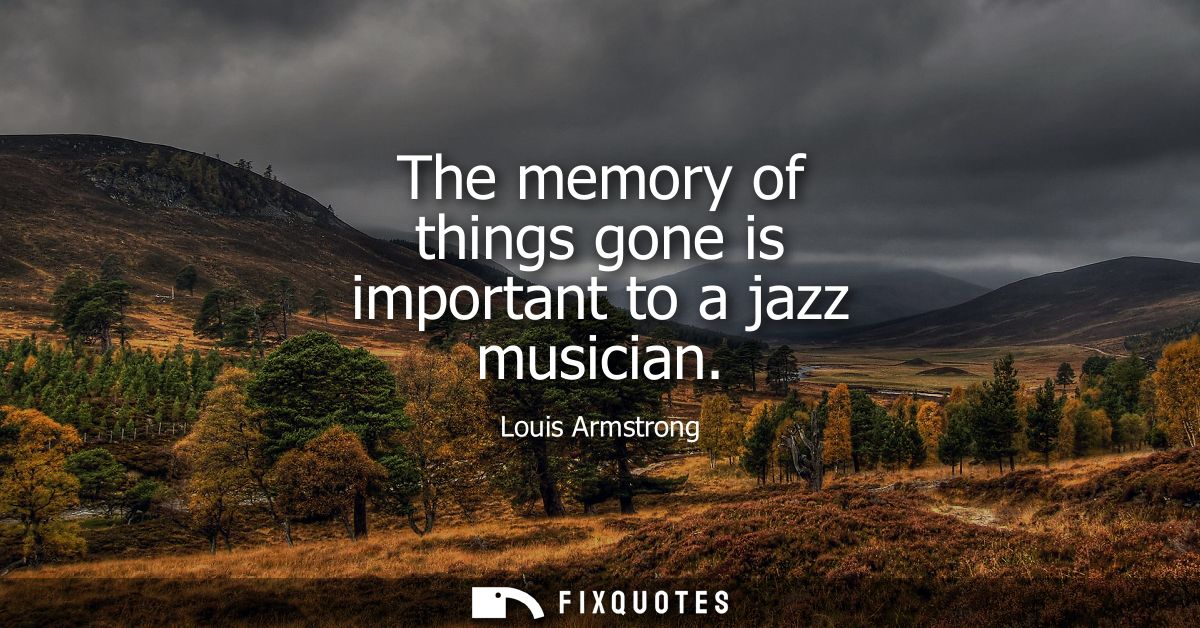
"The memory of things gone is important to a jazz musician"
About this Quote
For Louis Armstrong, “the memory of things gone” isn’t nostalgia as a hobby; it’s the raw material of swing. Jazz is built on a paradox: it’s made in the moment, but it only makes sense because the musician is carrying a whole archive of moments that already happened - melodies heard on stoops, bandstand disasters, gospel cadences, vaudeville jokes, the feel of a parade rhythm in the street. Armstrong is pointing to that invisible luggage. Improvisation sounds like freedom, but it’s really memory doing gymnastics at speed.
The intent is practical and almost pedagogical. Armstrong is reminding players that originality doesn’t come from pretending the past didn’t happen; it comes from metabolizing it. The subtext is also a quiet argument against the myth of the lone genius. Jazz musicians inherit a language - blues inflections, call-and-response, the “wrong” notes that become right through feel - and the job is to speak it with your own accent. Memory is what keeps the music from turning into empty virtuosity.
Context matters: Armstrong came out of New Orleans, a city where musical tradition wasn’t stored in conservatories but in neighborhoods, funerals, dance halls, and recordings passed hand to hand. In a Black American art form shaped by displacement and erasure, remembering is more than technique; it’s continuity. His line suggests that jazz isn’t just sound. It’s time travel with a horn, turning what’s “gone” into something that still breathes.
The intent is practical and almost pedagogical. Armstrong is reminding players that originality doesn’t come from pretending the past didn’t happen; it comes from metabolizing it. The subtext is also a quiet argument against the myth of the lone genius. Jazz musicians inherit a language - blues inflections, call-and-response, the “wrong” notes that become right through feel - and the job is to speak it with your own accent. Memory is what keeps the music from turning into empty virtuosity.
Context matters: Armstrong came out of New Orleans, a city where musical tradition wasn’t stored in conservatories but in neighborhoods, funerals, dance halls, and recordings passed hand to hand. In a Black American art form shaped by displacement and erasure, remembering is more than technique; it’s continuity. His line suggests that jazz isn’t just sound. It’s time travel with a horn, turning what’s “gone” into something that still breathes.
Quote Details
| Topic | Music |
|---|---|
| Source | Help us find the source |
| Cite |
Citation Formats
APA Style (7th ed.)
Armstrong, Louis. (2026, January 16). The memory of things gone is important to a jazz musician. FixQuotes. https://fixquotes.com/quotes/the-memory-of-things-gone-is-important-to-a-jazz-87345/
Chicago Style
Armstrong, Louis. "The memory of things gone is important to a jazz musician." FixQuotes. January 16, 2026. https://fixquotes.com/quotes/the-memory-of-things-gone-is-important-to-a-jazz-87345/.
MLA Style (9th ed.)
"The memory of things gone is important to a jazz musician." FixQuotes, 16 Jan. 2026, https://fixquotes.com/quotes/the-memory-of-things-gone-is-important-to-a-jazz-87345/. Accessed 26 Mar. 2026.
More Quotes by Louis
Add to List