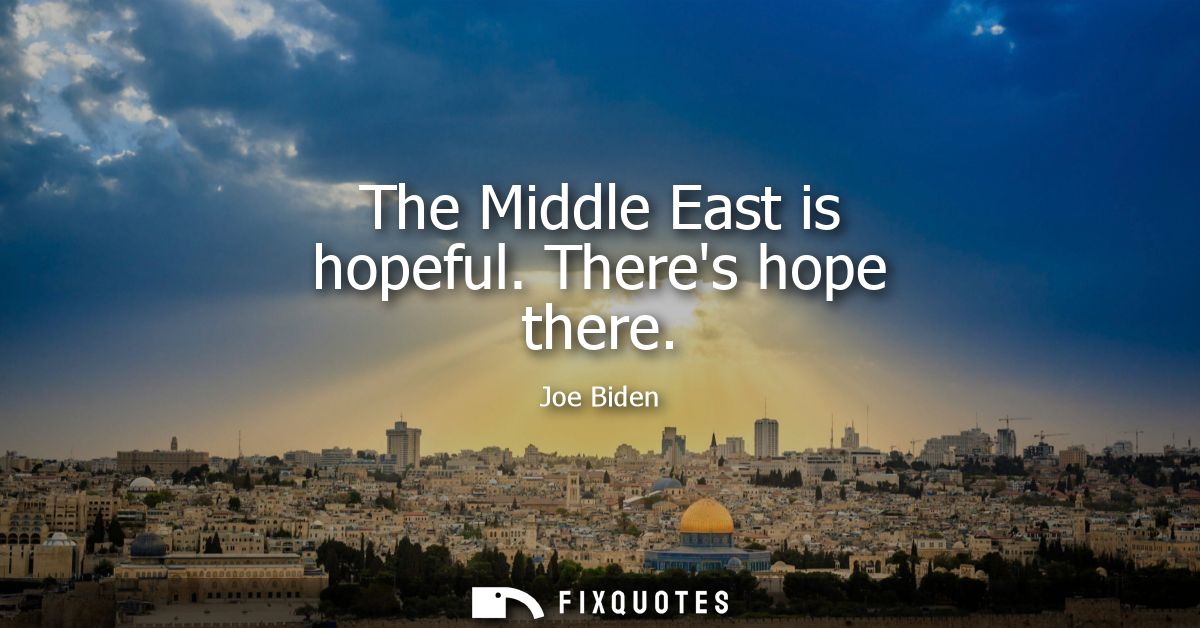
"The Middle East is hopeful. There's hope there"
About this Quote
Calling the Middle East "hopeful" is less a description than a strategic incantation: a senior American official trying to speak possibility into a region the U.S. political class has long framed as an endless emergency. As vice president, Biden isn’t freelancing; he’s doing the work of reassurance - to allies who need signs of U.S. steadiness, to domestic audiences tired of war, and to a foreign policy establishment that periodically needs permission to believe its own projects can end in something other than blowback.
The line is conspicuously spare, almost childlike. That’s the point. “Hope” is a soft-power keyword, a way to gesture toward political openings without naming the landmines: stalled peace processes, authoritarian retrenchment, proxy conflicts, the limits of American leverage. By refusing specifics, the quote stays flexible. It can attach itself to an election, a negotiation, a fragile ceasefire, a youth movement - whatever the news cycle demands. In diplomacy, vagueness can be a tool, not a flaw.
There’s subtext, too: expectation management. If the Middle East is “hopeful,” then engagement isn’t naive; it’s responsible. It subtly repositions U.S. policy from firefighter to partner, even if the record suggests the U.S. often plays both. The repetition - “hopeful… hope” - functions like a microphone check, testing whether optimism can still be heard over the static of prior interventions.
The line is conspicuously spare, almost childlike. That’s the point. “Hope” is a soft-power keyword, a way to gesture toward political openings without naming the landmines: stalled peace processes, authoritarian retrenchment, proxy conflicts, the limits of American leverage. By refusing specifics, the quote stays flexible. It can attach itself to an election, a negotiation, a fragile ceasefire, a youth movement - whatever the news cycle demands. In diplomacy, vagueness can be a tool, not a flaw.
There’s subtext, too: expectation management. If the Middle East is “hopeful,” then engagement isn’t naive; it’s responsible. It subtly repositions U.S. policy from firefighter to partner, even if the record suggests the U.S. often plays both. The repetition - “hopeful… hope” - functions like a microphone check, testing whether optimism can still be heard over the static of prior interventions.
Quote Details
| Topic | Hope |
|---|---|
| Source | Help us find the source |
| Featured | This quote was our Quote of the Day on August 7, 2023 |
| Cite |
Citation Formats
APA Style (7th ed.)
Biden, Joe. (2026, January 11). The Middle East is hopeful. There's hope there. FixQuotes. https://fixquotes.com/quotes/the-middle-east-is-hopeful-theres-hope-there-20392/
Chicago Style
Biden, Joe. "The Middle East is hopeful. There's hope there." FixQuotes. January 11, 2026. https://fixquotes.com/quotes/the-middle-east-is-hopeful-theres-hope-there-20392/.
MLA Style (9th ed.)
"The Middle East is hopeful. There's hope there." FixQuotes, 11 Jan. 2026, https://fixquotes.com/quotes/the-middle-east-is-hopeful-theres-hope-there-20392/. Accessed 1 Apr. 2026.
More Quotes by Joe
Add to List