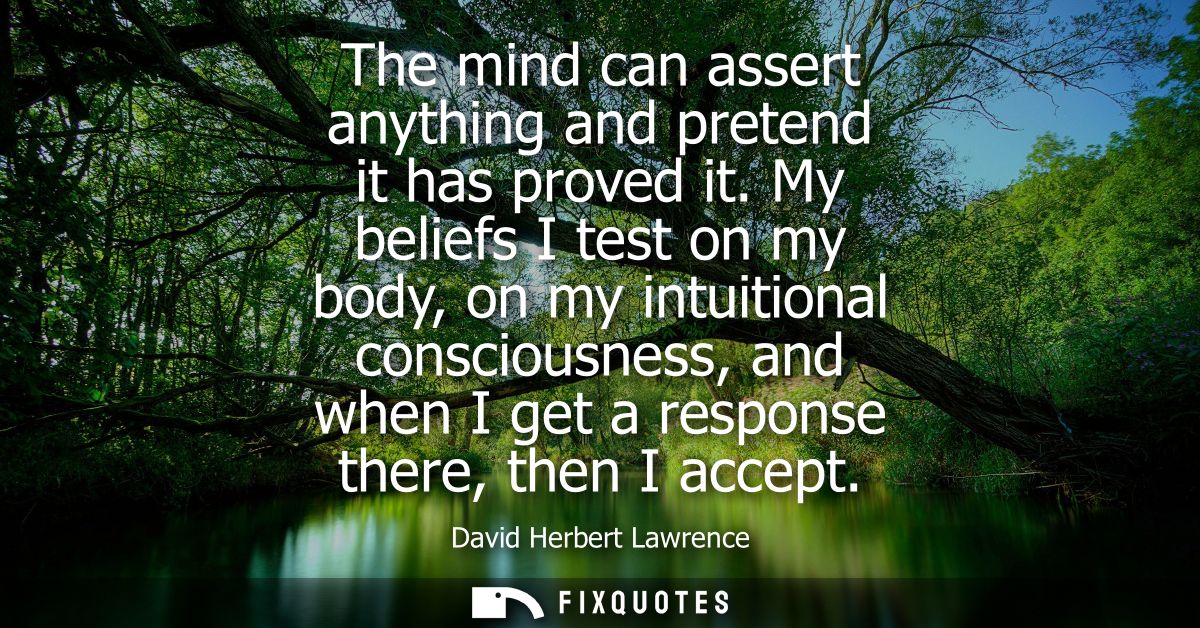
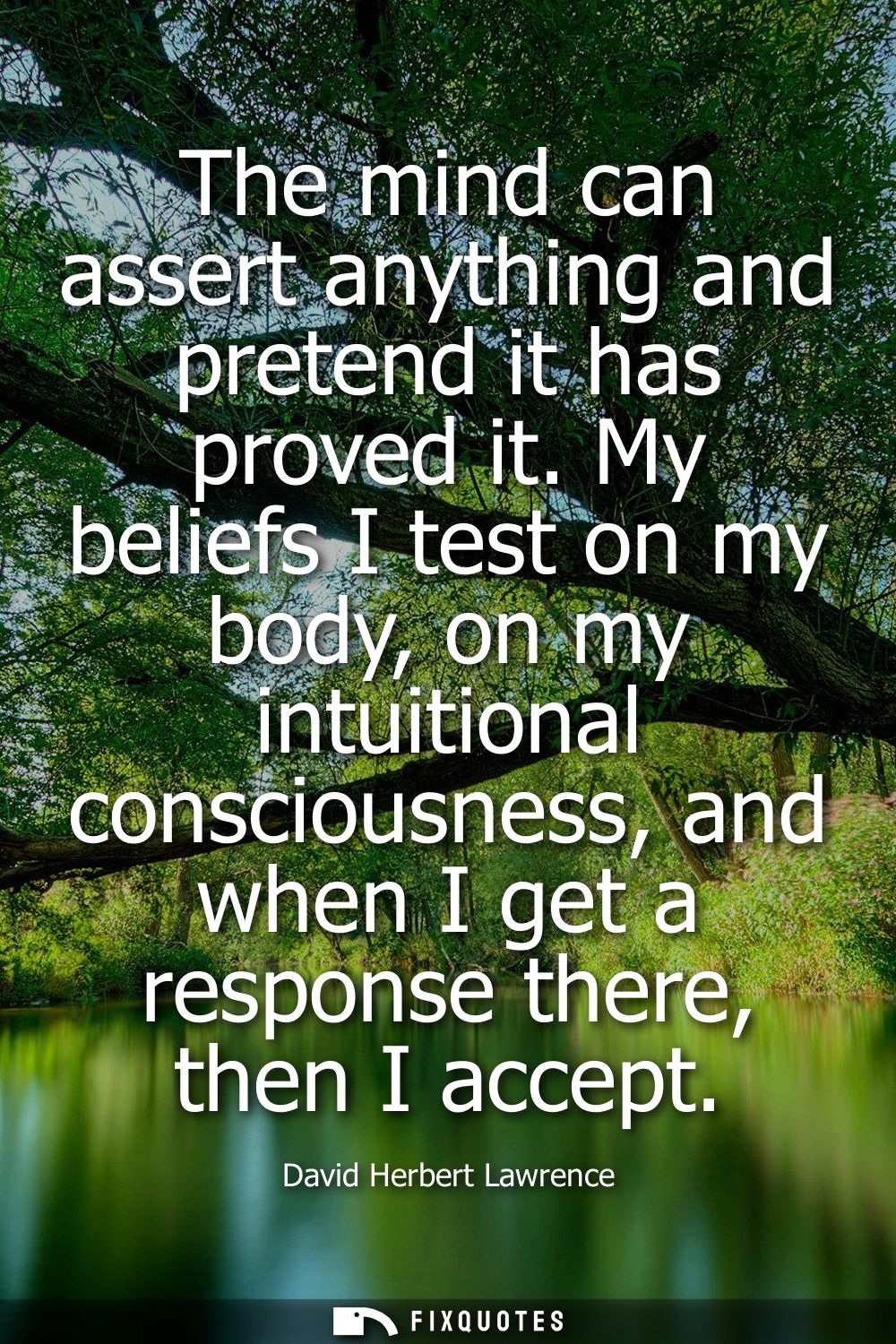
"The mind can assert anything and pretend it has proved it. My beliefs I test on my body, on my intuitional consciousness, and when I get a response there, then I accept"
About this Quote
Then he pivots to his alternative tribunal: “my body” and “intuitional consciousness.” That’s not anti-thinking so much as anti-disembodiment. Lawrence is insisting that belief isn’t a purely verbal contract you sign with yourself; it’s something your nervous system has to consent to. “Response” is the key word. He wants ideas to register as lived reality - felt, resisted, affirmed - rather than merely “held.” It’s a standard designed to block the mind’s talent for self-deception.
The context matters. Writing in the early 20th century, Lawrence is reacting against industrial modernity, mechanized life, and a culture that prizes rational mastery while flattening instinct, sexuality, and feeling into problems to be managed. His fiction and essays repeatedly argue that over-intellectualization produces a kind of spiritual anemia. The subtext is a warning: if you let the mind run unchecked, it will build elegant prisons and call them philosophies. Lawrence’s provocation is to treat the body as an epistemology - a lie detector for what we claim to believe.
Quote Details
| Topic | Truth |
|---|---|
| Source | Help us find the source |
| Cite |
Citation Formats
APA Style (7th ed.)
Lawrence, David Herbert. (2026, January 18). The mind can assert anything and pretend it has proved it. My beliefs I test on my body, on my intuitional consciousness, and when I get a response there, then I accept. FixQuotes. https://fixquotes.com/quotes/the-mind-can-assert-anything-and-pretend-it-has-12418/
Chicago Style
Lawrence, David Herbert. "The mind can assert anything and pretend it has proved it. My beliefs I test on my body, on my intuitional consciousness, and when I get a response there, then I accept." FixQuotes. January 18, 2026. https://fixquotes.com/quotes/the-mind-can-assert-anything-and-pretend-it-has-12418/.
MLA Style (9th ed.)
"The mind can assert anything and pretend it has proved it. My beliefs I test on my body, on my intuitional consciousness, and when I get a response there, then I accept." FixQuotes, 18 Jan. 2026, https://fixquotes.com/quotes/the-mind-can-assert-anything-and-pretend-it-has-12418/. Accessed 12 Feb. 2026.