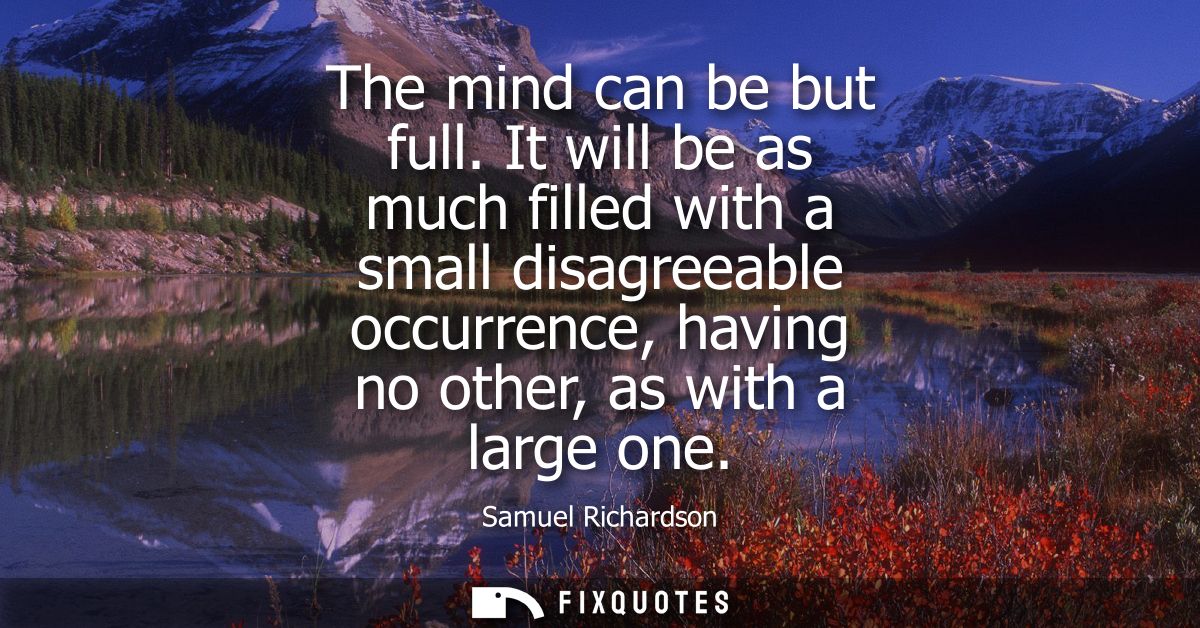
"The mind can be but full. It will be as much filled with a small disagreeable occurrence, having no other, as with a large one"
About this Quote
The subtext is quietly corrective. Richardson isn’t telling you to “get over it”; he’s warning you how easily your psyche can be hijacked by trivia when you lack competing claims on your attention. That’s why the comparison lands: a “small disagreeable occurrence” can produce the same mental saturation as a “large one,” not because they’re equal in consequence, but because the mind, left under-stimulated, treats irritation as stimulus. The sentence has the sting of recognition: you’ve been miserable all afternoon over an email because the day gave you nothing bigger to hold.
Contextually, this is classic Richardson, the novelist of minute feelings and moral weather. His fiction tracks how tiny social slights, delayed letters, and half-read intentions metastasize into full-blown crises. In an 18th-century world where reputation and propriety could hinge on small encounters, the remark doubles as social commentary: when a life is tightly regulated, “small” events aren’t small at all.
Quote Details
| Topic | Wisdom |
|---|---|
| Source | Help us find the source |
| Cite |
Citation Formats
APA Style (7th ed.)
Richardson, Samuel. (2026, January 17). The mind can be but full. It will be as much filled with a small disagreeable occurrence, having no other, as with a large one. FixQuotes. https://fixquotes.com/quotes/the-mind-can-be-but-full-it-will-be-as-much-36557/
Chicago Style
Richardson, Samuel. "The mind can be but full. It will be as much filled with a small disagreeable occurrence, having no other, as with a large one." FixQuotes. January 17, 2026. https://fixquotes.com/quotes/the-mind-can-be-but-full-it-will-be-as-much-36557/.
MLA Style (9th ed.)
"The mind can be but full. It will be as much filled with a small disagreeable occurrence, having no other, as with a large one." FixQuotes, 17 Jan. 2026, https://fixquotes.com/quotes/the-mind-can-be-but-full-it-will-be-as-much-36557/. Accessed 9 Mar. 2026.