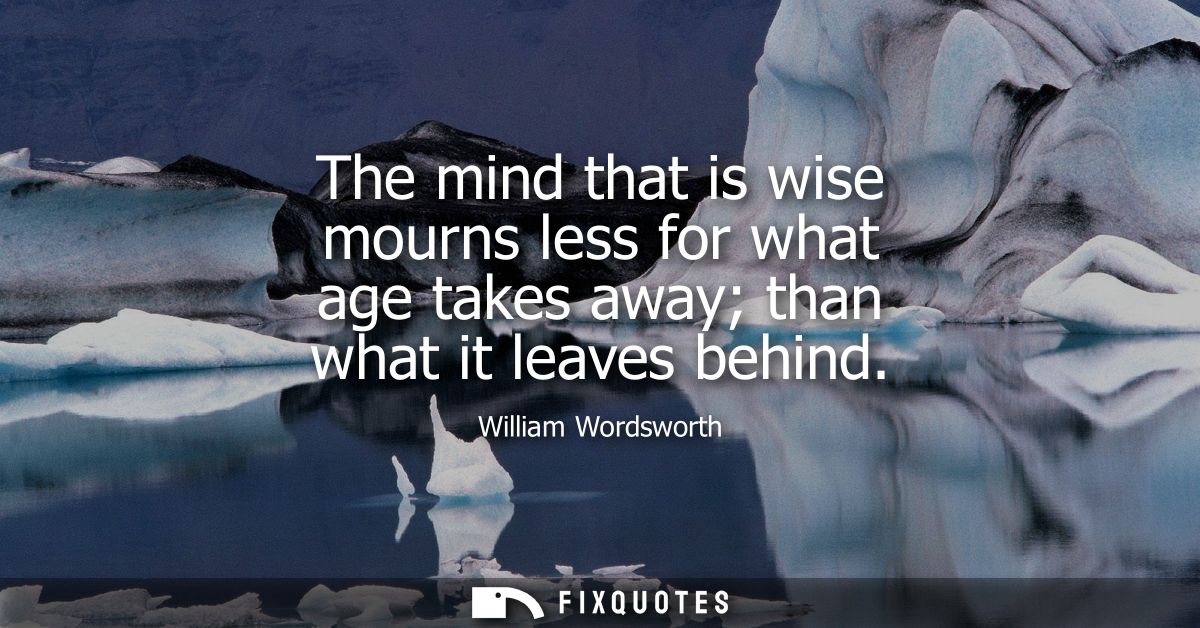
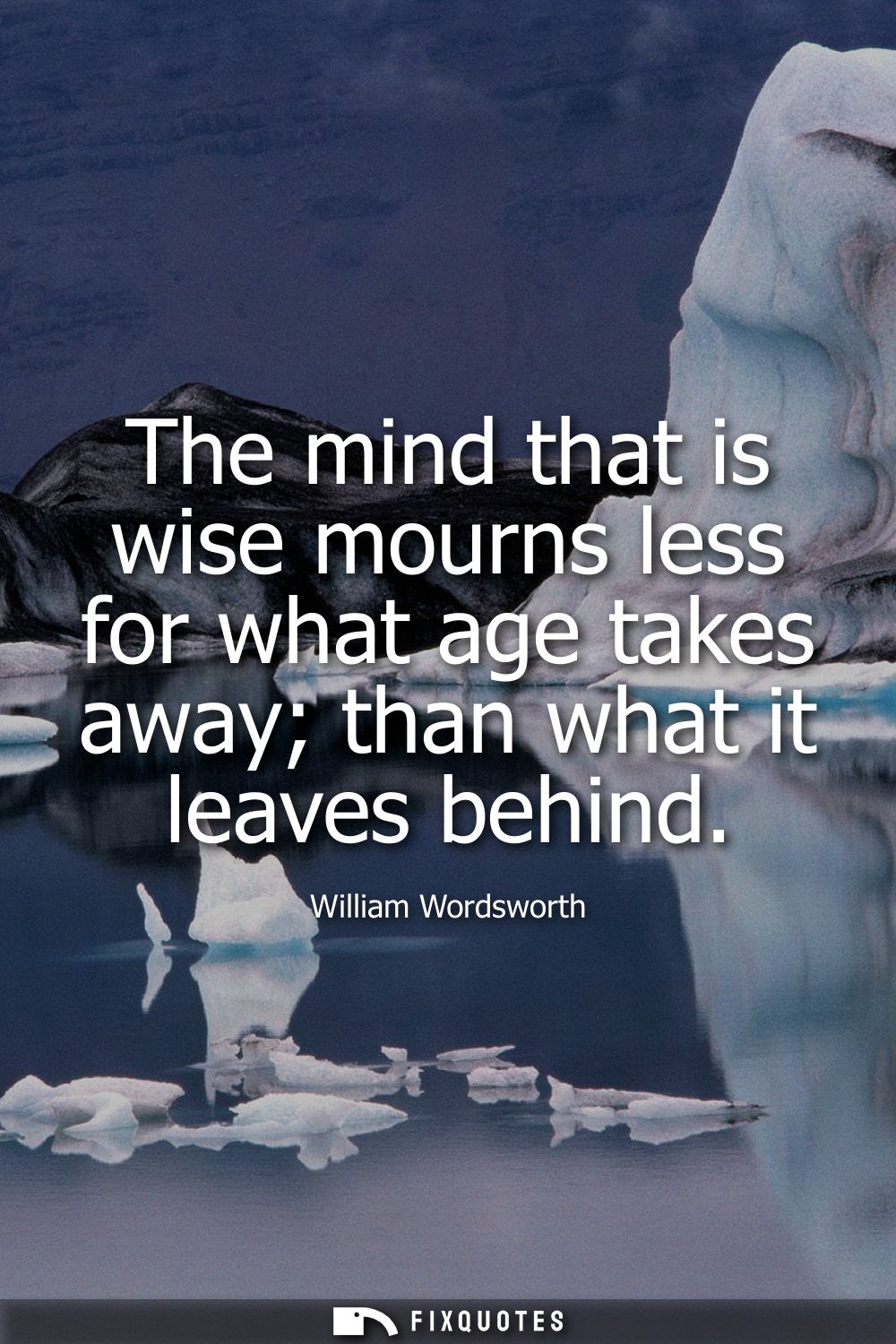
"The mind that is wise mourns less for what age takes away than what it leaves behind"
About this Quote
The line works because it flips the usual sentimental script. Instead of making age the villain that steals, Wordsworth makes it a ruthless editor that reveals. “Takes away” is passive theft; “leaves behind” is evidence. That shift turns mourning into something more cognitive than melodramatic: wisdom is not denial, it’s triage. You grieve less for what you couldn’t keep and more for what you failed to shape while you had the chance.
Context matters here. Wordsworth’s Romantic project was never just pretty scenery; it was a long argument about memory, development, and the inner life as a moral landscape. In poems like “Tintern Abbey,” he tracks how time changes perception and how reflection can redeem change without pretending it doesn’t hurt. This quote carries that mature Romantic stance: acceptance of nature’s cycles paired with a stern reckoning about human agency. Age doesn’t merely diminish you; it hands you your own receipts.
Quote Details
| Topic | Aging |
|---|---|
| Source | Unverified source: Lyrical Ballads, with Other Poems (1800), Vol. II (William Wordsworth, 1800)
Evidence: Thus fares it still in our decay: And yet the wiser mind Mourns less for what age takes away Than what it leaves behind. (The Fountain, A Conversation (Vol. II; page varies by printing/binding)). This line is from Wordsworth’s poem “The Fountain, A Conversation,” first published in the 1800 editi... Other candidates (1) Life Lessons of Wisdom & Motivation - Volume II (M.I. Seka, 2014) compilation95.0% ... The mind that is wise mourns less for what age takes away; than what it leaves behind. - William Wordsworth 1770 ... |
| Cite |
Citation Formats
APA Style (7th ed.)
Wordsworth, William. (2026, February 16). The mind that is wise mourns less for what age takes away than what it leaves behind. FixQuotes. https://fixquotes.com/quotes/the-mind-that-is-wise-mourns-less-for-what-age-11561/
Chicago Style
Wordsworth, William. "The mind that is wise mourns less for what age takes away than what it leaves behind." FixQuotes. February 16, 2026. https://fixquotes.com/quotes/the-mind-that-is-wise-mourns-less-for-what-age-11561/.
MLA Style (9th ed.)
"The mind that is wise mourns less for what age takes away than what it leaves behind." FixQuotes, 16 Feb. 2026, https://fixquotes.com/quotes/the-mind-that-is-wise-mourns-less-for-what-age-11561/. Accessed 5 Apr. 2026.