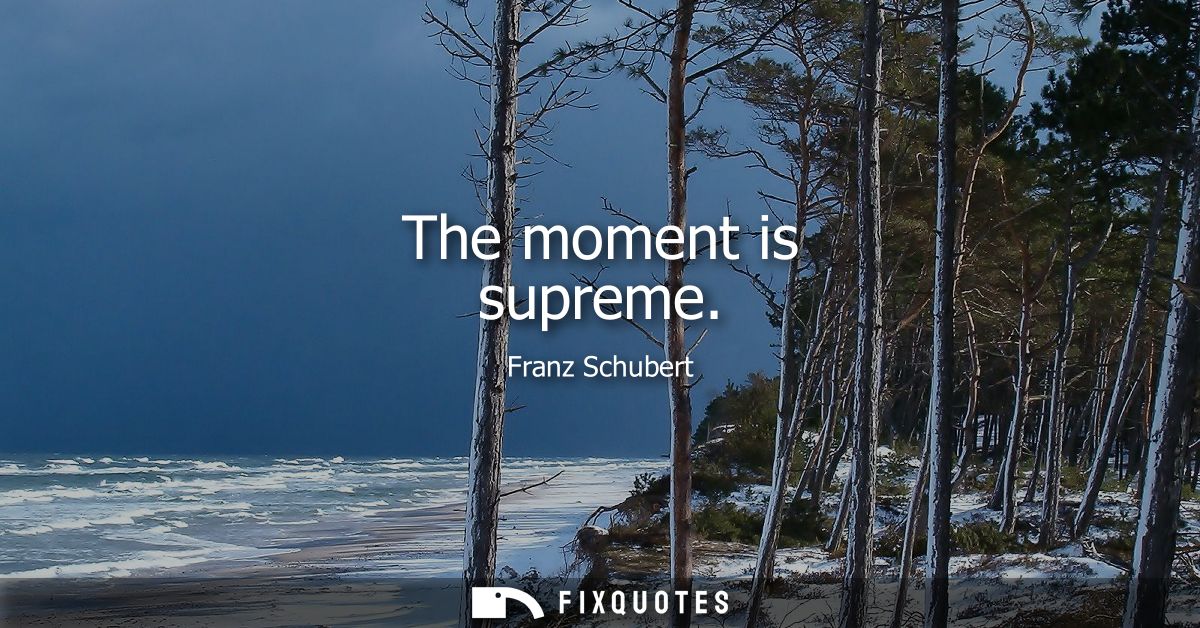
"The moment is supreme"
About this Quote
A composer who lived on borrowed time would say something like this and mean it literally. Schubert wrote in a Vienna where music was becoming both a private diary and a public commodity, where a song could be premiered in a friend’s living room and disappear the next week. “The moment is supreme” reads like an aesthetic manifesto for that world: stop chasing monuments, trust the instant when melody, breath, and attention align.
Schubert’s genius was always temporal. His lieder don’t just depict feeling; they dramatize the exact second a mood turns - the pivot from longing to dread, from tenderness to resignation. He’s the master of harmonic sidesteps that feel like thought itself changing course. In that sense, “supreme” isn’t sentimental. It’s a claim about how art works: meaning doesn’t arrive as a lecture, it hits as a fleeting pressure in the chest, a modulation you can’t quite explain but can’t unhear.
The subtext is almost defiant. Schubert, famously underrecognized in his short life, had every reason to care about legacy. Instead he elevates presence over posterity, the performance over the plaque. There’s also a quieter spiritual angle: the moment as the only reliable unit of truth when health, money, and reputation are unstable.
In a culture obsessed with “timeless” masterpieces, Schubert is insisting on something more honest: the timeless is built out of vanishing instants, and the artist’s job is to make one of them feel absolute.
Schubert’s genius was always temporal. His lieder don’t just depict feeling; they dramatize the exact second a mood turns - the pivot from longing to dread, from tenderness to resignation. He’s the master of harmonic sidesteps that feel like thought itself changing course. In that sense, “supreme” isn’t sentimental. It’s a claim about how art works: meaning doesn’t arrive as a lecture, it hits as a fleeting pressure in the chest, a modulation you can’t quite explain but can’t unhear.
The subtext is almost defiant. Schubert, famously underrecognized in his short life, had every reason to care about legacy. Instead he elevates presence over posterity, the performance over the plaque. There’s also a quieter spiritual angle: the moment as the only reliable unit of truth when health, money, and reputation are unstable.
In a culture obsessed with “timeless” masterpieces, Schubert is insisting on something more honest: the timeless is built out of vanishing instants, and the artist’s job is to make one of them feel absolute.
Quote Details
| Topic | Live in the Moment |
|---|---|
| Source | Help us find the source |
| Cite |
Citation Formats
APA Style (7th ed.)
Schubert, Franz. (2026, January 15). The moment is supreme. FixQuotes. https://fixquotes.com/quotes/the-moment-is-supreme-90024/
Chicago Style
Schubert, Franz. "The moment is supreme." FixQuotes. January 15, 2026. https://fixquotes.com/quotes/the-moment-is-supreme-90024/.
MLA Style (9th ed.)
"The moment is supreme." FixQuotes, 15 Jan. 2026, https://fixquotes.com/quotes/the-moment-is-supreme-90024/. Accessed 6 Mar. 2026.
More Quotes by Franz
Add to List