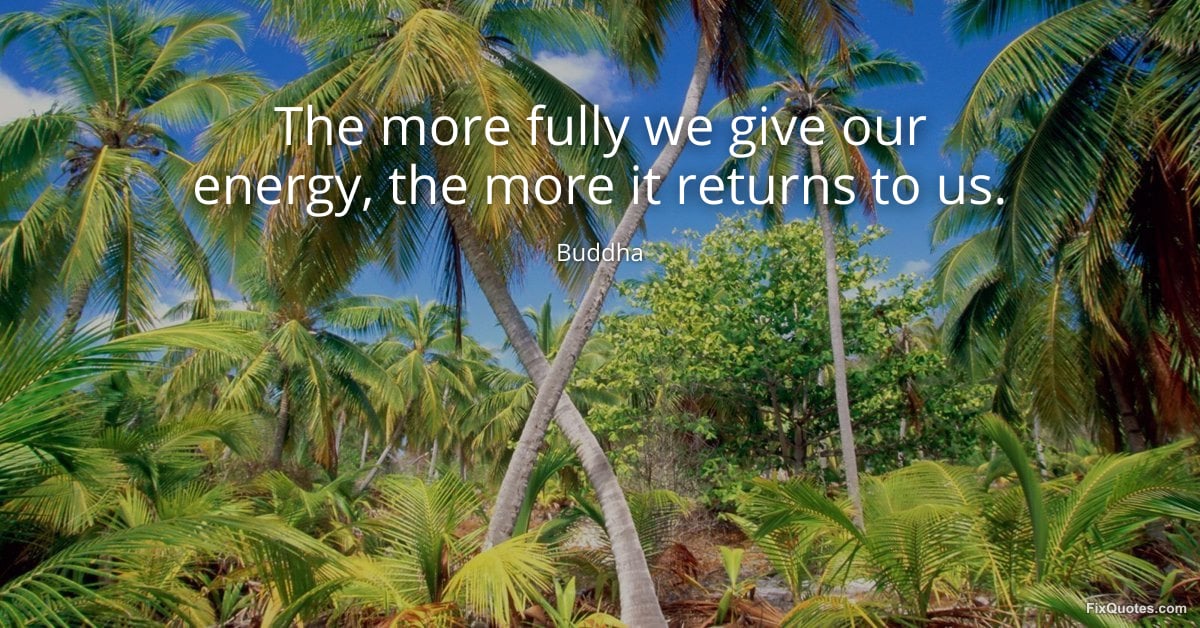
"The more fully we give our energy, the more it returns to us"
About this Quote
A line like this carries the quiet authority of a worldview, not a motivational slogan. Attributed to Buddha, it reflects a central Buddhist reversal: what looks like loss in ordinary thinking becomes gain at the level of spirit and character. To "give our energy" is not merely to work hard or be generous in the modern self-help sense. It points to attention, compassion, discipline, presence - the inner resources that Buddhism treats as the real architecture of a life.
Its force comes from how directly it challenges the fear of depletion. Most people are trained to imagine themselves as containers: if you pour out too much, you are left empty. Buddha's subtext is more radical. Energy, rightly used, is regenerative. In Buddhist thought, intention shapes experience. Acts of care, devotion, and mindful effort do not simply spend the self; they cultivate it. The return is not a cash-back reward from the universe but a transformation of the giver. You become, through practice, more capable of clarity and less trapped by scarcity.
That matters in the historical context of Buddha's teaching, which emerged against systems obsessed with status, ritual, and attachment. He redirected moral attention inward, toward the mind's habits. The line distills that shift. Its rhetoric is simple, almost circular, but that simplicity is strategic: it sounds like a paradox until you live it. Give more of your best self, and the self ceases to feel so brittle. That is both ethical instruction and psychological insight.
Its force comes from how directly it challenges the fear of depletion. Most people are trained to imagine themselves as containers: if you pour out too much, you are left empty. Buddha's subtext is more radical. Energy, rightly used, is regenerative. In Buddhist thought, intention shapes experience. Acts of care, devotion, and mindful effort do not simply spend the self; they cultivate it. The return is not a cash-back reward from the universe but a transformation of the giver. You become, through practice, more capable of clarity and less trapped by scarcity.
That matters in the historical context of Buddha's teaching, which emerged against systems obsessed with status, ritual, and attachment. He redirected moral attention inward, toward the mind's habits. The line distills that shift. Its rhetoric is simple, almost circular, but that simplicity is strategic: it sounds like a paradox until you live it. Give more of your best self, and the self ceases to feel so brittle. That is both ethical instruction and psychological insight.
Quote Details
| Topic | Motivational |
|---|---|
| Source | Help us find the source |
| Cite |
Citation Formats
APA Style (7th ed.)
Buddha. (2026, March 10). The more fully we give our energy, the more it returns to us. FixQuotes. https://fixquotes.com/quotes/the-more-fully-we-give-our-energy-the-more-it-185884/
Chicago Style
Buddha. "The more fully we give our energy, the more it returns to us." FixQuotes. March 10, 2026. https://fixquotes.com/quotes/the-more-fully-we-give-our-energy-the-more-it-185884/.
MLA Style (9th ed.)
"The more fully we give our energy, the more it returns to us." FixQuotes, 10 Mar. 2026, https://fixquotes.com/quotes/the-more-fully-we-give-our-energy-the-more-it-185884/. Accessed 15 Mar. 2026.
More Quotes by Buddha
Add to List