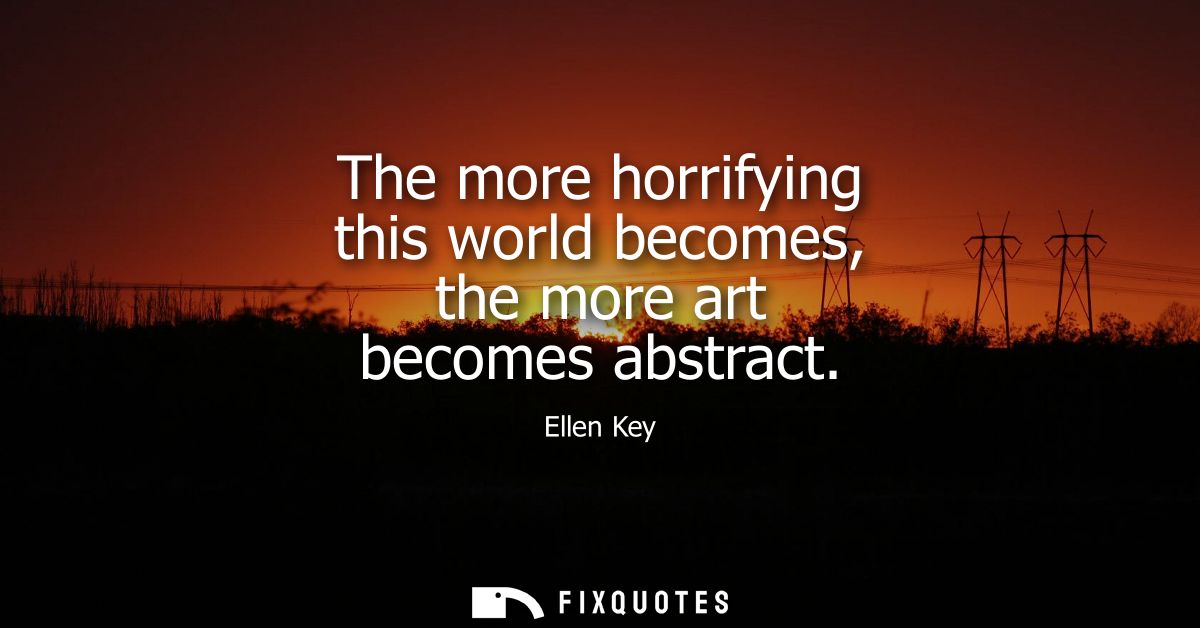
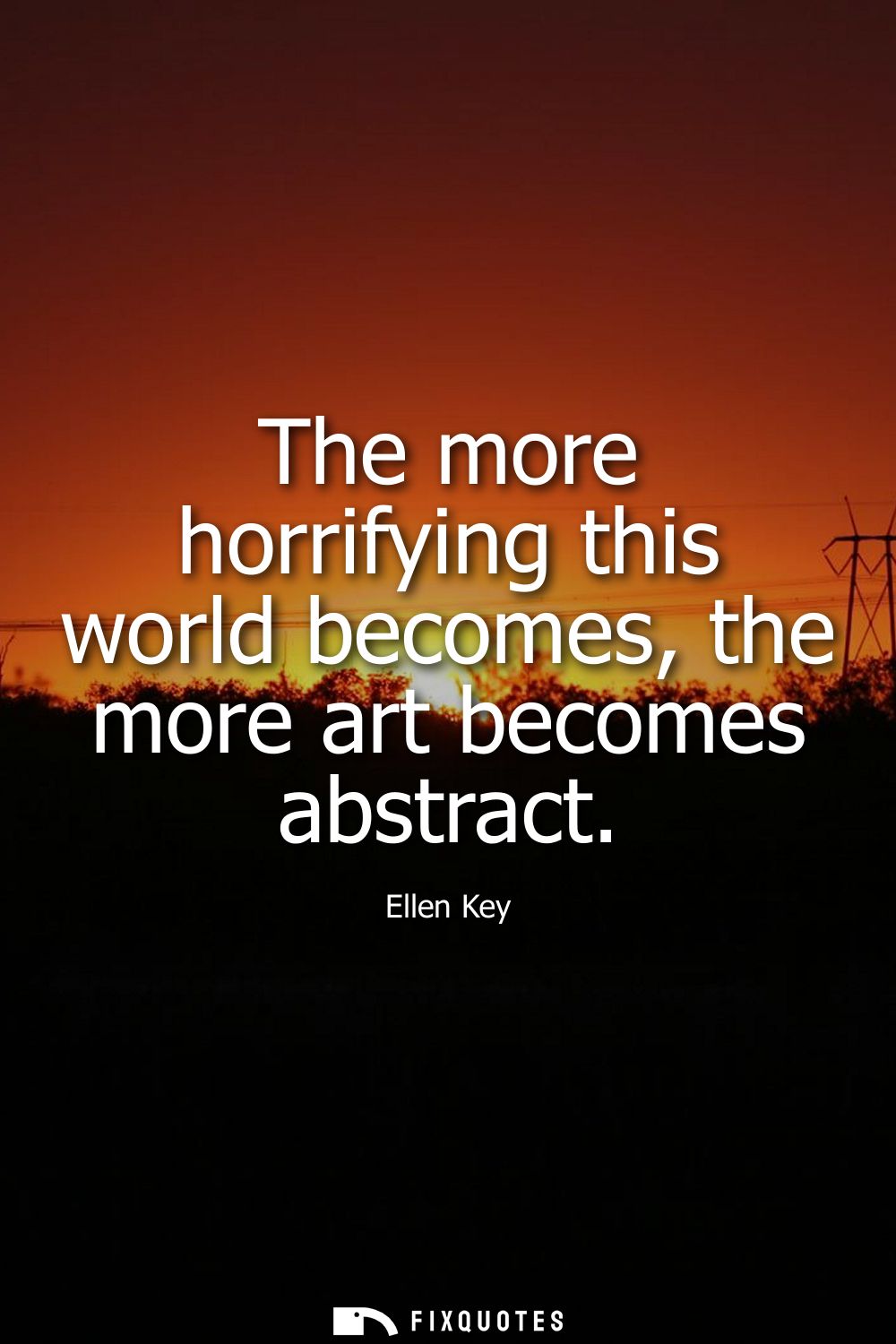
"The more horrifying this world becomes, the more art becomes abstract"
About this Quote
Horror doesn’t just wound the body; it breaks the narrative habits that used to make the world feel legible. Ellen Key’s line frames abstraction not as a fashionable revolt but as an adaptive response: when reality turns monstrous, the old representational tools start to feel like lies. If a culture’s daily facts become grotesque - mass violence, industrial dehumanization, political hysteria - then painting the “real” too faithfully risks normalizing it, turning catastrophe into décor. Abstraction, here, is a refusal to grant horror the comforting coherence of a story you can follow.
Key lived through the acceleration of modernity: the late 19th century’s faith in progress curdling into the 20th century’s mechanized killing and social fracture. In that climate, art’s drift toward the nonliteral reads less like escapism than triage. Fragmentation, distortion, and emptiness can mirror a reality that no longer feels continuous. They also create a space where feeling can be registered without being pinned down to a single propaganda-friendly image.
The subtext carries a quiet indictment of audiences, too. When people demand clarity and prettiness in ugly times, they’re often asking for anesthesia. Abstract art can frustrate that appetite. It refuses the spectator the easy moral of a figurative scene and instead offers a kind of ethical static: sensation without consolation, form without reassurance. Key’s sentence doubles as diagnosis and warning - if the world grows unbearable, the arts won’t serenely “reflect” it; they’ll splinter, because that’s what truth looks like when it’s been shattered.
Key lived through the acceleration of modernity: the late 19th century’s faith in progress curdling into the 20th century’s mechanized killing and social fracture. In that climate, art’s drift toward the nonliteral reads less like escapism than triage. Fragmentation, distortion, and emptiness can mirror a reality that no longer feels continuous. They also create a space where feeling can be registered without being pinned down to a single propaganda-friendly image.
The subtext carries a quiet indictment of audiences, too. When people demand clarity and prettiness in ugly times, they’re often asking for anesthesia. Abstract art can frustrate that appetite. It refuses the spectator the easy moral of a figurative scene and instead offers a kind of ethical static: sensation without consolation, form without reassurance. Key’s sentence doubles as diagnosis and warning - if the world grows unbearable, the arts won’t serenely “reflect” it; they’ll splinter, because that’s what truth looks like when it’s been shattered.
Quote Details
| Topic | Art |
|---|---|
| Source | Help us find the source |
| Cite |
Citation Formats
APA Style (7th ed.)
Key, Ellen. (2026, January 14). The more horrifying this world becomes, the more art becomes abstract. FixQuotes. https://fixquotes.com/quotes/the-more-horrifying-this-world-becomes-the-more-141317/
Chicago Style
Key, Ellen. "The more horrifying this world becomes, the more art becomes abstract." FixQuotes. January 14, 2026. https://fixquotes.com/quotes/the-more-horrifying-this-world-becomes-the-more-141317/.
MLA Style (9th ed.)
"The more horrifying this world becomes, the more art becomes abstract." FixQuotes, 14 Jan. 2026, https://fixquotes.com/quotes/the-more-horrifying-this-world-becomes-the-more-141317/. Accessed 31 Mar. 2026.
More Quotes by Ellen
Add to List