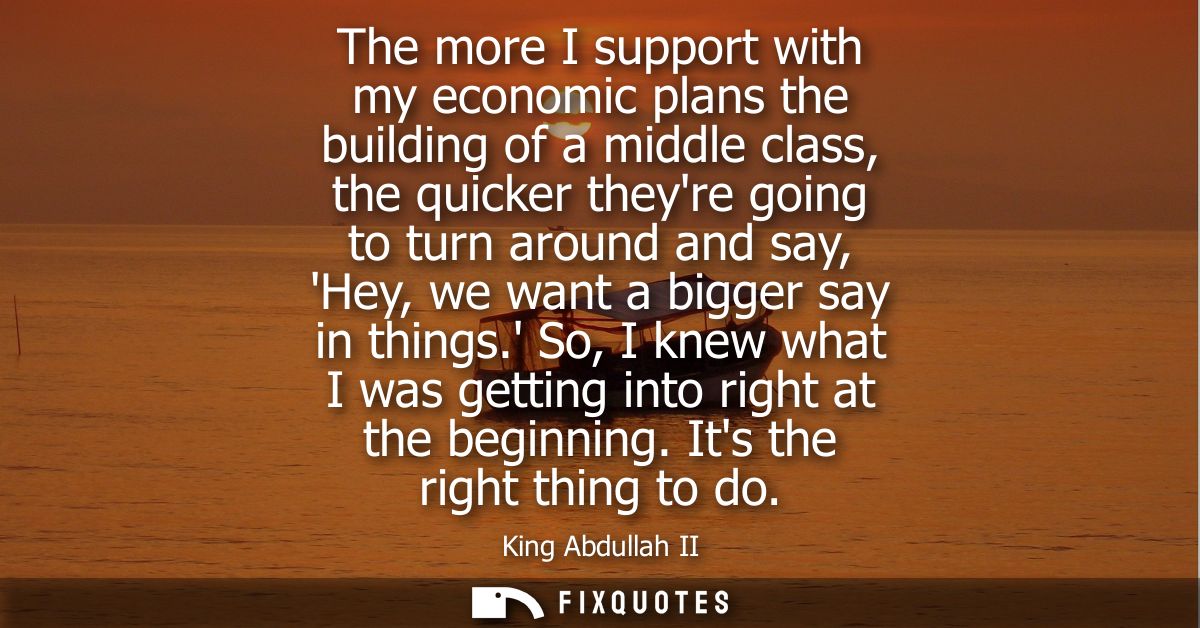
"The more I support with my economic plans the building of a middle class, the quicker they're going to turn around and say, 'Hey, we want a bigger say in things.' So, I knew what I was getting into right at the beginning. It's the right thing to do"
About this Quote
Power concedes nothing without being asked, and King Abdullah II is candidly admitting he’s helping write the script for the next demand. The line does something rare for a sitting monarch: it treats the expansion of a middle class not as a public-relations win, but as a political accelerant. Prosperity, in his telling, is not a sedative. It’s a catalyst that produces expectations, confidence, and eventually a constituency that wants leverage.
The intent is double-edged. On the surface, it’s a reformist pledge: economic plans aimed at widening opportunity. Underneath, it’s a preemptive normalization of dissent. By saying he “knew what [he] was getting into,” Abdullah frames future calls for participation as foreseeable and legitimate, not destabilizing surprises. That’s a savvy move in a region where regimes often treat political demands as ingratitude or foreign contamination. He’s inoculating reform against the usual backlash: yes, empowerment will lead to pressure; no, that doesn’t make it wrong.
Context matters. Jordan sits on a fault line of economic strain, youth unemployment, subsidy politics, and periodic protest, while balancing security concerns and the monarchy’s central role. Building a middle class is both economic policy and statecraft: it can stabilize society, but it also creates citizens with the time and resources to organize. The quiet rhetorical power here is the moral claim at the end: “It’s the right thing to do.” He’s not promising democracy outright; he’s committing to a trajectory where legitimacy must eventually be shared, even if it complicates his own rule.
The intent is double-edged. On the surface, it’s a reformist pledge: economic plans aimed at widening opportunity. Underneath, it’s a preemptive normalization of dissent. By saying he “knew what [he] was getting into,” Abdullah frames future calls for participation as foreseeable and legitimate, not destabilizing surprises. That’s a savvy move in a region where regimes often treat political demands as ingratitude or foreign contamination. He’s inoculating reform against the usual backlash: yes, empowerment will lead to pressure; no, that doesn’t make it wrong.
Context matters. Jordan sits on a fault line of economic strain, youth unemployment, subsidy politics, and periodic protest, while balancing security concerns and the monarchy’s central role. Building a middle class is both economic policy and statecraft: it can stabilize society, but it also creates citizens with the time and resources to organize. The quiet rhetorical power here is the moral claim at the end: “It’s the right thing to do.” He’s not promising democracy outright; he’s committing to a trajectory where legitimacy must eventually be shared, even if it complicates his own rule.
Quote Details
| Topic | Freedom |
|---|
More Quotes by King
Add to List