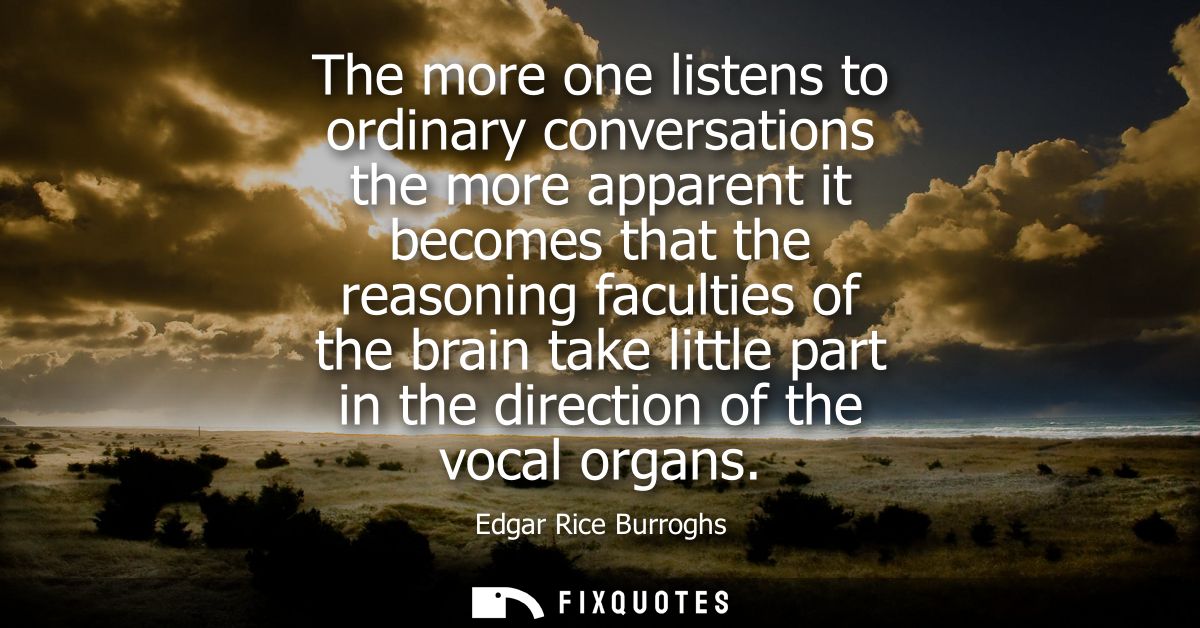
"The more one listens to ordinary conversations, the more apparent it becomes that the reasoning faculties of the brain take little part in the direction of the vocal organs"
About this Quote
The subtext is a writer’s impatience with speech as friction. Burroughs built entire worlds on clear, propulsive prose, where cause and effect matter and dialogue advances action. Against that standard, real-life conversation looks like noise: repetition, status-signaling, ritual complaint, ready-made opinions. His phrasing makes it anatomical, as if the mouth has its own agenda. That dehumanizing edge is the joke and the warning: people aren’t lying; they’re barely steering.
Context matters. Burroughs wrote through the rise of mass newspapers, advertising, and early broadcast culture - eras that professionalized “talk” and taught audiences to mimic slogans, catchphrases, and moral certainties. The quote anticipates a modern anxiety: speech gets cheaper as channels multiply, and thinking doesn’t scale at the same rate. It’s not just miscommunication he’s mocking; it’s the unsettling ease with which sound substitutes for judgment.
Quote Details
| Topic | Reason & Logic |
|---|---|
| Source | Help us find the source |
| Cite |
Citation Formats
APA Style (7th ed.)
Burroghs, Edgar Rice. (2026, February 16). The more one listens to ordinary conversations, the more apparent it becomes that the reasoning faculties of the brain take little part in the direction of the vocal organs. FixQuotes. https://fixquotes.com/quotes/the-more-one-listens-to-ordinary-conversations-167366/
Chicago Style
Burroghs, Edgar Rice. "The more one listens to ordinary conversations, the more apparent it becomes that the reasoning faculties of the brain take little part in the direction of the vocal organs." FixQuotes. February 16, 2026. https://fixquotes.com/quotes/the-more-one-listens-to-ordinary-conversations-167366/.
MLA Style (9th ed.)
"The more one listens to ordinary conversations, the more apparent it becomes that the reasoning faculties of the brain take little part in the direction of the vocal organs." FixQuotes, 16 Feb. 2026, https://fixquotes.com/quotes/the-more-one-listens-to-ordinary-conversations-167366/. Accessed 27 Mar. 2026.