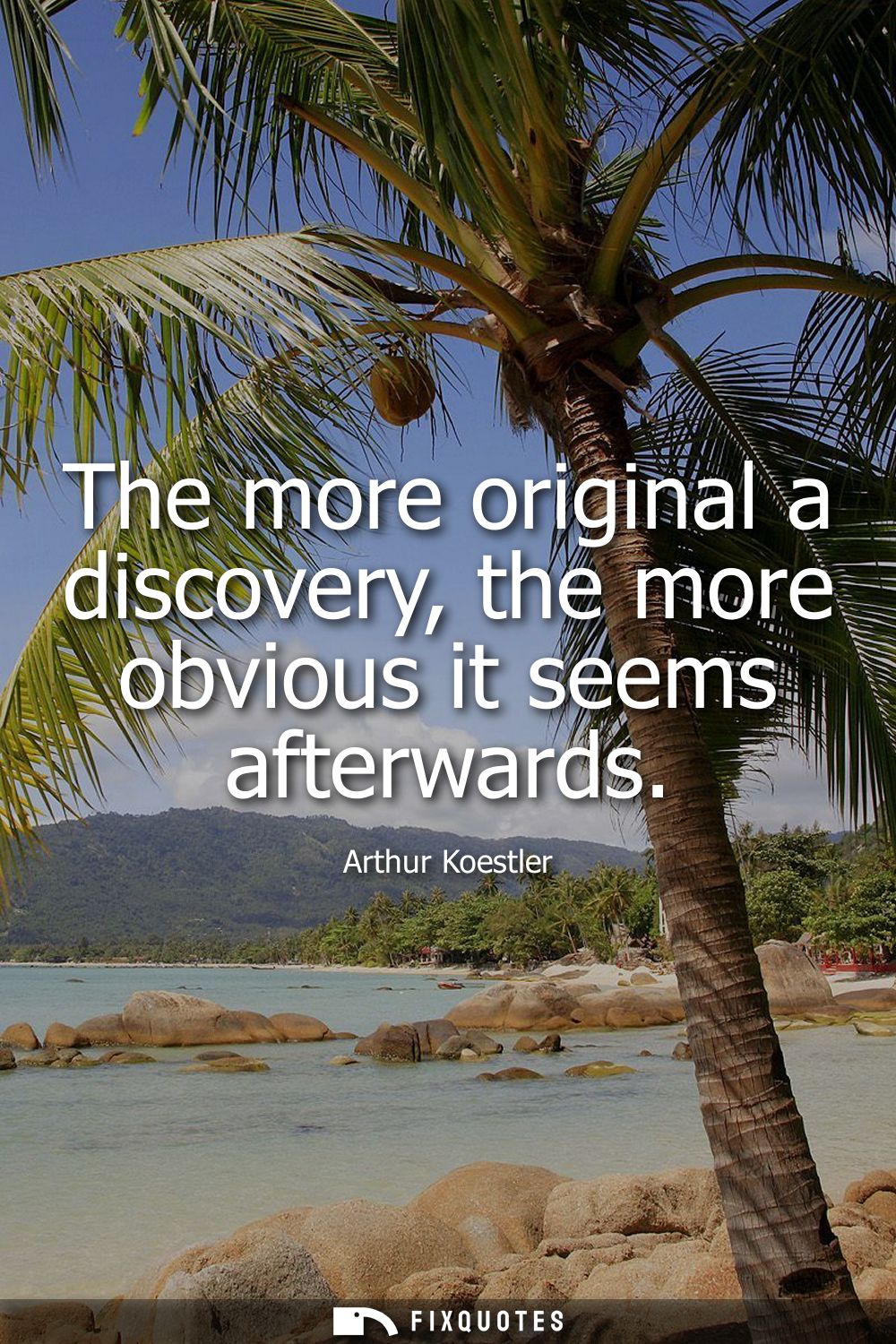
"The more original a discovery, the more obvious it seems afterwards"
About this Quote
The subtext is protective and accusatory at once. Protective, because Koestler knows originality often looks like error in real time; the “obvious afterwards” effect is the consolation prize innovators get when the bruises have already landed. Accusatory, because the same effect erases the risk and loneliness of discovery. If it was so obvious, why didn’t you see it? If you didn’t see it, how much authority should you have to judge the person who did?
Context matters: Koestler spent his career orbiting big ideological machines and the psychology of belief, and he had a particular interest in how the mind manufactures certainty. The quote is a small thesis about narrative power. Societies love origin stories that make progress look linear and clean; it’s easier to celebrate genius than to admit how much luck, stubbornness, and institutional resistance shape what counts as “truth.” The more radical the idea, the faster we pretend it was always there, hiding in plain sight.
Quote Details
| Topic | Wisdom |
|---|---|
| Source | Arthur Koestler, The Act of Creation (1964). |
| Cite |
Citation Formats
APA Style (7th ed.)
Koestler, Arthur. (2026, January 16). The more original a discovery, the more obvious it seems afterwards. FixQuotes. https://fixquotes.com/quotes/the-more-original-a-discovery-the-more-obvious-it-100853/
Chicago Style
Koestler, Arthur. "The more original a discovery, the more obvious it seems afterwards." FixQuotes. January 16, 2026. https://fixquotes.com/quotes/the-more-original-a-discovery-the-more-obvious-it-100853/.
MLA Style (9th ed.)
"The more original a discovery, the more obvious it seems afterwards." FixQuotes, 16 Jan. 2026, https://fixquotes.com/quotes/the-more-original-a-discovery-the-more-obvious-it-100853/. Accessed 29 Mar. 2026.