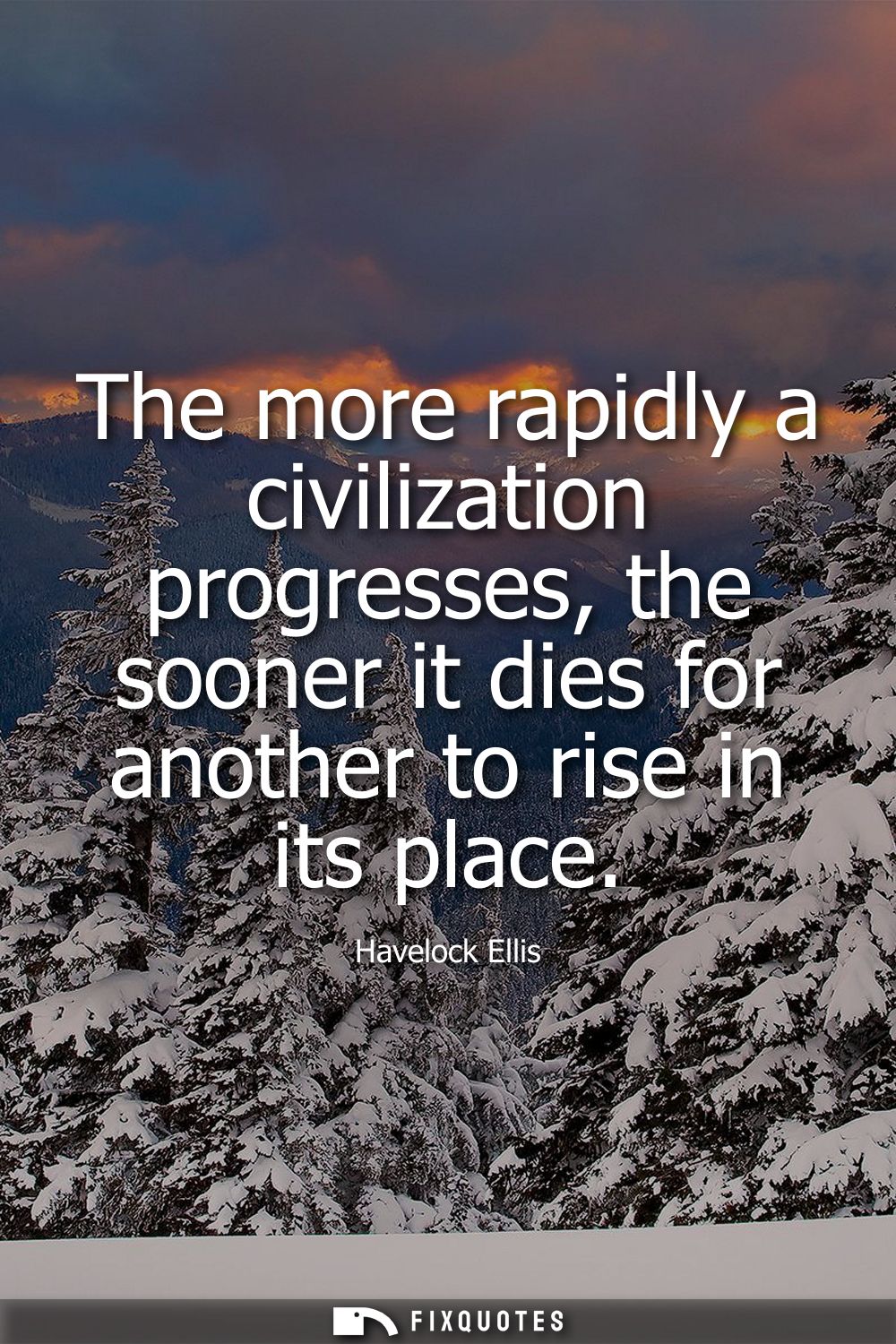
"The more rapidly a civilization progresses, the sooner it dies for another to rise in its place"
About this Quote
The intent is partly diagnostic, partly admonitory. Rapid advancement concentrates change into a single generation: technologies outpace institutions, cities swell faster than customs can adapt, appetites multiply before ethics and governance learn restraint. Ellis is suspicious of acceleration itself. The implied mechanism isn't that progress is "bad", but that it destabilizes the cultural immune system - shared meanings, rituals, and limits - that makes a society coherent. When those lag, a civilization doesn't just evolve; it fragments, making room for a successor with a fresher story and a tighter grip on legitimacy.
The subtext carries a cyclical, almost Spenglerian mood (The Decline of the West lands in 1918): history as replacement, not redemption. It also reflects fin-de-siecle anxieties about decadence, degeneration, and overstimulation - the sense that modern life is a constant stress test for psyche and polity alike. Ellis turns "progress" into a memento mori: every breakthrough is also a break with the past, and too many breaks, too quickly, can become a collapse. The sting is that the "another" rising isn't necessarily better - just better adapted to the new tempo.
Quote Details
| Topic | Change |
|---|---|
| Source | Help us find the source |
| Cite |
Citation Formats
APA Style (7th ed.)
Ellis, Havelock. (2026, January 17). The more rapidly a civilization progresses, the sooner it dies for another to rise in its place. FixQuotes. https://fixquotes.com/quotes/the-more-rapidly-a-civilization-progresses-the-61751/
Chicago Style
Ellis, Havelock. "The more rapidly a civilization progresses, the sooner it dies for another to rise in its place." FixQuotes. January 17, 2026. https://fixquotes.com/quotes/the-more-rapidly-a-civilization-progresses-the-61751/.
MLA Style (9th ed.)
"The more rapidly a civilization progresses, the sooner it dies for another to rise in its place." FixQuotes, 17 Jan. 2026, https://fixquotes.com/quotes/the-more-rapidly-a-civilization-progresses-the-61751/. Accessed 12 Feb. 2026.