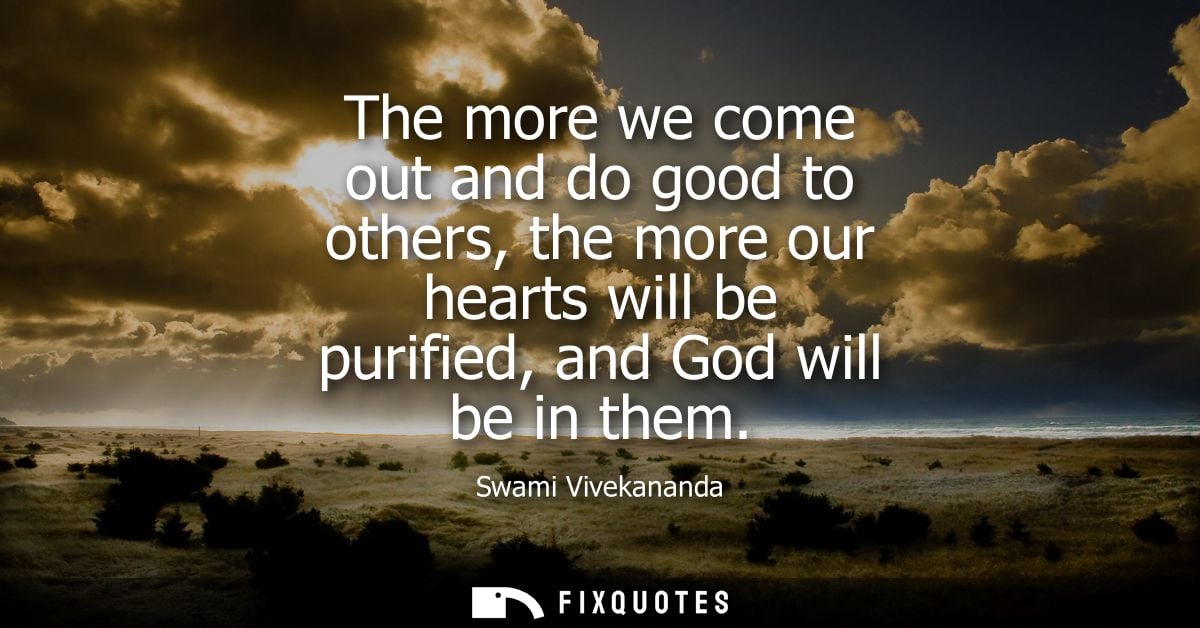
"The more we come out and do good to others, the more our hearts will be purified, and God will be in them"
About this Quote
The line also flips the usual transaction people imagine with God. Instead of “get pure, then be worthy,” he proposes “do good, then become capable.” Purification isn’t antiseptic moral perfection; it’s a cleansing of ego, resentment, and fear through contact with others’ needs. The subtext is almost therapeutic: service rewires the heart. It gives you fewer opportunities to romanticize your own suffering and more chances to practice humility, patience, and solidarity.
Context matters. Vivekananda, speaking as a Hindu monk addressing both India’s reformist currents and the West’s appetite for “Eastern spirituality,” pushes back against ritualism and escapist mysticism. His Vedantic background treats divinity as immanent, not distant; “God will be in them” reads less like a reward and more like an unveiling. When the heart is less crowded with self, it becomes a clearer vessel for the divine already present.
It’s persuasive because it binds metaphysics to ethics. No abstraction, no monastery-only enlightenment: the spiritual test is whether your life becomes useful.
Quote Details
| Topic | Kindness |
|---|---|
| Source | Help us find the source |
| Cite |
Citation Formats
APA Style (7th ed.)
Vivekananda, Swami. (2026, January 18). The more we come out and do good to others, the more our hearts will be purified, and God will be in them. FixQuotes. https://fixquotes.com/quotes/the-more-we-come-out-and-do-good-to-others-the-14972/
Chicago Style
Vivekananda, Swami. "The more we come out and do good to others, the more our hearts will be purified, and God will be in them." FixQuotes. January 18, 2026. https://fixquotes.com/quotes/the-more-we-come-out-and-do-good-to-others-the-14972/.
MLA Style (9th ed.)
"The more we come out and do good to others, the more our hearts will be purified, and God will be in them." FixQuotes, 18 Jan. 2026, https://fixquotes.com/quotes/the-more-we-come-out-and-do-good-to-others-the-14972/. Accessed 11 Mar. 2026.