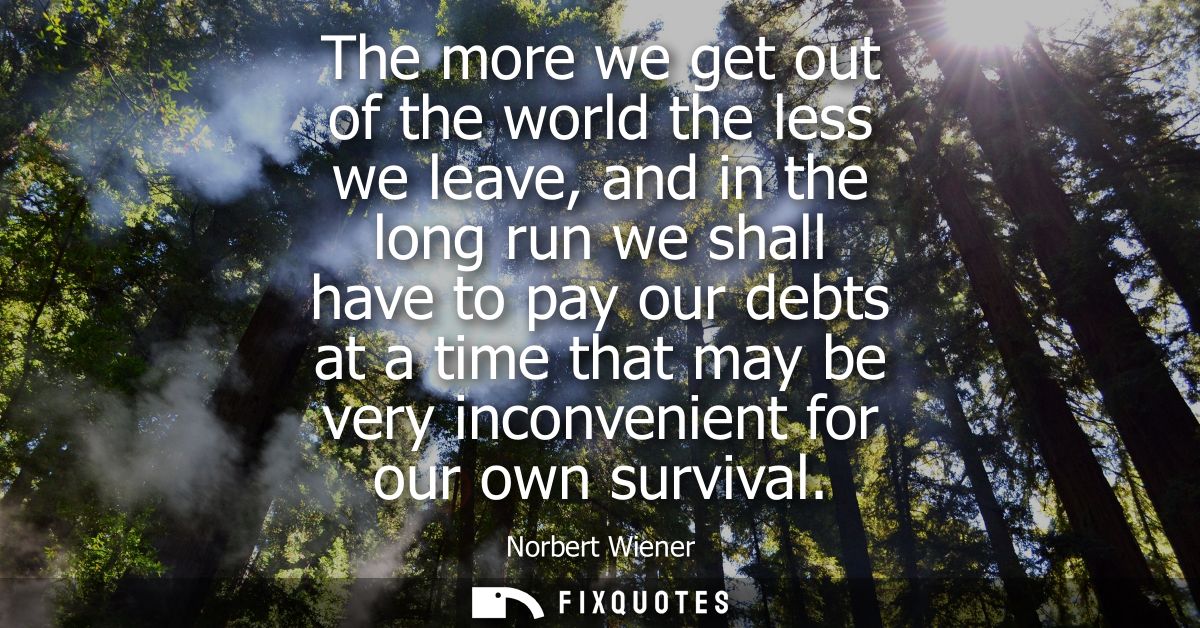
"The more we get out of the world, the less we leave, and in the long run we shall have to pay our debts at a time that may be very inconvenient for our own survival"
About this Quote
The subtext is a critique of short-termism dressed up as rational accounting. “Less we leave” isn’t just about resources; it’s about options. A society that treats the planet as an input stream is also shrinking its future degrees of freedom, the same way a feedback system becomes unstable when it ignores the signals it doesn’t like. Wiener’s signature move is smuggling ethics into engineering language: debts accumulate whether or not you believe in morality, because the universe keeps records in physical constraints.
Then he tightens the vise with “pay our debts” and “very inconvenient,” a dry understatement that lands like satire. Inconvenient for whom? Not for some abstract “economy,” but “our own survival.” The punchline is that the bill arrives on biology’s schedule, not ours. Written in the mid-20th century, amid postwar industrial acceleration and Wiener’s anxieties about automated systems and militarized science, the warning reads less like pastoral environmentalism and more like systems analysis: you can’t indefinitely externalize costs in a closed world. Eventually the externality becomes the environment you’re trying to live in.
Quote Details
| Topic | Ethics & Morality |
|---|---|
| Source | Later attribution: The Human Use Of Human Beings (Norbert Wiener, 1988) modern compilationISBN: 9780786752263 · ID: DydKDgAAQBAJ
Evidence:
... the more we get out of the world the less we leave, and in the long run we shall have to pay our debts at a time that may be very inconvenient for our own survival. We are the slaves of our technical improvement and we can no more ... |
| Cite |
Citation Formats
APA Style (7th ed.)
Wiener, Norbert. (2026, March 27). The more we get out of the world, the less we leave, and in the long run we shall have to pay our debts at a time that may be very inconvenient for our own survival. FixQuotes. https://fixquotes.com/quotes/the-more-we-get-out-of-the-world-the-less-we-93949/
Chicago Style
Wiener, Norbert. "The more we get out of the world, the less we leave, and in the long run we shall have to pay our debts at a time that may be very inconvenient for our own survival." FixQuotes. March 27, 2026. https://fixquotes.com/quotes/the-more-we-get-out-of-the-world-the-less-we-93949/.
MLA Style (9th ed.)
"The more we get out of the world, the less we leave, and in the long run we shall have to pay our debts at a time that may be very inconvenient for our own survival." FixQuotes, 27 Mar. 2026, https://fixquotes.com/quotes/the-more-we-get-out-of-the-world-the-less-we-93949/. Accessed 31 Mar. 2026.