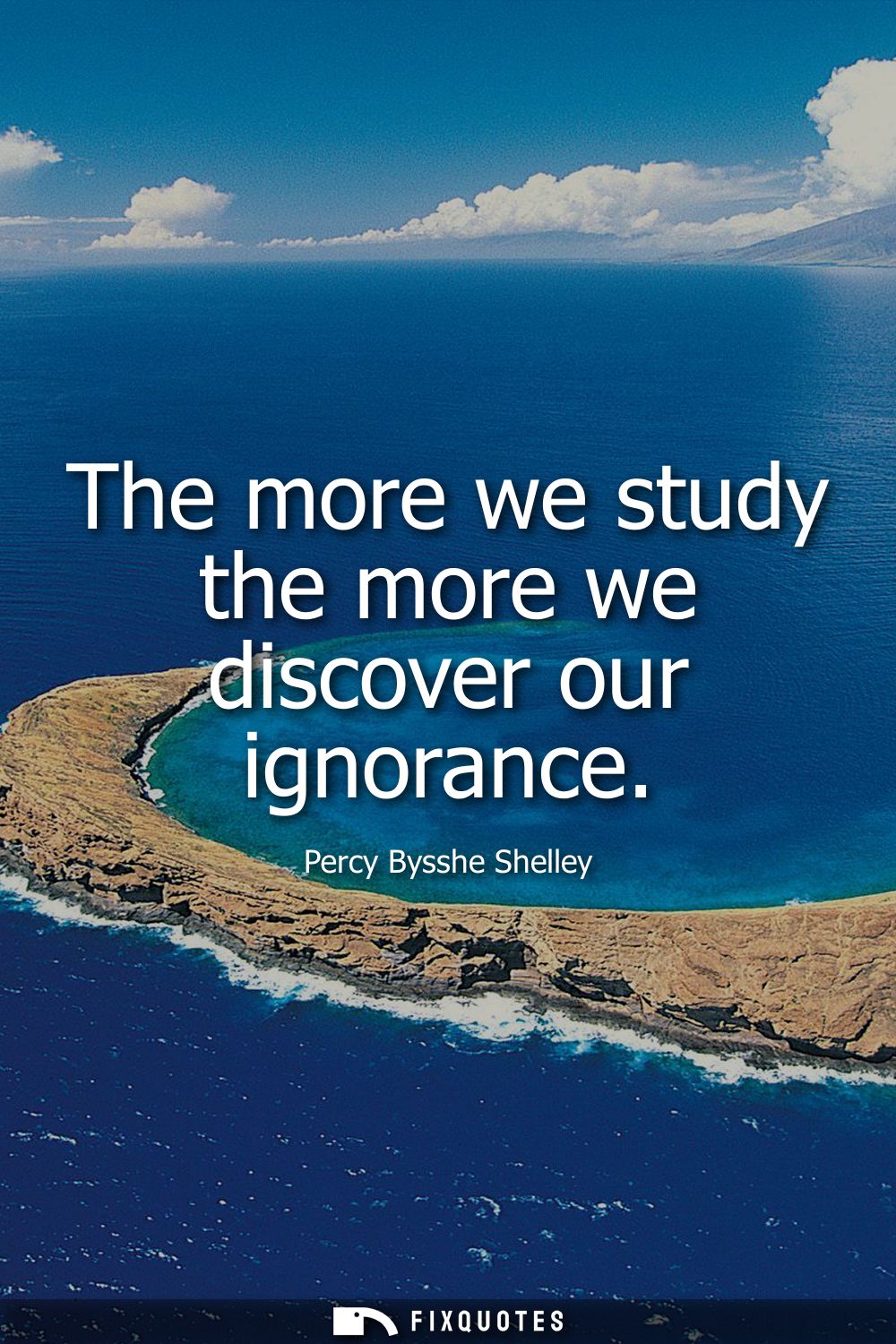
"The more we study the more we discover our ignorance"
About this Quote
Knowledge doesn’t arrive like a trophy; it lands like a mirror, and Shelley is interested in what it reflects back at the ambitious mind. "The more we study the more we discover our ignorance" isn’t a pious call to humility so much as a diagnosis of what serious inquiry does to ego: it expands the perimeter of what you can see, and therefore the perimeter of what you can’t. Study doesn’t fill a bucket. It turns on the lights in a bigger room, and suddenly the corners multiply.
Shelley writes as a Romantic who distrusted tidy, institutional certainty. In an era intoxicated by Enlightenment systems, industrial progress, and the idea that the world could be mapped, categorized, and finally mastered, he keeps prying open the hidden costs of that confidence. The line has a quiet, almost surgical irony: the very act that should make you feel secure - accumulating knowledge - is what reveals the vastness you’ve failed to account for. It’s not anti-intellectual; it’s anti-complacency.
The subtext is moral as much as epistemic. Shelley’s politics and poetry both lean toward liberation, and liberation begins by noticing the limits of what you’ve been taught to treat as settled. Ignorance here isn’t shameful; it’s productive, a sign that the mind is alive, moving, refusing to fossilize into dogma. Read that way, the quote doubles as a warning about intellectual vanity and a defense of curiosity: the point of learning isn’t to arrive, it’s to remain capable of being undone by reality.
Shelley writes as a Romantic who distrusted tidy, institutional certainty. In an era intoxicated by Enlightenment systems, industrial progress, and the idea that the world could be mapped, categorized, and finally mastered, he keeps prying open the hidden costs of that confidence. The line has a quiet, almost surgical irony: the very act that should make you feel secure - accumulating knowledge - is what reveals the vastness you’ve failed to account for. It’s not anti-intellectual; it’s anti-complacency.
The subtext is moral as much as epistemic. Shelley’s politics and poetry both lean toward liberation, and liberation begins by noticing the limits of what you’ve been taught to treat as settled. Ignorance here isn’t shameful; it’s productive, a sign that the mind is alive, moving, refusing to fossilize into dogma. Read that way, the quote doubles as a warning about intellectual vanity and a defense of curiosity: the point of learning isn’t to arrive, it’s to remain capable of being undone by reality.
Quote Details
| Topic | Knowledge |
|---|
More Quotes by Percy
Add to List