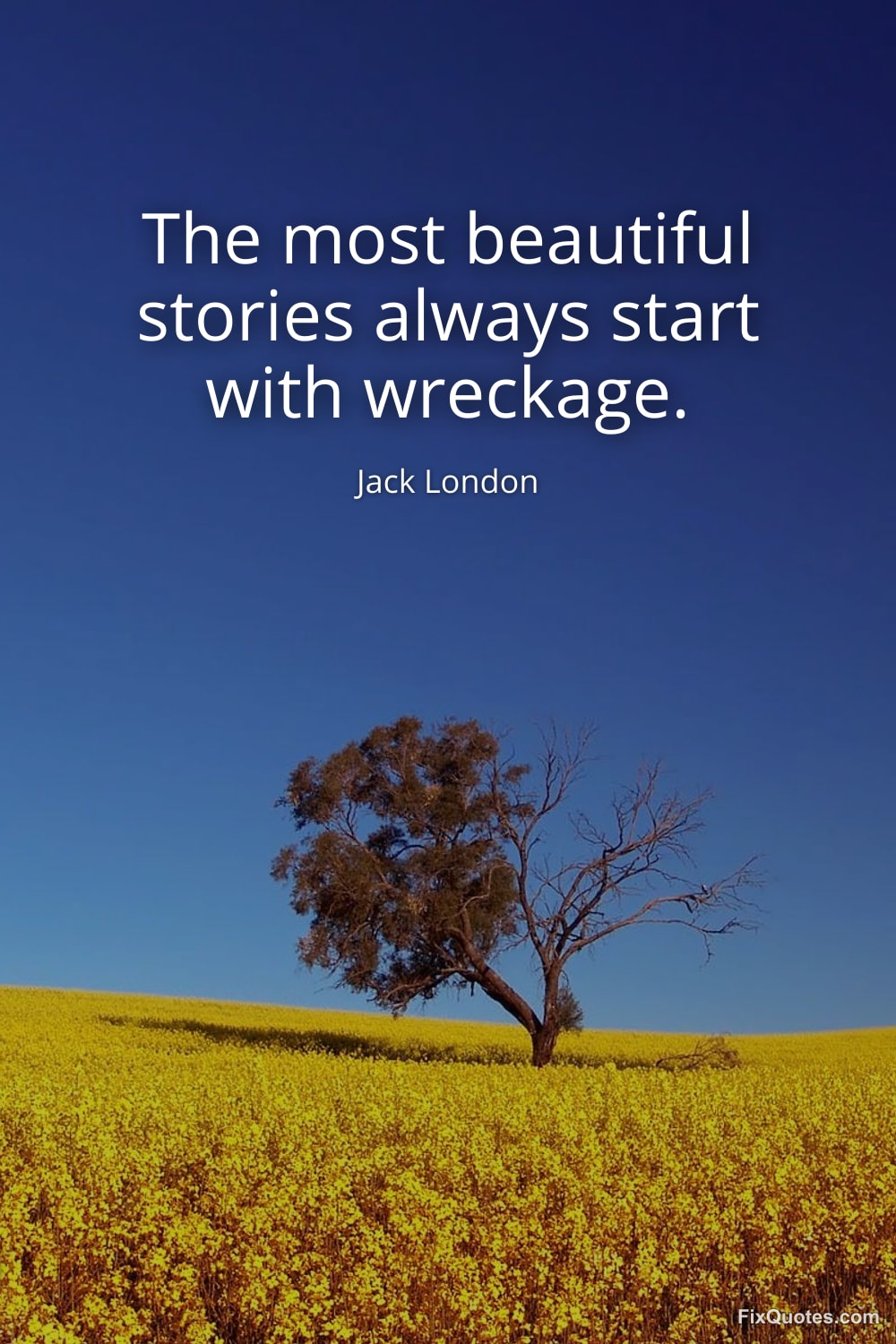
"The most beautiful stories always start with wreckage"
About this Quote
Beauty, for Jack London, is rarely born in a parlor. It crawls out of the surf. "The most beautiful stories always start with wreckage" reads like a credo from a writer who treated disaster not as a twist, but as the entry fee to meaning. London’s best-known worlds are brutal and indifferent; nature doesn’t care about your plans, your pedigree, your moral bookkeeping. Wreckage is the moment the comforting fiction of control collapses, leaving a character with nothing but nerve, instinct, and whatever self they can assemble from the debris.
The line works because it smuggles a hard truth inside a romantic word. "Beautiful" isn’t softness here; it’s clarity. Wreckage strips away social performance and exposes the core London was obsessed with: the animal will to live, the thin veneer of civilization, the way hardship can forge a strange kind of purity. It also flatters the reader’s hunger for transformation. We don’t just want events; we want conversion experiences, the before-and-after that makes a life legible.
Context matters. London came up through poverty, grueling labor, and an era of industrial churn that produced both mass wealth and mass precarity. He wrote at the height of naturalism, when authors argued that environment and biology press down on human choice. "Wreckage" is that pressure made visible: a shipwreck, a broke man, a ruined dream. The subtext is unsentimental encouragement: don’t fear the break. The break is where the story finally tells the truth.
The line works because it smuggles a hard truth inside a romantic word. "Beautiful" isn’t softness here; it’s clarity. Wreckage strips away social performance and exposes the core London was obsessed with: the animal will to live, the thin veneer of civilization, the way hardship can forge a strange kind of purity. It also flatters the reader’s hunger for transformation. We don’t just want events; we want conversion experiences, the before-and-after that makes a life legible.
Context matters. London came up through poverty, grueling labor, and an era of industrial churn that produced both mass wealth and mass precarity. He wrote at the height of naturalism, when authors argued that environment and biology press down on human choice. "Wreckage" is that pressure made visible: a shipwreck, a broke man, a ruined dream. The subtext is unsentimental encouragement: don’t fear the break. The break is where the story finally tells the truth.
Quote Details
| Topic | New Beginnings |
|---|---|
| Source | Help us find the source |
| Cite |
Citation Formats
APA Style (7th ed.)
London, Jack. (2026, January 15). The most beautiful stories always start with wreckage. FixQuotes. https://fixquotes.com/quotes/the-most-beautiful-stories-always-start-with-173094/
Chicago Style
London, Jack. "The most beautiful stories always start with wreckage." FixQuotes. January 15, 2026. https://fixquotes.com/quotes/the-most-beautiful-stories-always-start-with-173094/.
MLA Style (9th ed.)
"The most beautiful stories always start with wreckage." FixQuotes, 15 Jan. 2026, https://fixquotes.com/quotes/the-most-beautiful-stories-always-start-with-173094/. Accessed 13 Feb. 2026.
More Quotes by Jack
Add to List