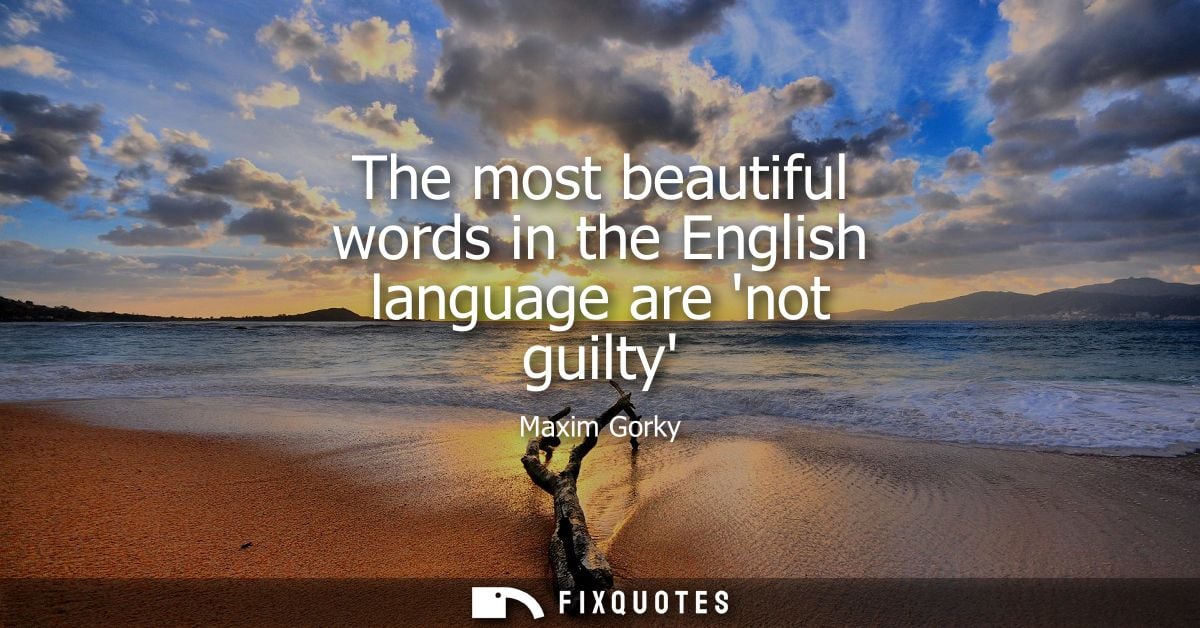
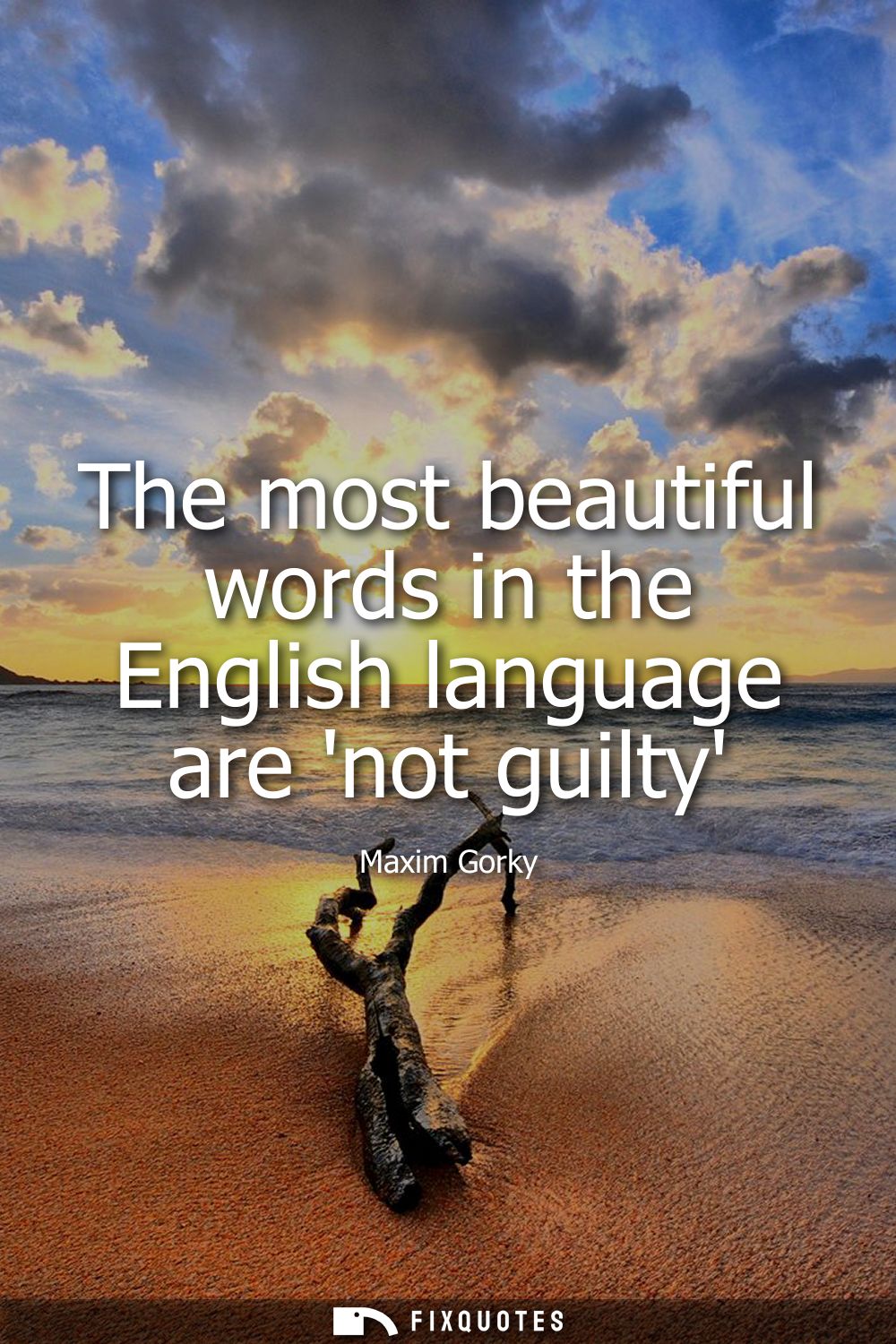
"The most beautiful words in the English language are 'not guilty'"
About this Quote
“Not guilty” lands like a velvet curtain dropping on a trapdoor. Gorky’s line flatters the ear with its talk of beauty, then immediately swaps poetry for procedure: two blunt syllables, a legal verdict, the state’s grammar. The provocation is the point. He’s daring the reader to admit that, in a world where power can crush you for being poor, restless, or merely in the way, beauty isn’t a sunset; it’s survival.
As a novelist formed in late imperial Russia and hardened by the politics that followed, Gorky understood that innocence isn’t a private condition so much as a public designation. “Not guilty” is a stamp that decides whether you go home or disappear. That’s the subtext: the self doesn’t matter until an institution agrees it matters. The phrase also exposes how thin the line is between “criminal” and “citizen” when law is less a moral compass than a tool of social control. If the system is rigged, then exoneration becomes ecstatic, even erotic in its relief.
There’s an extra twist of bitterness in calling it the “most beautiful” English words. It’s the language of courts and contracts, of modernity’s bureaucratic sheen, made gorgeous only because the alternative is so ugly: guilt presumed, punishment casual, life reduced to a file. Gorky’s cynicism isn’t abstract; it’s street-level. He isn’t praising justice. He’s confessing how rare, how miraculous, it feels when justice briefly remembers your name.
As a novelist formed in late imperial Russia and hardened by the politics that followed, Gorky understood that innocence isn’t a private condition so much as a public designation. “Not guilty” is a stamp that decides whether you go home or disappear. That’s the subtext: the self doesn’t matter until an institution agrees it matters. The phrase also exposes how thin the line is between “criminal” and “citizen” when law is less a moral compass than a tool of social control. If the system is rigged, then exoneration becomes ecstatic, even erotic in its relief.
There’s an extra twist of bitterness in calling it the “most beautiful” English words. It’s the language of courts and contracts, of modernity’s bureaucratic sheen, made gorgeous only because the alternative is so ugly: guilt presumed, punishment casual, life reduced to a file. Gorky’s cynicism isn’t abstract; it’s street-level. He isn’t praising justice. He’s confessing how rare, how miraculous, it feels when justice briefly remembers your name.
Quote Details
| Topic | Justice |
|---|---|
| Source | Help us find the source |
| Cite |
Citation Formats
APA Style (7th ed.)
Gorky, Maxim. (2026, January 18). The most beautiful words in the English language are 'not guilty'. FixQuotes. https://fixquotes.com/quotes/the-most-beautiful-words-in-the-english-language-7202/
Chicago Style
Gorky, Maxim. "The most beautiful words in the English language are 'not guilty'." FixQuotes. January 18, 2026. https://fixquotes.com/quotes/the-most-beautiful-words-in-the-english-language-7202/.
MLA Style (9th ed.)
"The most beautiful words in the English language are 'not guilty'." FixQuotes, 18 Jan. 2026, https://fixquotes.com/quotes/the-most-beautiful-words-in-the-english-language-7202/. Accessed 18 Feb. 2026.
More Quotes by Maxim
Add to List